
Buffered vs True Bypass: Which One Your Board Actually Needs
Posted by Jon Cusack on 2nd Oct 2026
|
The 30-second version
|
The buffered vs true bypass argument has been running since the first stompbox, and most of it misses the point. Neither is better; they solve different halves of the same problem.
We build both kinds here in Holland, Michigan, including a boost whose toggle picks either one, so we have no dog in this fight. Our opinion, stated plainly: most boards sound better with one good buffer in them, and almost none sound better with five.
What is the difference between buffered and true bypass?
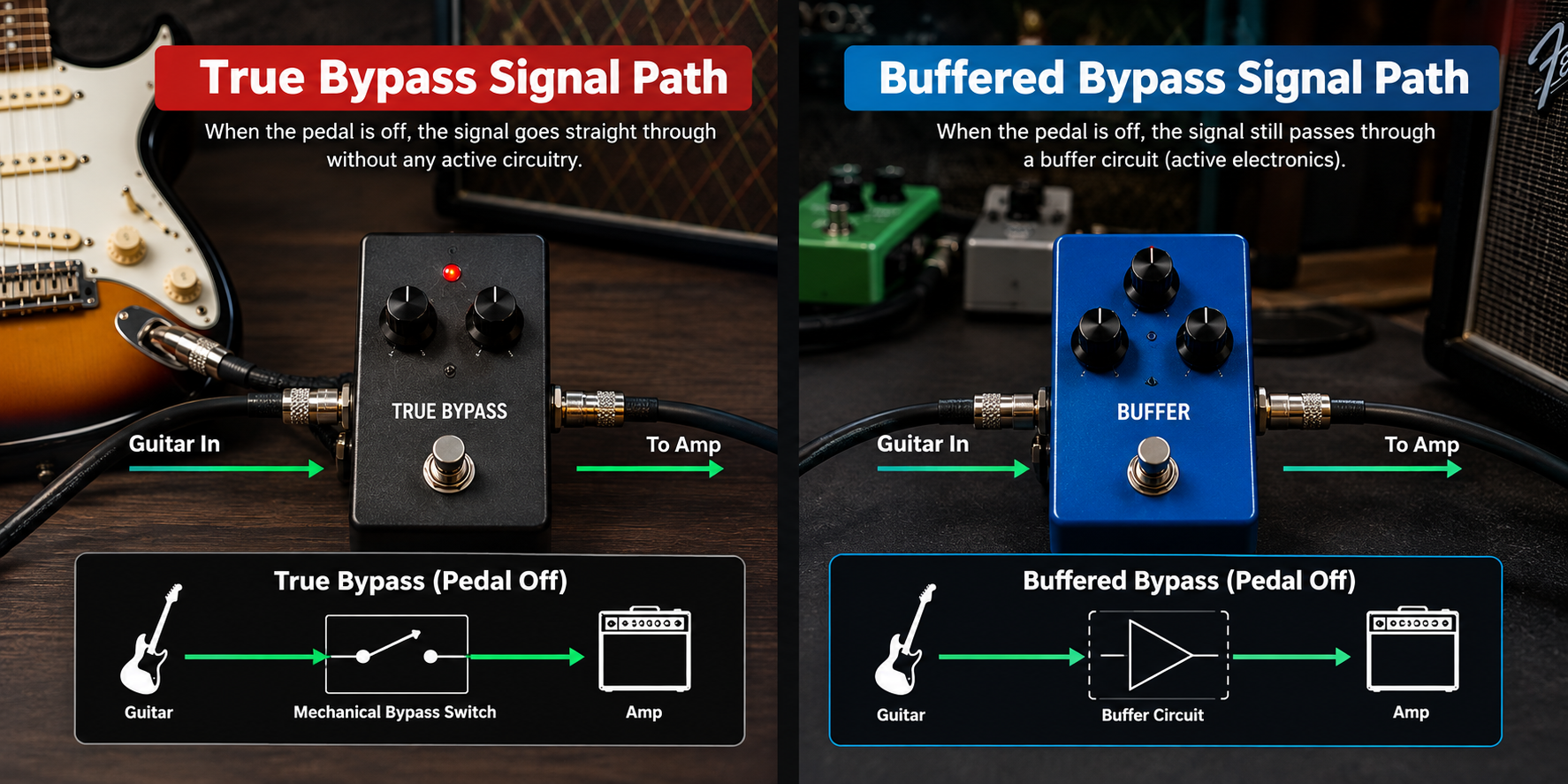
True bypass disconnects a pedal's circuit when you switch it off, so your guitar runs straight to the next pedal through a mechanical switch. Buffered bypass leaves a small amplifier in the path at all times, passing your signal along at the same volume but at a lower impedance.
Think of a relay race. True bypass is the runner stepping aside and handing you the baton to carry yourself, for as far as the track runs. A buffer is a fresh runner taking the baton and carrying it the rest of the way at full speed.
|
True bypass |
Buffered bypass |
|
|---|---|---|
|
When off |
Circuit fully disconnected |
Buffer stays in the signal path |
|
Adds |
Nothing active, but cable and two jacks |
A 1:1 gain stage, low output impedance |
|
Strength |
Keeps vintage fuzz and wah behaving as designed |
Drives long cables without treble loss |
|
Weakness |
Loading adds up across a big board |
Several in a row can stack their character |
|
Best for |
Small boards, short cables, fuzz-first rigs |
Large boards, long runs, stage rigs |
Neither label tells you how a pedal sounds when it's on. That part is the circuit, not the switching.
Why does a long true bypass chain dull your tone?
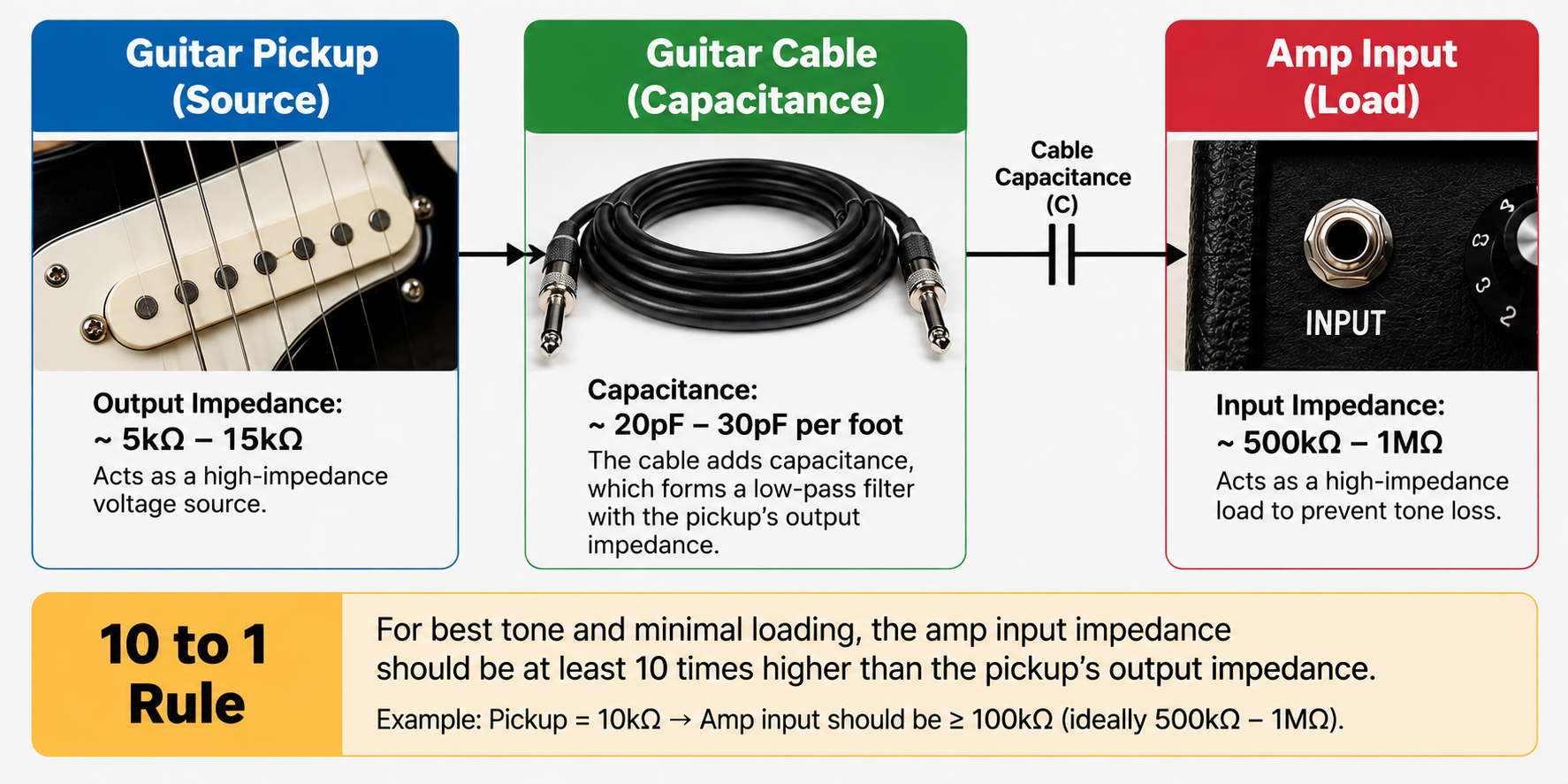
Because your pickups are a weak, high-impedance source, and everything downstream loads them. A guitar pickup puts out a fragile signal that cable capacitance and low input impedances gradually filter.
Guitar World's primer on impedance puts the convention at ten to one: the load should be at least ten times the source, and most amp inputs sit around 1M ohm.
When that load drops too low, Huw Price writes there, "you may experience treble loss as well as a lack of sustain." That is tone suck.
Here's the twist that catches players out. Bypassed pedals are not the problem individually; the patch cables and jacks between them are.
A dozen of those in series is a long, capacitive run before your amp ever sees the signal, and that run is your real signal chain.
How many true bypass pedals can you run before you need a buffer?
Nobody can answer that from a distance, and published thresholds disagree: retailer and builder guides put it anywhere from five such pedals to ten. Cable length, pickups and amp move the number more than the pedal count does.
Test it instead. This takes a minute:
- Plug straight in. Guitar to amp, one short cable. Play a chord you know well and listen to the top end.
- Plug through the board. Same guitar, same amp, every pedal switched off, your normal cables.
- Switch between the two, with the amp settings identical.
- Listen for treble and attack, not volume. Tone suck shows up as softened highs and slower pick response.
- Add a buffer at the front and repeat. If the gap closes, you needed one. If nothing changes, you did not.
If you hear no difference, stop reading the forums and go play. A short board with a fuzz at the front is one of the rigs that really does not need one.
Where should a buffer go, and where should it never go?
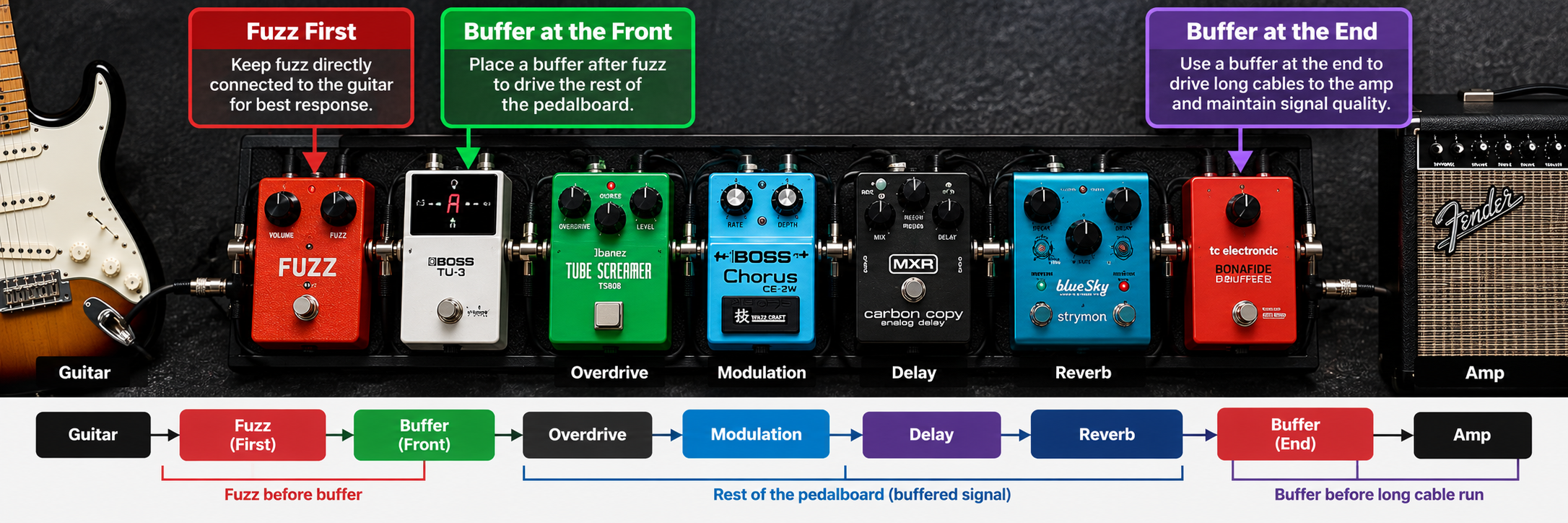
Put the first one early in the chain and a second at the end if your board is large.
Pete Thorn's buffer primer for Premier Guitar recommends exactly that split: one near the front to protect the core tone, one at the end to drive the cable to your amp.
The exception is fuzz. Thorn's rule of thumb is input impedance: a fuzz below about 500k ohms wants your pickups directly, so the buffer belongs after it, while anything above that can sit behind a buffer safely.
Vintage germanium circuits are the strict case. As Guitarist magazine notes in its rundown of bypass types, those fuzzes "usually hate buffers before them" and are happiest first in line.
One more caution. Premier Guitar's Stomp School column points out that if a buffer has a small peak at 700Hz, five in a row make that peak five times bigger.
Which should you choose for your board?
Choose by rig size and by what sits first in your chain, not by which label sounds more boutique.
- Stay all-bypass if your board is three or four pedals, your cables are short, and a vintage fuzz lives at the front.
- Add one if you run a mid-sized board, play long cable runs, or hear the top end soften in the test above.
- Run two if your board is large: one early, one last, nothing in between.
Prefer to settle it by ear? Our More Louder clean boost has a toggle for either mode, with roughly 118 ohms out when buffered, and our two-channel Double Buffer covers two points at 1M ohm in and 100 ohms out.
Our pedal switchers and utilities take the same position: the PBT switching systems let you set the input and both outputs to either mode, so the rig changes without rewiring.
Pedals built for switcher loops, like our always-on Never-Off range, skip the bypass question entirely, since the switcher does that job.
Honest caveat: none of this fixes a bad cable, a noisy power supply, or a pedal that sounds dull when it is on. It only protects what your pickups send.
Frequently asked questions
Is true bypass better than buffered bypass?
No. True bypass keeps a pedal out of the path entirely, which matters most on small boards and in front of fuzz. Buffered bypass protects your signal across long runs. One of the most revered overdrives ever built uses buffered bypass, which should settle the question of whether buffering ruins tone.
Does a true bypass pedal affect your tone when it is off?
The circuit does not, but the cables and jacks on either side of it do. Each bypassed pedal adds patch cable and two connections, and that extra capacitance accumulates across a board. This is why a ten-pedal chain can sound duller than a single pedal, even with everything switched off.
Should your tuner be buffered?
A buffered tuner is a tidy way to get one at the front of the chain for free, since the tuner usually sits first anyway. A More Louder in buffered mode does the same job. The catch is fuzz: if a germanium fuzz needs to see your pickups, the tuner's buffer in front of it will thin out the fuzz.
Why do pedals pop when you switch them?
Popping usually starts at the footswitch. On our bench the usual cause is a mechanical switch passing a small DC charge as the contacts change state. Pull-down resistors inside the pedal reduce it, and a buffer before or after the pedal often cuts it further. If one pedal pops and the rest do not, that pedal is the suspect.
The bottom line on buffered vs true bypass
|
Your rig |
Pick |
Why |
|---|---|---|
|
3 to 4 pedals, short cables |
All bypass, no buffer |
Nothing in the path to color it |
|
Fuzz first, anything after |
Bypass up front |
Germanium fuzz wants the pickups |
|
6 or more pedals |
One buffer early |
Stops the chain loading your pickups |
|
Big board, long cable to the amp |
Buffers at both ends |
The last one drives the run |
|
Switcher rig |
Buffer set in the switcher |
One decision covers every loop |
Buffered vs true bypass is settled by your ears and your cable length, not by a label on a box. Run the A/B test, add one only if it closes a gap you can hear, and stop at two. One Double Buffer covers both ends of a big board on its own.