
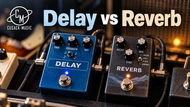
Delay vs Reverb: Where One Becomes the Other
Posted by Jon Cusack on 15th Oct 2026
|
The 30-second version
|
The delay vs reverb question usually gets answered with adjectives. One is "rhythmic," the other is "spacious," and the reader walks away no better at choosing.
My position: this is not a matter of taste, and you can put a number on it. Researchers measured where one becomes the other, the figure is roughly 50 milliseconds, and knowing it makes the category stop being mysterious.
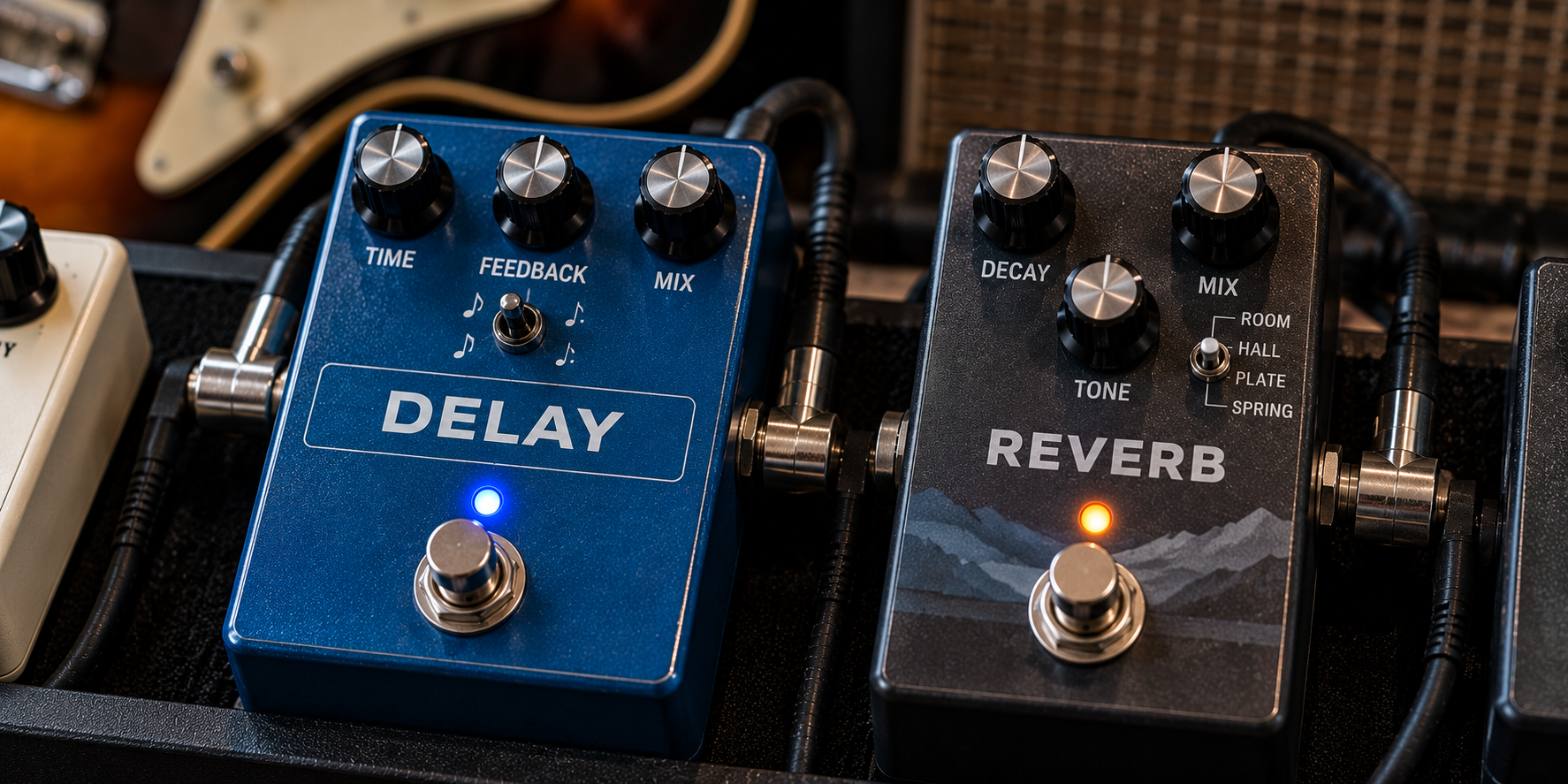
What is the difference between delay and reverb?
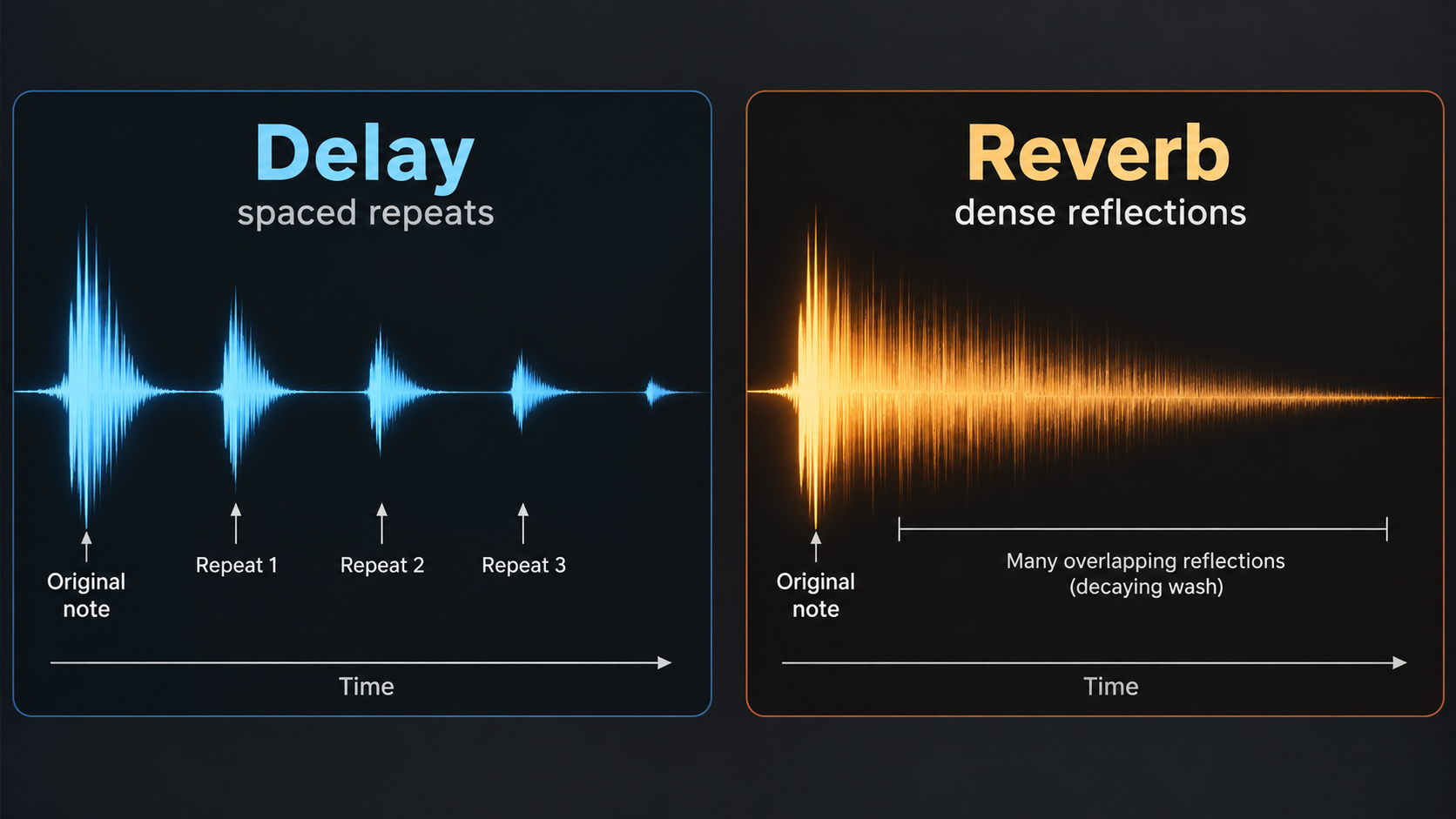
Density of reflections. One hands back a small number of distinct copies; the other hands back thousands, packed so tightly your ear gives up counting and hears a room instead.
Think of a canyon versus a tiled bathroom. Shout into the canyon and your voice comes back once, clearly. Shout in the bathroom and you get a smear.
|
Delay |
Reverb |
|
|---|---|---|
|
What you hear |
Countable repeats |
A single wash |
|
Reflection count |
A handful |
Thousands |
|
Main controls |
Time, feedback, mix |
Decay, pre-delay, mix |
|
Reads to the ear as |
Rhythm |
Space |
|
Typical job |
Thicken a riff, build a pulse |
Place the part in a room |
|
Gets muddy when |
Repeats fight the tempo |
The tail outlasts the chord |
Both belong to one family. Time-based effects manipulate when you hear something rather than its pitch or volume, and these two sit at opposite ends of that shelf.
Reverb vs echo: where does one become the other?
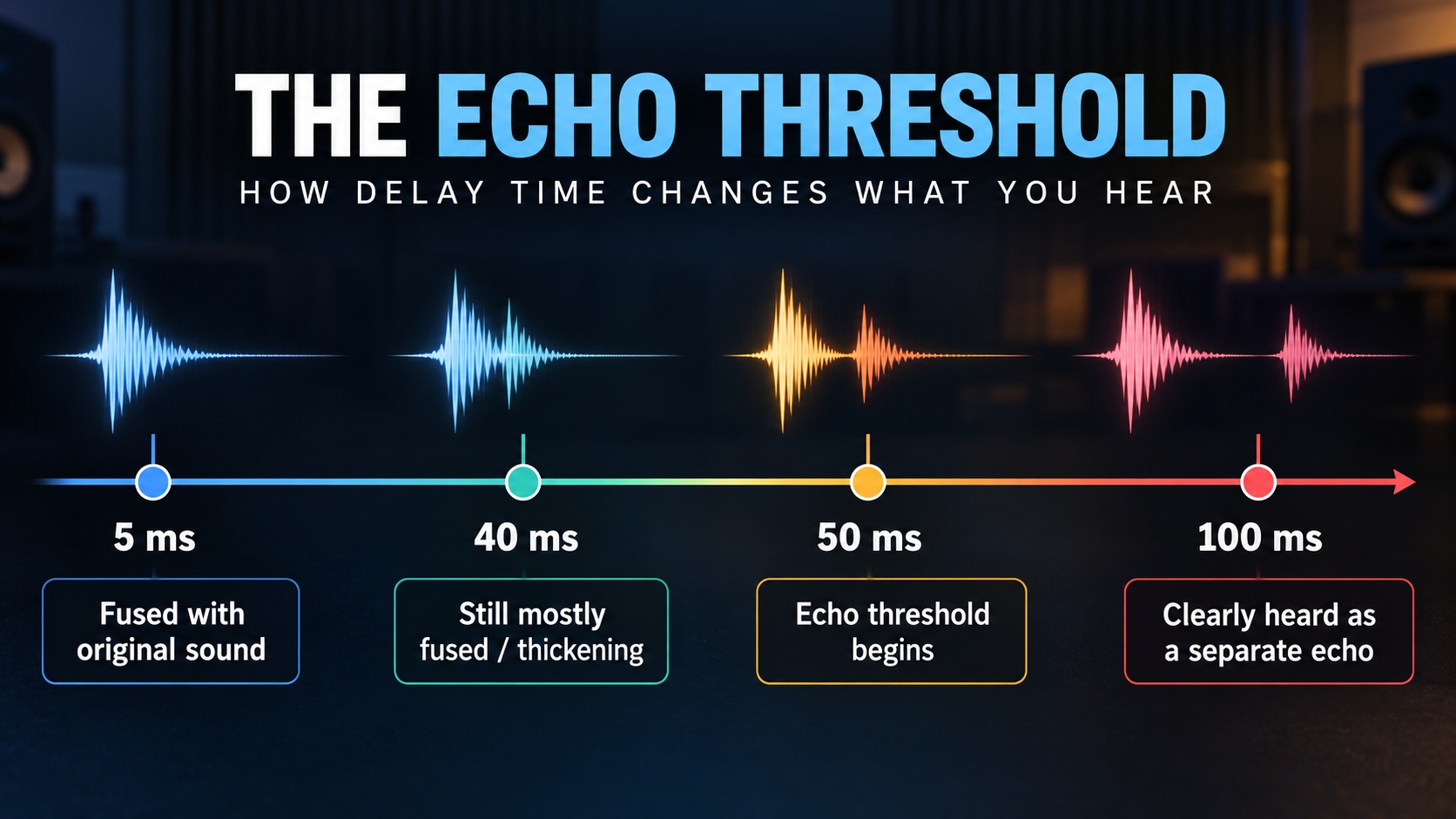
At about 50 milliseconds, and this is measured, not asserted. Below that gap your brain fuses the arrivals into one event; above it, it starts hearing them separately.
Wikipedia's entry on reverberation states the boundary plainly. Reflections arriving in a sequence of less than roughly 50 ms read as reverberation, while an echo is detectable at a minimum of 50 to 100 ms after the previous sound.
The perception research is more precise. The precedence effect describes how two copies of a sound fuse, with the first arrival deciding where you think it came from.
Helmut Haas described this in 1949, and Wallach and colleagues named the effect the same year.
Their figures are worth knowing. Fusion happens at 1 to 5 ms for clicks and stretches to about 40 ms for complex material like speech or piano, while the echo threshold sits above 50 ms for speech and near 100 ms for music.
So the echo vs delay distinction is a naming convention. Push a pedal past the threshold and you get an echo; stay under it and the same circuit produces thickening nobody would call an echo.
How does reverb work, and what is pre-delay doing in there?
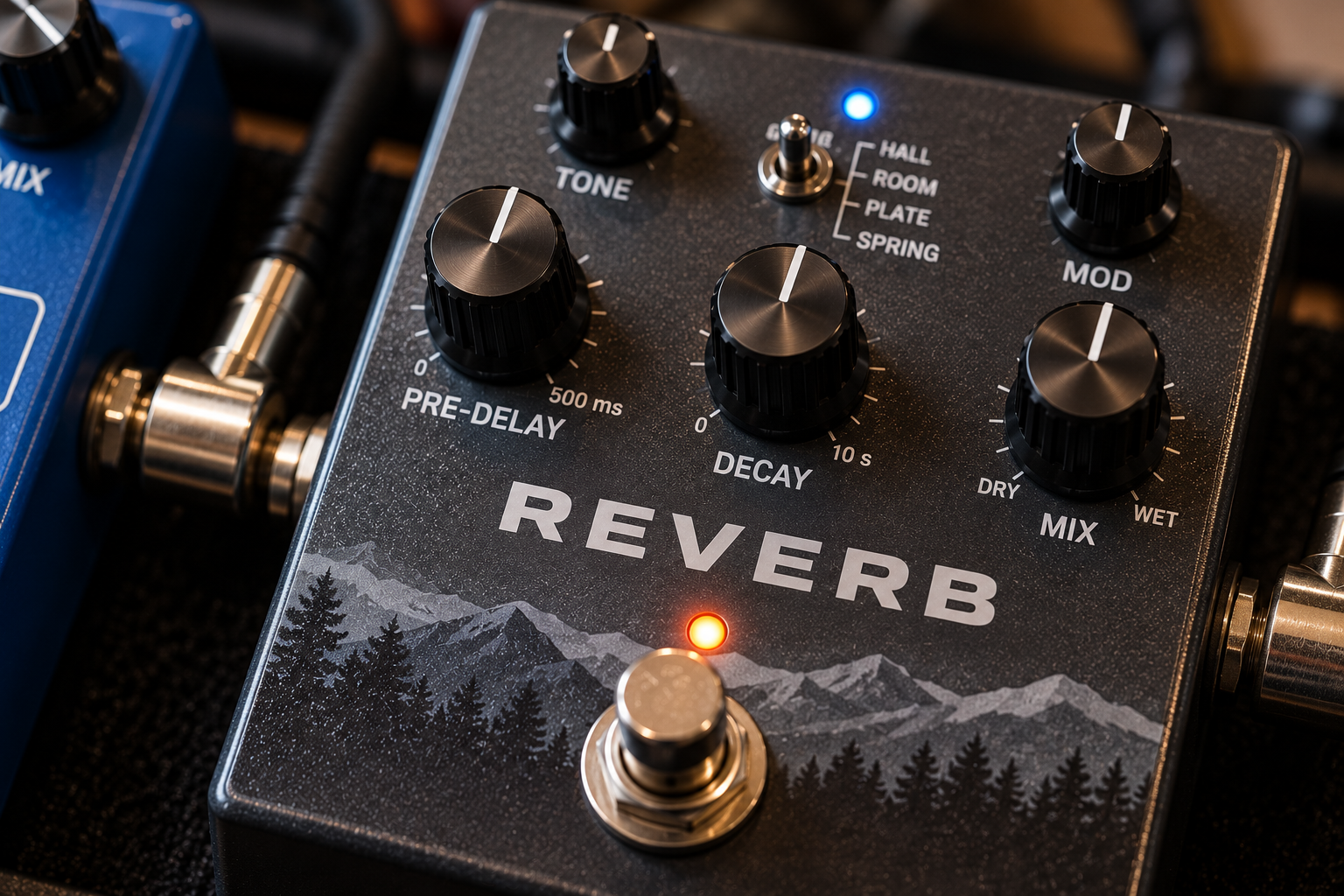
Reverb recreates the persistence of sound after a source stops. A room keeps feeding you reflections after the note ends, and decay is how long that fade takes.
Acousticians measure it as RT60, the time for sound pressure level to drop by 60 decibels once the signal stops. Wallace Clement Sabine worked the formula out empirically in the late 1890s.
Pre-delay is the gap between your dry note and the arrival of the tail. It is, literally, a short wait living inside the circuit.
That overlap is not theoretical for me, because it is a knob on a pedal I build. My Resound V2 puts pre-delay on its Room program, where short decay plus that gap produces a slapback or small-chamber effect.
Which is the argument in one control. Push the gap far enough and the tail stops feeling attached to the note, so you hear two events rather than one, exactly as the threshold research predicts.
Ambience is what players call it when the tail is short and the mix is low. Not a separate effect, just a room used conservatively.
Reverb vs delay guitar parts: what does each one actually do?
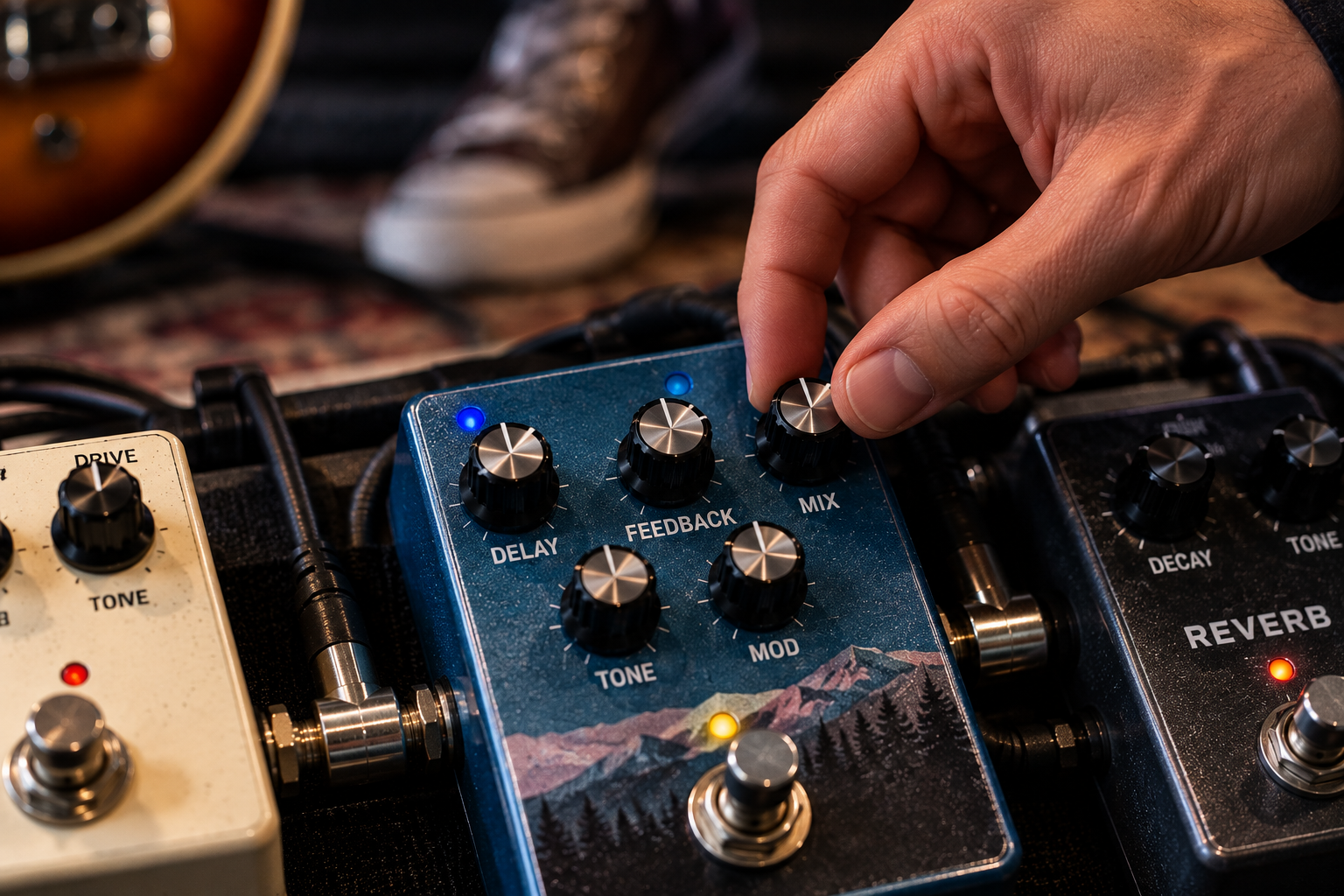
Different jobs, which is why the comparison is worth making at all.
Echo adds rhythm. Set the repeats to a subdivision of the tempo and a simple line turns into a pattern, which is why it runs through ambient playing and eighth-note arena parts.
Ambience adds depth. It pushes the part backward and makes a thin tone sound recorded somewhere rather than plugged straight in.
Here is the trade nobody mentions. Repeats compete with the beat, so a busy part plus heavy echo becomes mush. A long tail over fast changes smears two chords together.
Wet signal is the processed portion you hear alongside your untouched note. Wet/Dry Mix sets how much of each reaches the amp, and it decides whether either effect reads as tasteful or as a costume.
Do I need delay and reverb, or will one of them do?
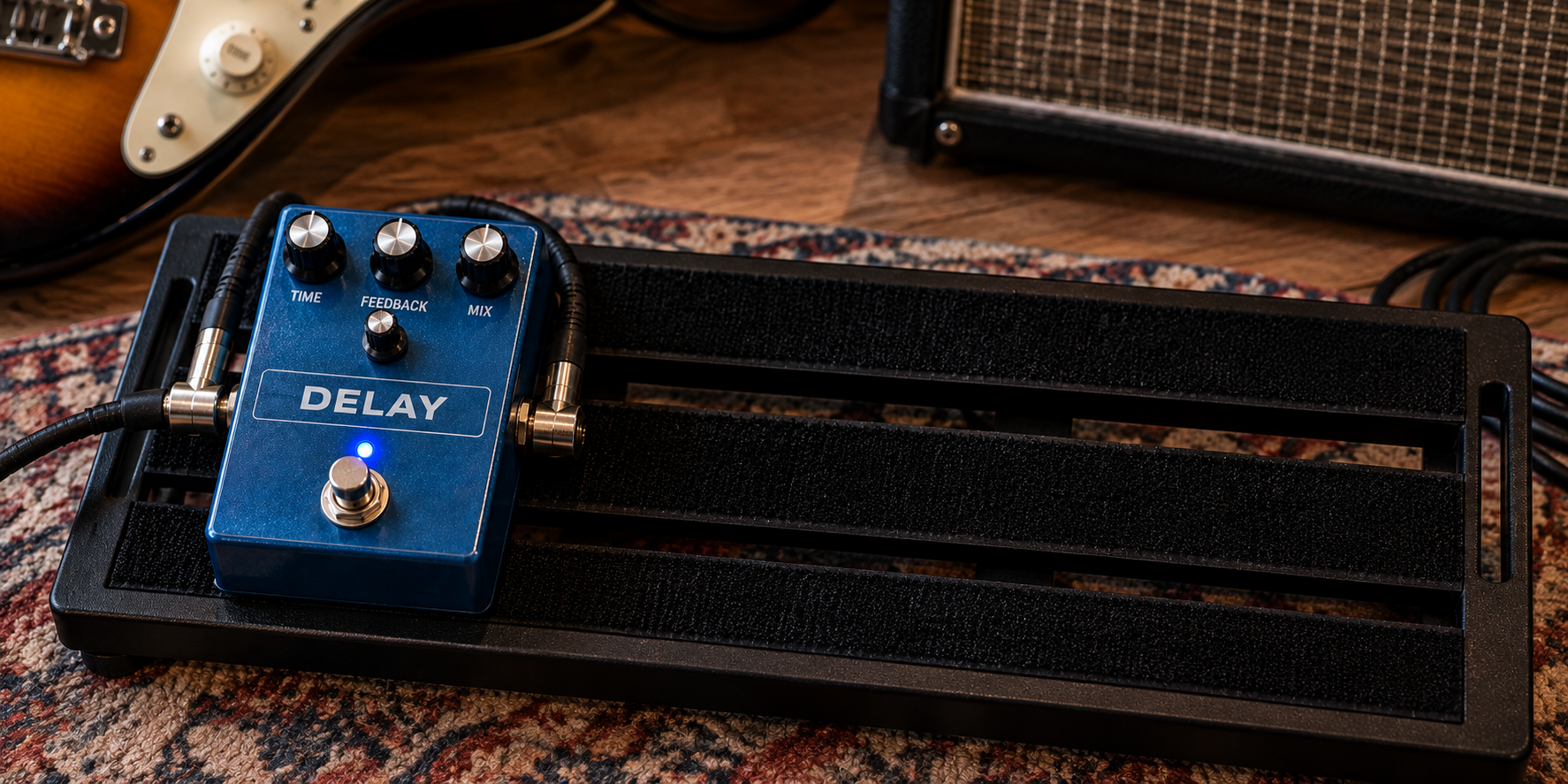
One, to start, and I would choose by what the part is missing.
- Start with ambience if your tone sounds dry, small, or stuck to the speaker. This is the more common problem, and many amps have a spring tank already.
- Start with echo if your playing sounds thin rhythmically, or you want a pulse under a simple line.
- Get both if you record, or play styles where space and rhythm both carry the part. Ambient, post-rock, shoegaze and worship players want both.
- Let one pedal cover two jobs if board space is tight. Several programs on my Rebound handle echo duty while the amp's own tank supplies the room.
Honest caveat: plenty of players buy spatial effects to fix what was really an amp or pickup problem. Spatial effects place a sound; they do not improve it.
Delay or reverb first? Running delay and reverb together
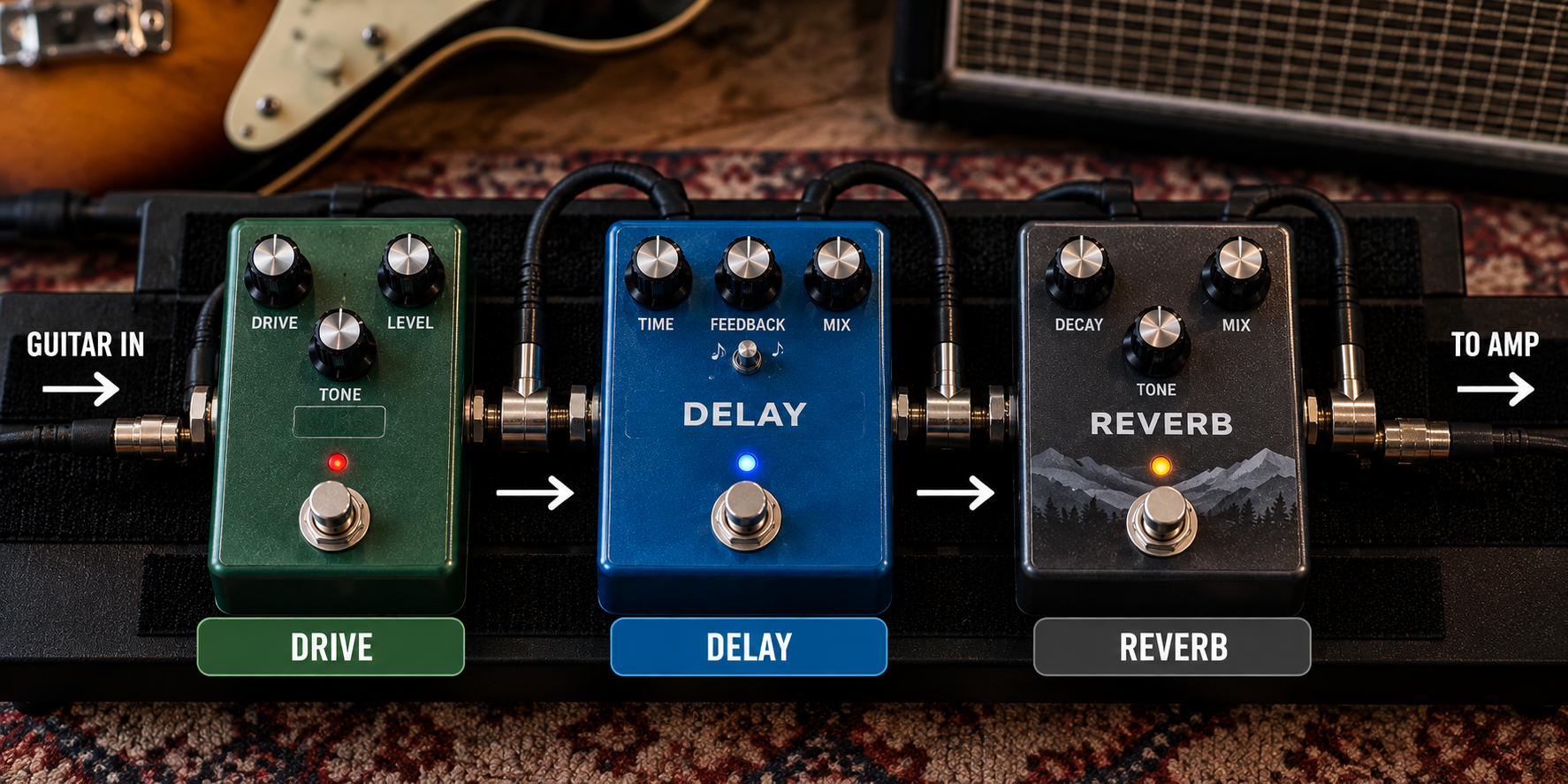
Echo first, ambience second. That is the standard order, and the reason is mechanical rather than aesthetic.
Put the room first and you copy the room. Every repeat arrives carrying its own tail, the wash stacks on itself, and three repeats in it is porridge.
Put the repeats first and each enters the space cleanly, the way a real echo behaves in a real hall. Reversing it on purpose is a legitimate ambient trick, just never the starting point.
Both go after your drive pedals. An echo feeding a distortion circuit smears every repeat into the next, and that applies doubled to a tail.
Running them together works best when you give each less than feels right alone. Cut both Wet/Dry Mix settings by about a third from your solo values, because the two occupy overlapping space and the sum is louder than the parts.
Bypass behaviour matters more here than anywhere else, since these sit last in line. That is the buffered versus true bypass decision, and a long tail is what a bad one chops off first.
Frequently asked questions
Is reverb just a lot of delays?
Functionally, close to it. Digital algorithms are built from networks of short delay lines fed back into each other, producing a reflection density no discrete echo can match. You can count one output and not the other, which is the same perceptual line the research draws at roughly 50 ms.
Can one pedal do both?
Partly, and it depends which way round. Set a very short time with high feedback and repeats run together into something room-like, useful when a board has no space left. It will not match a real algorithm, because the reflection pattern stays too regular and the ear hears a metallic ring rather than a space.
Why does my ambience disappear in a band?
Because other instruments fill the space your tail was occupying. A setting that sounds lush alone often vanishes in a mix, which tempts players to crank it and muddy everything. Set levels with the band playing, not in your bedroom.