
What Is a Reverb Pedal? How It Works and How to Set One
Posted by Jon Cusack on 16th Oct 2026
|
The 30-second version
|
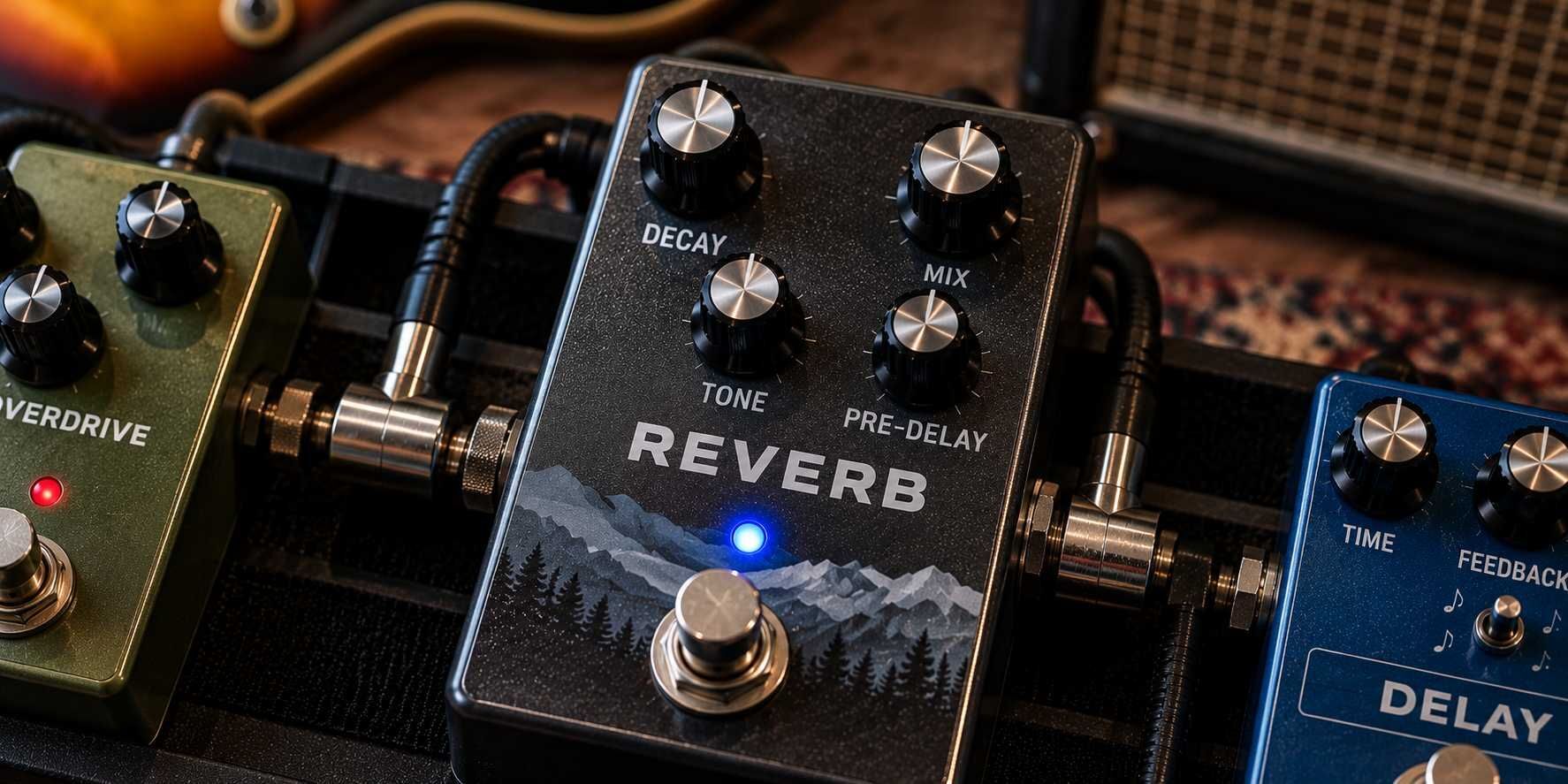
A reverb pedal is the effect most players buy without understanding, because it sounds good instantly at any setting. That is also why it is the one most often set wrong.
My position after years of building these: the mix control is the only knob that really matters, and almost everyone has it too high. Set that first, then worry about which space you are in.
What is a reverb pedal, and what does it do?
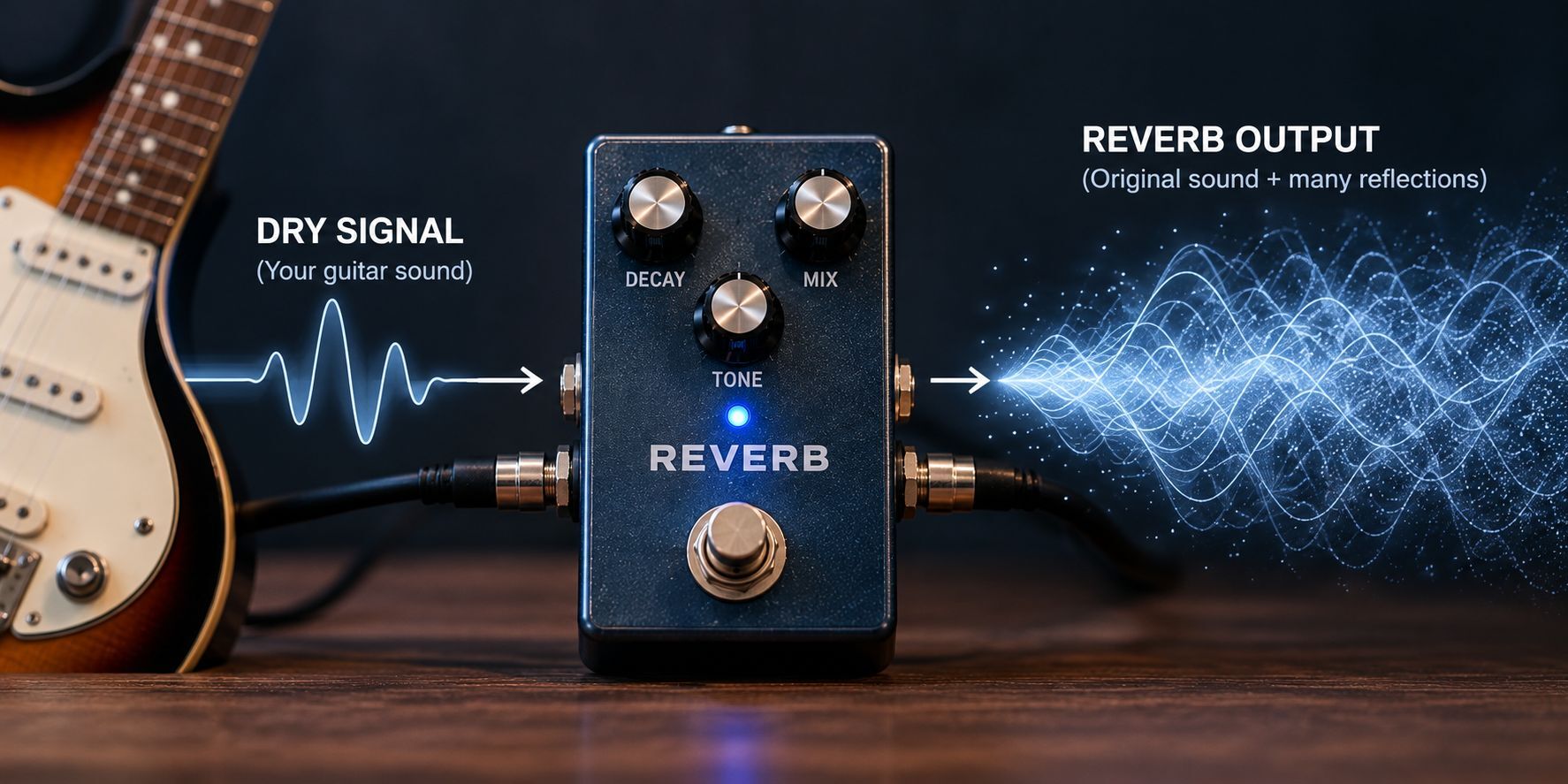
It is a stompbox that puts your guitar in a room that is not there. It returns a cloud of reflections behind your dry note, which your ear reads as space rather than separate repeats.
Picture clapping once in a stairwell. You hear the clap, then a smear that fades over a second or two, and you could never count the bounces. That smear is what a pedal recreates.
The practical effect is depth. A dry guitar sounds pinned to the speaker; add a little ambience and the part sounds recorded somewhere, which is why it sits on more boards than anything but overdrive.
How does a reverb pedal work?
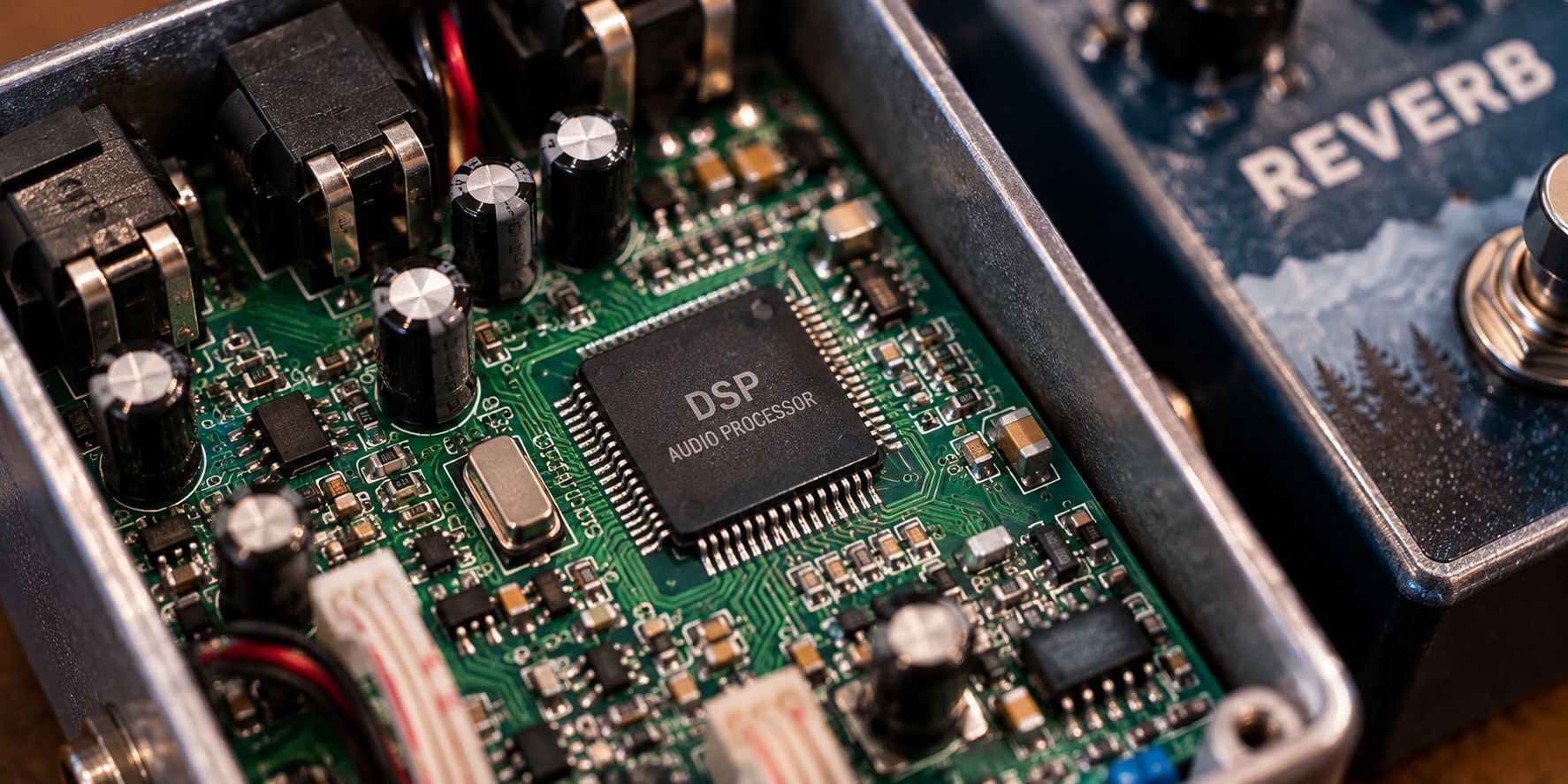
With a lot of very short delays stacked on top of each other. Wikipedia's entry on how these units are built describes digital designs as simulating the effect using multiple delay lines with fading trails.
That is the trick in one sentence. Dozens of taps at slightly different times, each quieter than the last, add up to something too dense to separate out.
Digital Signal Processing (DSP) is the arithmetic that does it, running on a chip that stores your signal as numbers. The first digital unit arrived in 1976.
Many pedals shape the early reflections and the late tail separately. Early reflections are the first bounces off nearby surfaces and tell your ear how big the space is; the late tail tells it what the walls are made of.
What are the main types of reverb?
Six, and the names are borrowed from hardware that existed before pedals did. Each is an algorithm imitating a physical object or place.
|
Type |
Where the name comes from |
Sounds like |
Best for |
|---|---|---|---|
|
Spring |
Springs in a tank inside an amp |
Bright, splashy, a metallic drip |
Surf, country, anything twangy |
|
Plate |
A suspended sheet of steel |
Smooth, dense, no obvious room |
Vocals, leads, solos |
|
Room |
A small real space |
Short, tight, realistic |
Making a dry part sound recorded |
|
Hall |
A large real space |
Long, slow, spacious |
Ballads, ambient, big chords |
|
Chamber |
A purpose-built echo room |
Lush, washed out, characterful |
Vintage studio textures |
|
Shimmer |
Nothing. It is a studio trick |
Octave-up drift, choir-like |
Ambient, post-rock, pads |
Room reverb and hall reverb are the two most people reach for first, and the difference between them is just size and decay length. A room ends quickly; a hall keeps going.
Shimmer reverb is the odd one out, because no physical object makes that sound. It exists only in Digital Signal Processing (DSP), and it alters the pitch of the reflected signal.
The standard construction puts a pitch shifter set an octave up inside a feedback loop with a long tail, which is why it blooms upward instead of fading flat. The recipe traces back to Eno and Lanois records of the 1980s, assembled from studio hardware rather than any single box.
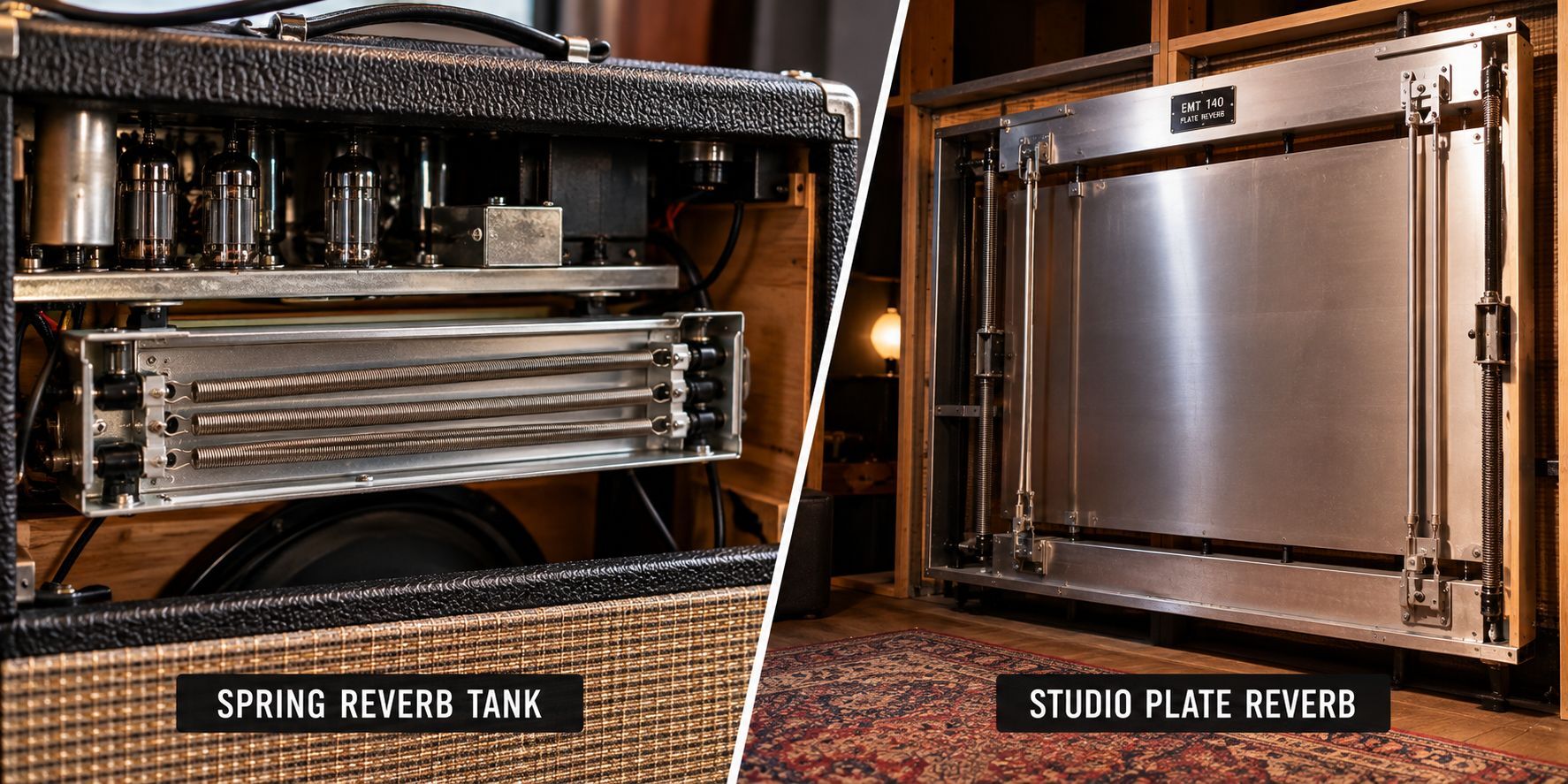
Spring reverb vs plate reverb: what actually separates them?
Both are mechanical, both predate digital, and both work the same way: drive a piece of metal, then listen to it move.
Springs came first. Bell Labs introduced the idea, Laurens Hammond was granted a patent on a spring system in 1939, and Hammond organs carried it by around 1941. Guitarists got it because the tanks fit inside an amplifier.
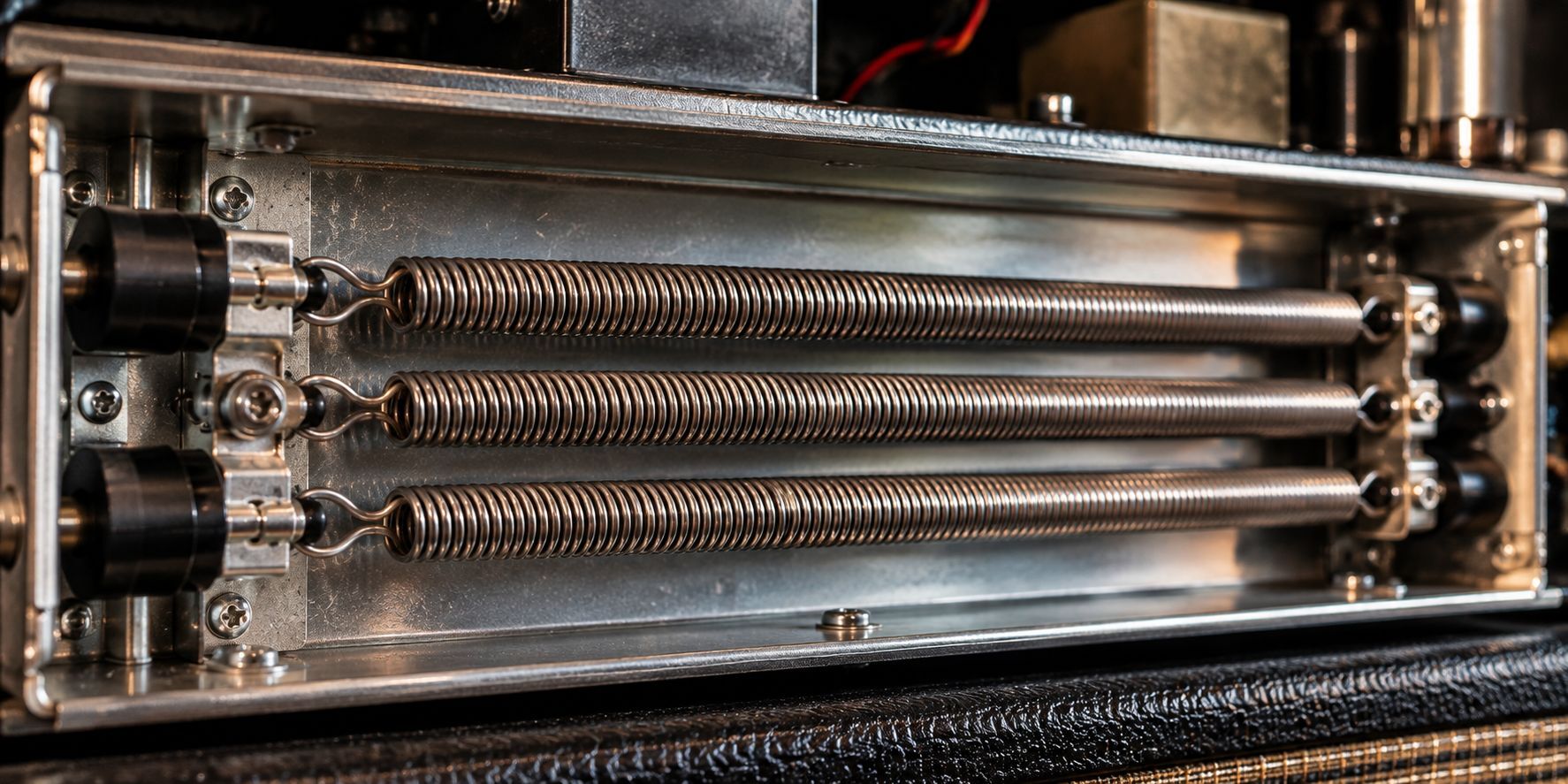
Plate reverb came later and bigger. Elektromesstechnik introduced the EMT 140 in the late 1950s, driving a suspended steel sheet with a transducer much like a loudspeaker driver and picking up the motion with contact microphones.
The difference follows from the physics. A spring is one long thin path, so its character arrives as a bright, ping-like drip, most obvious on staccato playing. A plate is a wide two-dimensional surface, so reflections scatter everywhere and arrive as a smooth wash with no identifiable room behind it.
Which to pick: spring if you want the effect audible as an effect, plate if you want it to flatter the note without announcing itself. Neither is more authentic. Both are artificial, just artificial in different decades.
What do the reverb pedal settings actually do?
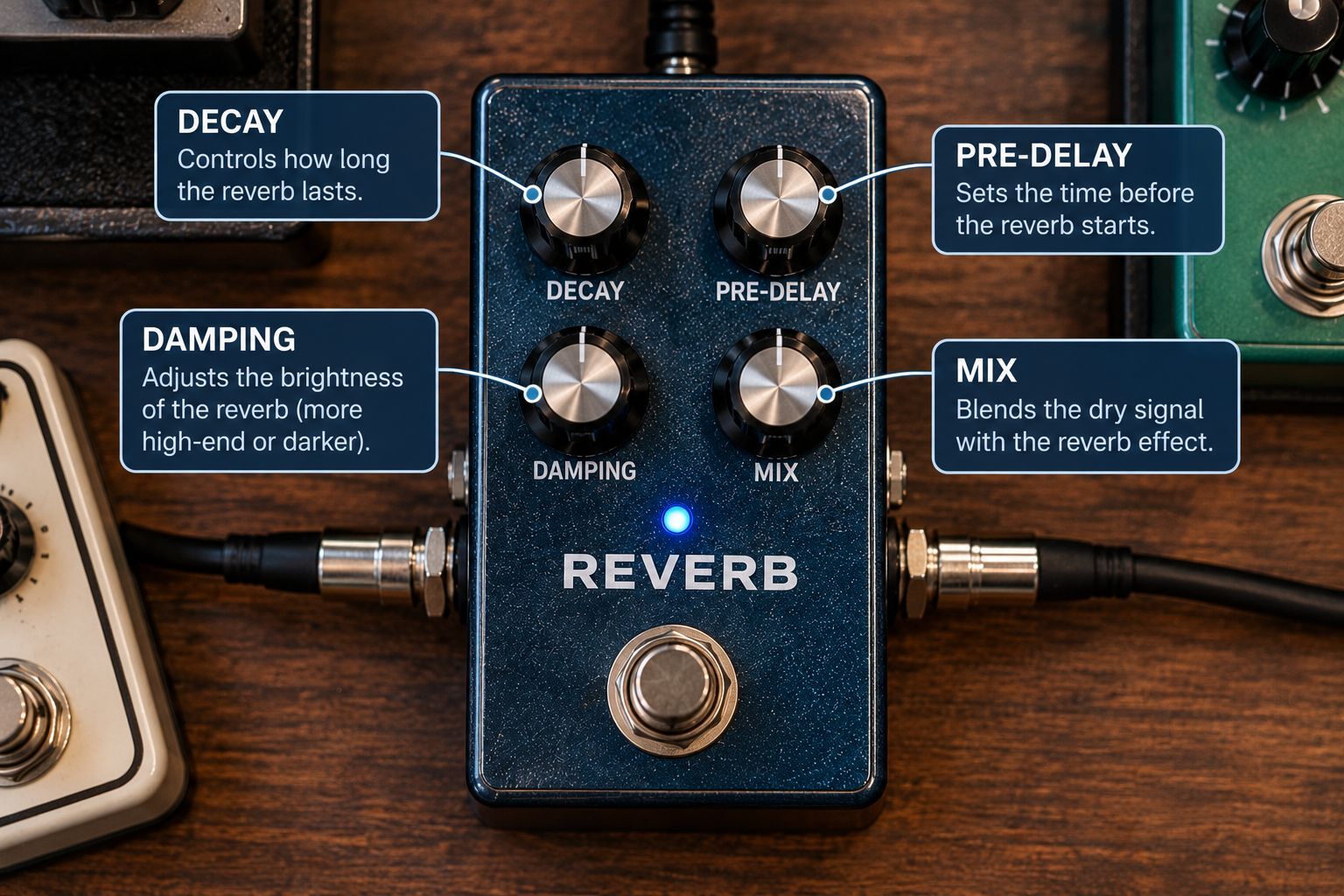
Four controls carry almost everything. Learn these and the labels on any pedal make sense, whatever its maker calls them.
- Decay sets how long the tail lasts. Engineers measure this as decay time, or RT60, the time for the level to drop by 60 decibels after the signal stops.
- Pre-delay is the gap between your dry note and the arrival of the tail. Raise it and the note keeps its attack; leave it at zero and the wash swallows your pick.
- Damping controls how fast the high frequencies disappear from the tail. More damping means a darker, softer space, the way carpet and curtains behave in a real room.
- Mix control sets how much processed signal joins your dry note. This is the one that ruins tones.
My Resound V2 carries eight programs including spring, plate, hall and shimmer, which is why I keep arguing the type matters less than the settings. Same knobs, eight rooms.
One honest caveat on damping: not every pedal has one, and some bury it under a tone control doing roughly the same job.
How to use a reverb pedal: four places to start
Set the mix first, every time, and set it lower than feels right in a quiet room.
- Subtle depth. Room reverb, short decay, mix around 15 percent. The goal is that switching it off sounds wrong but switching it on is barely noticeable.
- Surf and twang. Spring program, medium decay, mix around 30 percent, damping low so it stays bright. This is the one setting where the effect is supposed to be heard.
- Big ballad chords. Hall reverb, long decay, pre-delay raised so the chord speaks before the wash arrives, mix around 25 percent.
- Ambient drift. Shimmer reverb, maximum decay, heavy damping to stop the octave getting shrill, mix up to taste. Play less than you want to.
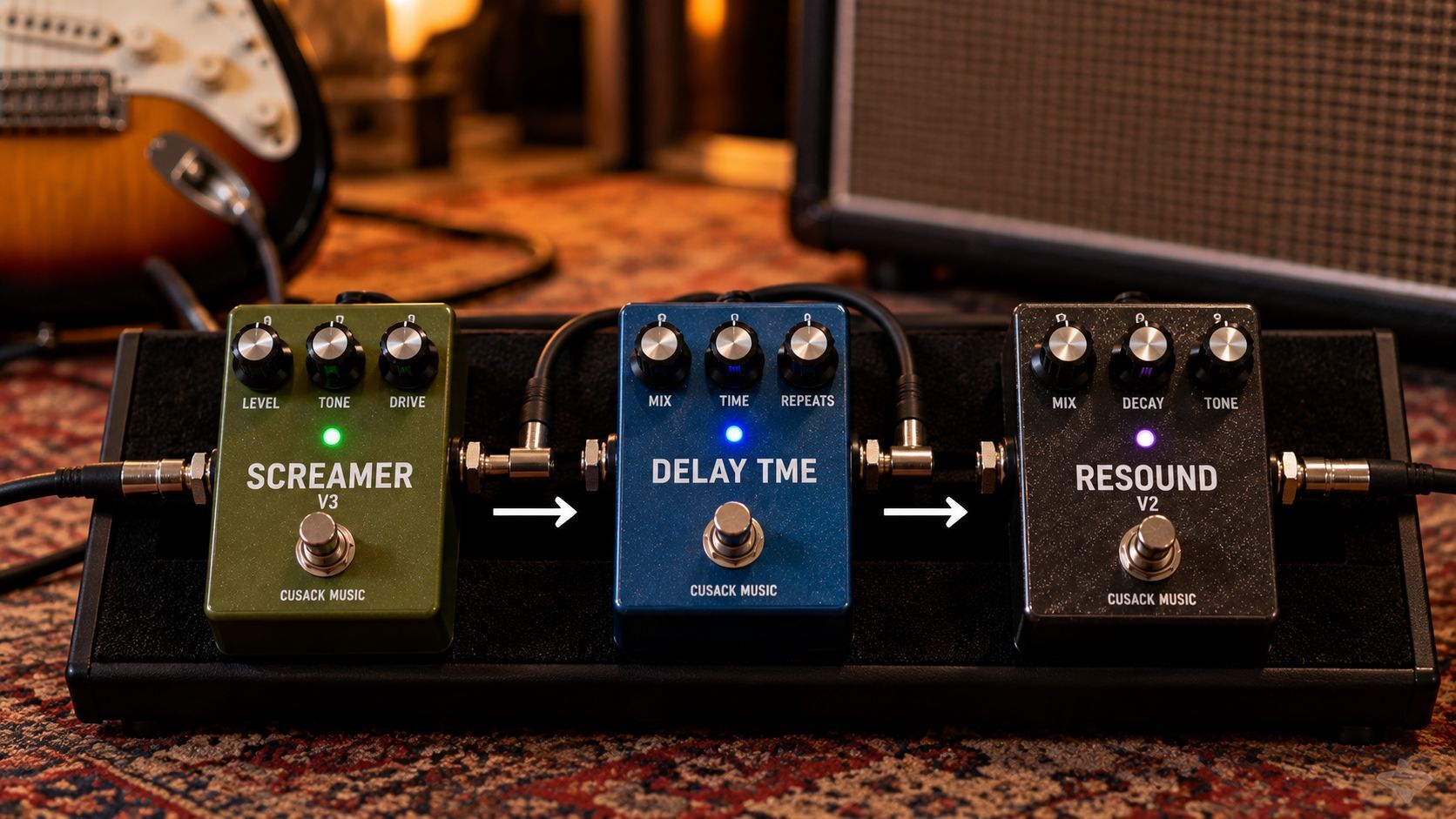 Put the pedal last, after drive and after any echo. Feeding ambience into a distortion circuit smears it, and placing it before a delay means every repeat carries its own tail, which stacks into mush by the third one.
That ordering question is covered properly in the guide to what a delay pedal is, since the two effects share a slot at the end of most boards.
Bypass matters here more than almost anywhere, because a long tail is the first thing a bad switching scheme chops off. That is the buffered versus true bypass question, and trails are why ambient players care about it.
Frequently asked questions
Do I need a reverb pedal if my amp has one?
Not necessarily, and plenty of players never buy one. An amp's built-in tank is a real circuit, so if yours has it you already own the spring sound. Buy a pedal when you want a flavour your amp cannot make, or play through backline amps you do not choose.
What is the difference between reverb and delay?
One gives you repeats you can count, the other gives a wash too dense to separate. The line between them is measurable, at roughly 50 milliseconds between reflections. Below that your ear fuses them into a space; above it, it starts hearing separate events.
Why does my reverb sound muddy?
Almost always the mix control, sometimes the decay. A long tail over fast chord changes leaves the previous chord ringing under the new one. Shorten the decay first, add pre-delay second, then reach for the mix. Damping helps too, since muddiness is often low-mid buildup rather than length.
What does pre-delay actually change?
Clarity. It keeps the tail from landing on top of your pick attack, so the note stays defined and the space sits behind it rather than over it. It also reads as size: a longer gap suggests a bigger room, because in a real hall the first reflection takes longer to come back.
Is digital reverb worse than a real spring tank?
No, just different. A spring tank makes one sound; a processor makes a dozen, including a convincing spring. What a tank gives you is physical behaviour, the crash when you knock it, which no algorithm bothers to model.
Should reverb go in the amp's effects loop?
Usually yes if your amp has one, because it keeps the tail clean behind a preamp-driven sound rather than feeding ambience into distortion. In front of a clean amp it makes little difference. The answer depends on how much gain you run.
The bottom line on reverb pedals
One effect, six flavours, four controls that do the real work. Decay sets the length, pre-delay protects the attack, damping sets the colour, and mix decides whether any of it reads as musical.
Remember one thing: the mix knob is the whole game. Decay time sets the length, but a mediocre algorithm set well beats a great one set loud.
Honest limitation: everything here shifts in a band. Settings that sound lush alone thin out in a mix, so set levels with other people playing whenever you can.
Mine sit in the delay and reverb range alongside the echo side of the board.