
What Is a Delay Pedal? How It Works, and How to Set One
Posted by Jon Cusack on 13th Oct 2026
|
The 30-second version
|
The delay effect is the one most players buy second and understand last. Everyone knows it makes an echo. Far fewer know that the single number on the time knob decides whether you hear an echo at all, or just a thicker version of what you played.
My honest opinion, before any of the detail: feedback is the knob that ruins more parts than any other. Two repeats sound deliberate, six sound like a problem with the gear.
What is a delay pedal, and what does it do?
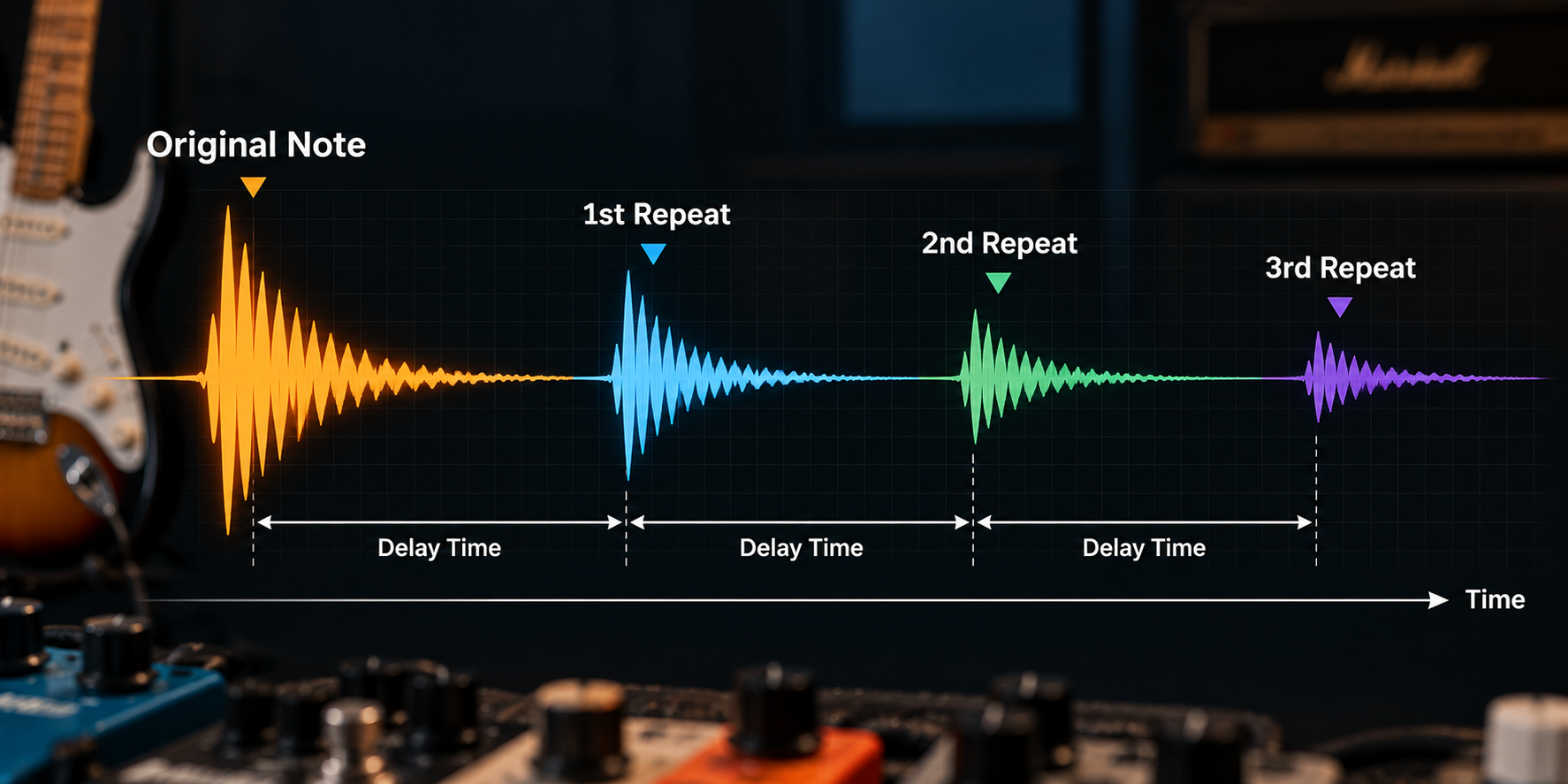
A delay pedal captures what you play, waits, and plays it back behind you. Wikipedia's entry on the effect describes it as a technique that "records an input signal to a storage medium and then plays it back after a period of time").
Picture shouting across a canyon. Your voice leaves, hits the far wall, and comes back a moment later, quieter than it went out. A pedal does the same thing with a wall you control.
The repeats are the whole effect. One of them is a doubling. Three or four is an echo. Twenty is a wash that swallows whatever you play next.
How does a delay pedal work?
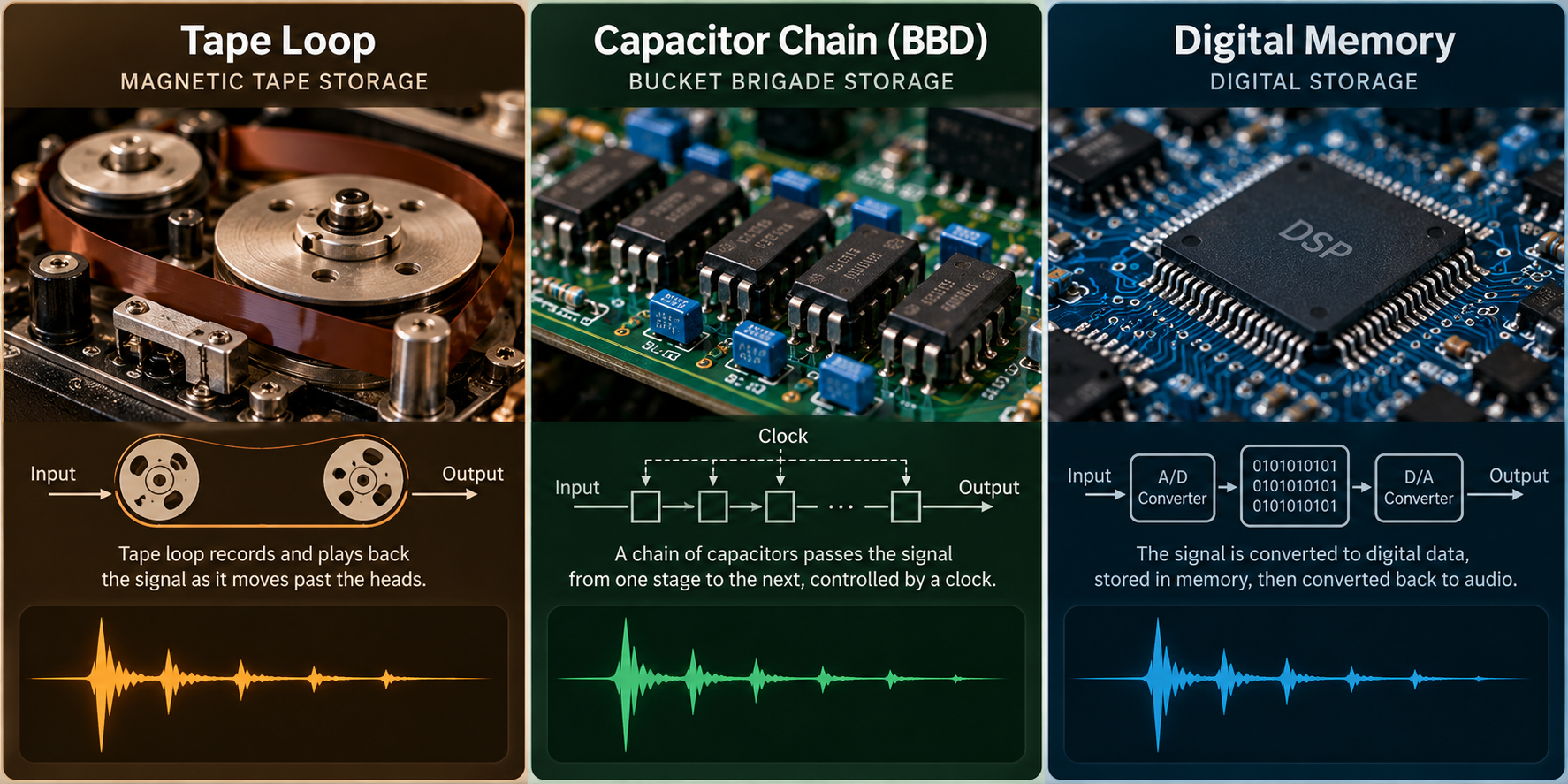
Every one of them does the same three jobs: store the signal, hold it, release it. What changes is the storage medium, and that choice is most of what people mean when they argue about delay sounds.
Three media have done the job:
- Tape: a loop of magnetic tape with a record head and a playback head. The gap between the heads sets the time.
- Moving heads: the Echoplex, introduced in 1959 and designed by Mike Battle, added a sliding record head so players could change the time without changing tape speed.
- Bucket brigade chips: a chain of capacitors that hand the signal along one step at a time.
- Digital memory: the signal is converted to numbers, stored in RAM, and converted back.
The bucket brigade name is not marketing. A bucket-brigade device was developed in 1969 by Sangster and Teer at Philips Research Labs.
The signal is literally passed down a line of capacitors, one step per clock tick, the way a fire brigade passes buckets. Each handoff loses a little, which is why those repeats get darker and murkier as they go.
That darkening is not a flaw anyone chose. A bucket-brigade device is bound by the sampling theorem, so it needs a filter on the way in and another on the way out, and those filters cost you treble.
What is the difference between analog delay, digital delay and tape echo?
Character, mostly, and the differences are real. Here is how the three behave.
|
Tape echo |
Analog delay |
Digital delay |
|
|---|---|---|---|
|
How it stores |
Magnetic tape loop |
Capacitor chain (BBD) |
Numbers in memory |
|
Repeats over time |
Degrade, wobble, drift |
Get darker each pass |
Stay clean indefinitely |
|
Typical max time |
Short, set by head spacing |
Often under a second |
Seconds, sometimes minutes |
|
Upkeep |
Tape and heads wear out |
None |
None |
|
Best for |
Character, instability, vintage |
Warmth that sits behind you |
Clarity, long times, precision |
Now the part the three-box version gets wrong. The line between analog and digital is blurrier than any spec sheet suggests.
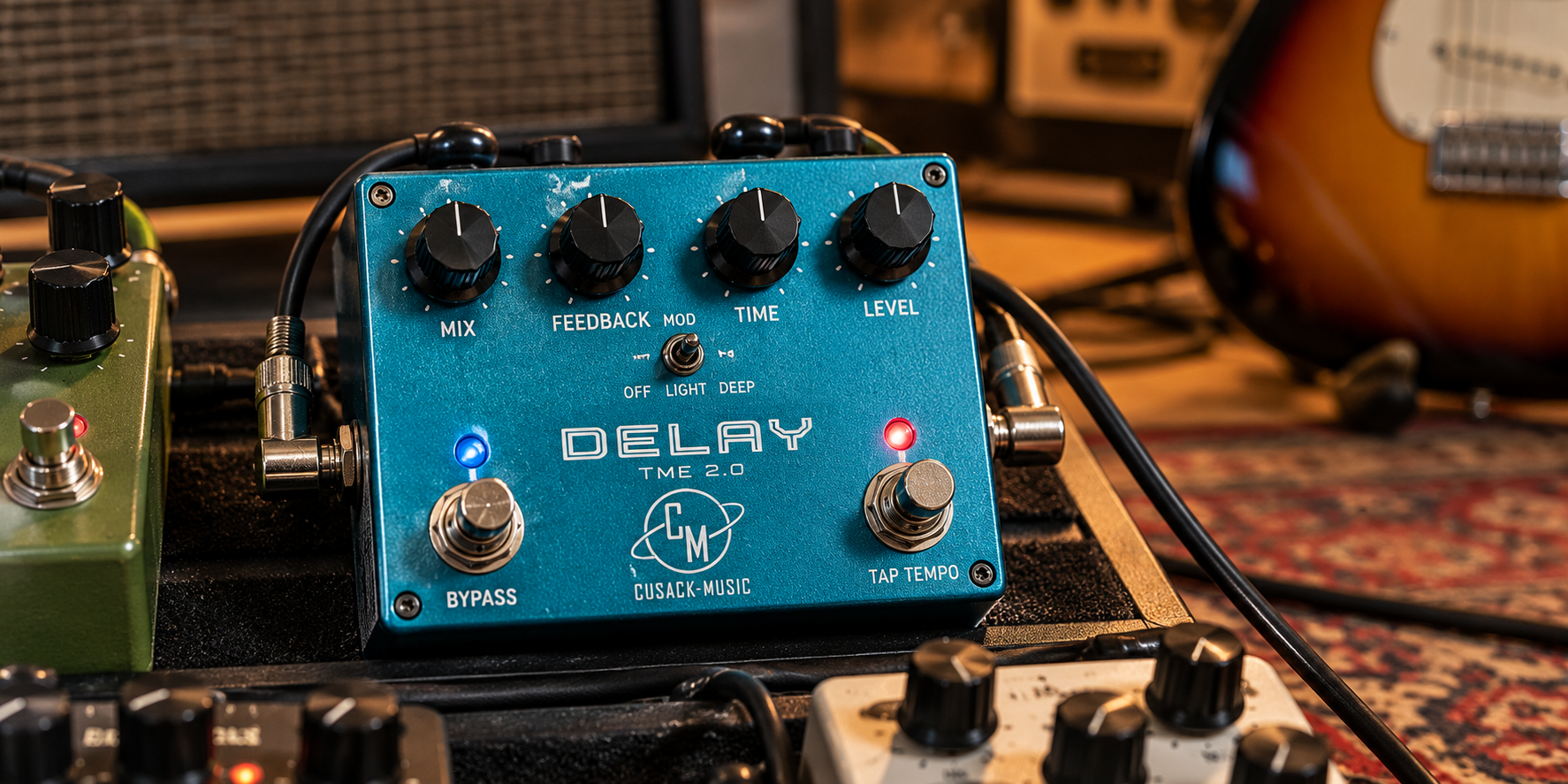
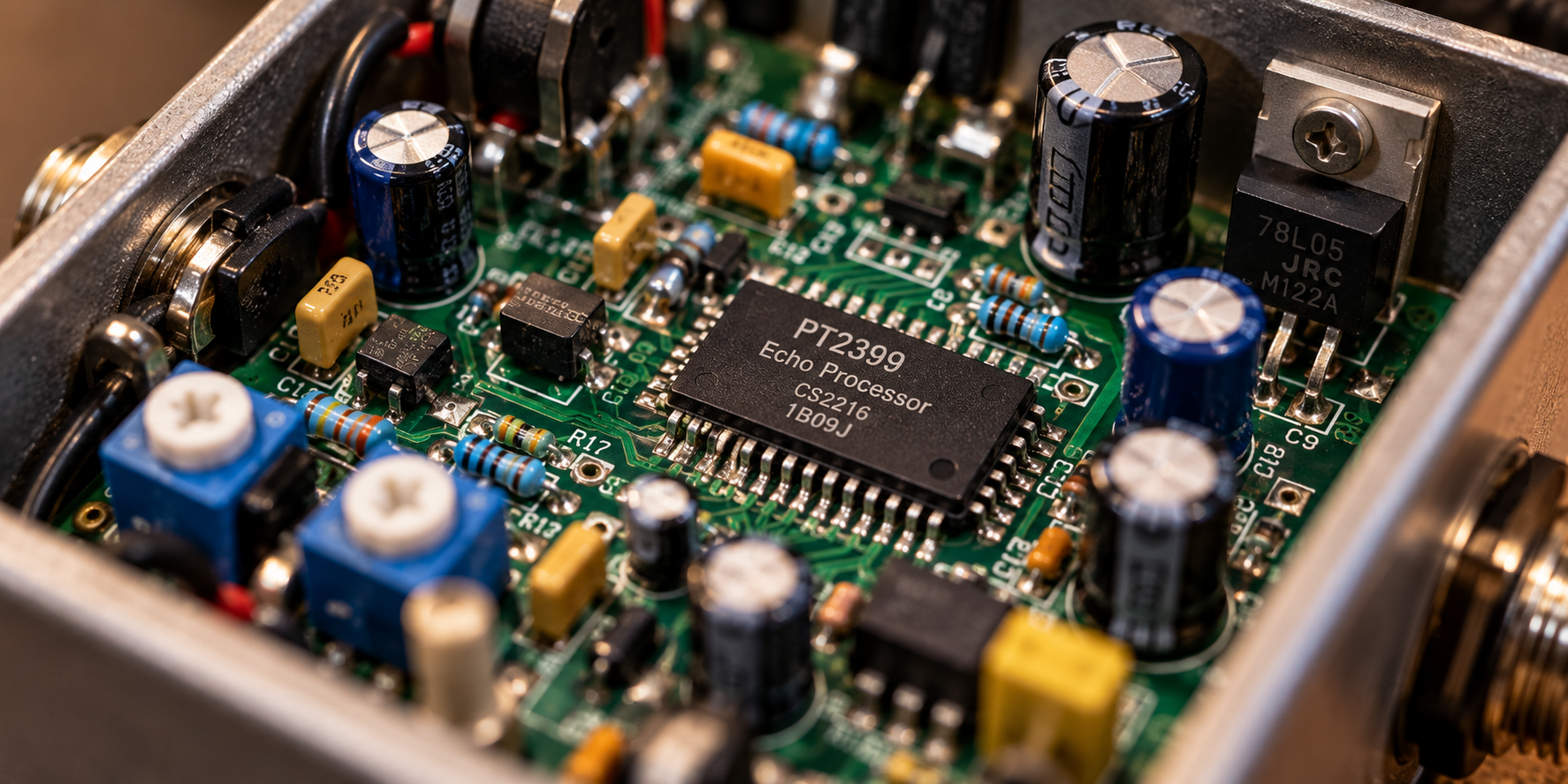
My own Delay TME is built around the PT2399 chip, which is digital silicon. It samples the audio, stores it in internal memory, and converts it back.
It is also the chip builders reach for when they want tape-like repeats, because its treble rolls off sharply and its distortion climbs as the delay time lengthens. A widely cited technical teardown of the chip puts its clean working range at roughly 30 to 340 milliseconds and notes audible distortion past about 350.
So "digital" told you nothing useful there. What you actually hear is filtering and distortion, not the storage format.
What do the delay pedal settings actually do?
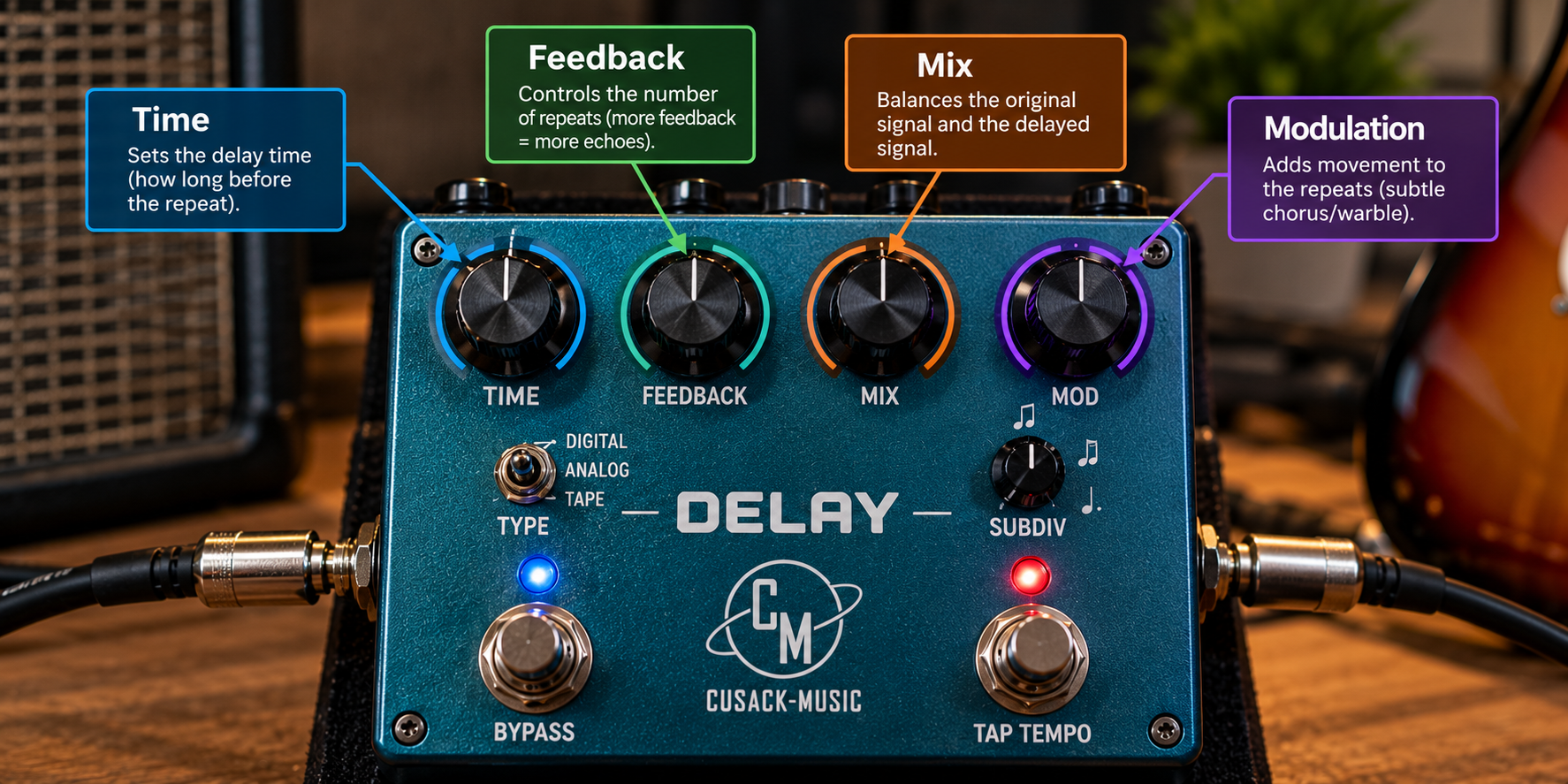
Four controls cover almost everything, and two of them do the heavy lifting.
|
Control |
What it changes |
What goes wrong at maximum |
|---|---|---|
|
Time |
The gap before the first repeat |
Repeats land off the beat and clutter the part |
|
Feedback |
How many repeats you get |
Self-oscillation, a rising howl that never stops |
|
Mix or Level |
How loud the repeats are |
The echo competes with what you are playing |
|
Modulation |
Pitch wobble on the repeats |
Seasick, which is sometimes the point |
Delay time and feedback are the pair that matter. Time decides whether the effect reads as rhythm or as space; feedback decides whether it supports the part or buries it.
A tap tempo footswitch replaces guessing the time with playing it in, and the divide settings turn one tapped beat into quarters, eighths or dotted eighths. Both of my delays have it, and the thinking is the same as on a tap-tempo tremolo.
Why does delay time change what you hear?
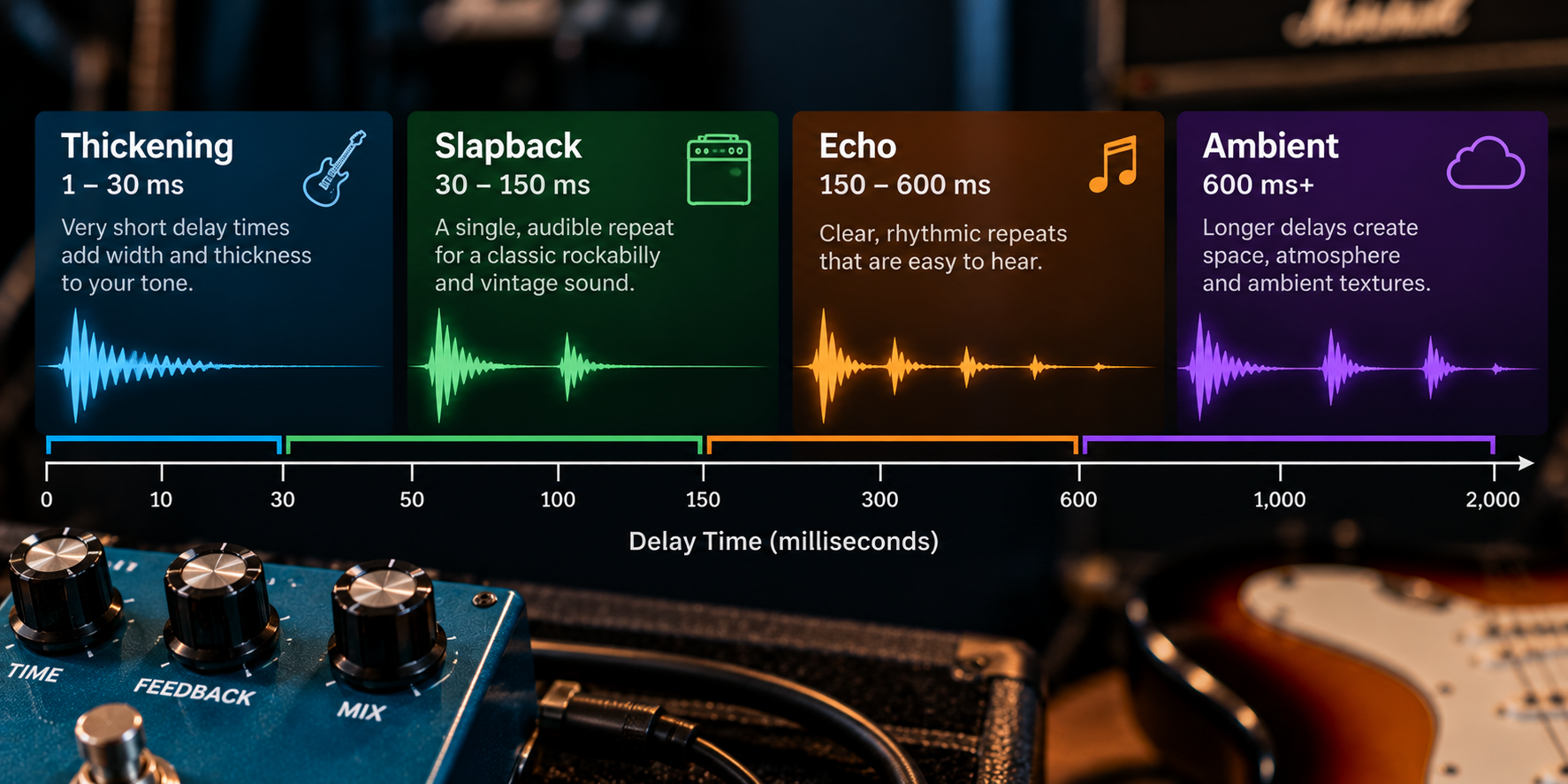
Because your ears stop hearing two events and start hearing one. This is psychoacoustics, not preference, and it is the most useful thing on this page.
The precedence effect describes how a delayed copy arriving within roughly 2 to 50 milliseconds of the original fuses with it rather than being heard separately.
Push past that window and the brain gives up on fusing. Wikipedia's entry puts the echo threshold above 50 milliseconds for speech and around 100 for music.
Which gives you a practical map:
- Under 50 ms: no audible echo. The sound just gets thicker and wider.
- 60 to 250 ms: slapback. One distinct repeat, close behind, with almost no feedback.
- 250 to 600 ms: a clear echo you can play against, which is where most lead sounds live.
- 600 ms and up: ambient washes, where the repeats become a background rather than a response.
Slapback is the setting with a history. It is what Sam Phillips built at Sun in 1954 using two Ampex recorders, and it is on the Elvis Presley and Buddy Holly records that followed.
How to use a delay pedal: four settings to start from
Set time first, feedback second, mix last. These four cover most of what a delay pedal for beginners needs to do:
- Slapback. Time around 100 ms, feedback at or near zero, mix moderate. One repeat, tight behind the note. Rockabilly, country, early rock and roll.
- Lead echo. Time 300 to 500 ms, feedback for two or three repeats, mix around half. The repeats answer your phrase without crowding it.
- Ambient wash. Time 600 ms or more, feedback high, mix moderate. The repeats become atmosphere, so play fewer notes than feels natural.
- Dotted eighth. Time set from the song tempo, feedback low, mix around half. Creates a galloping pattern against a straight part, which is why it has been a stadium rock staple for forty years.
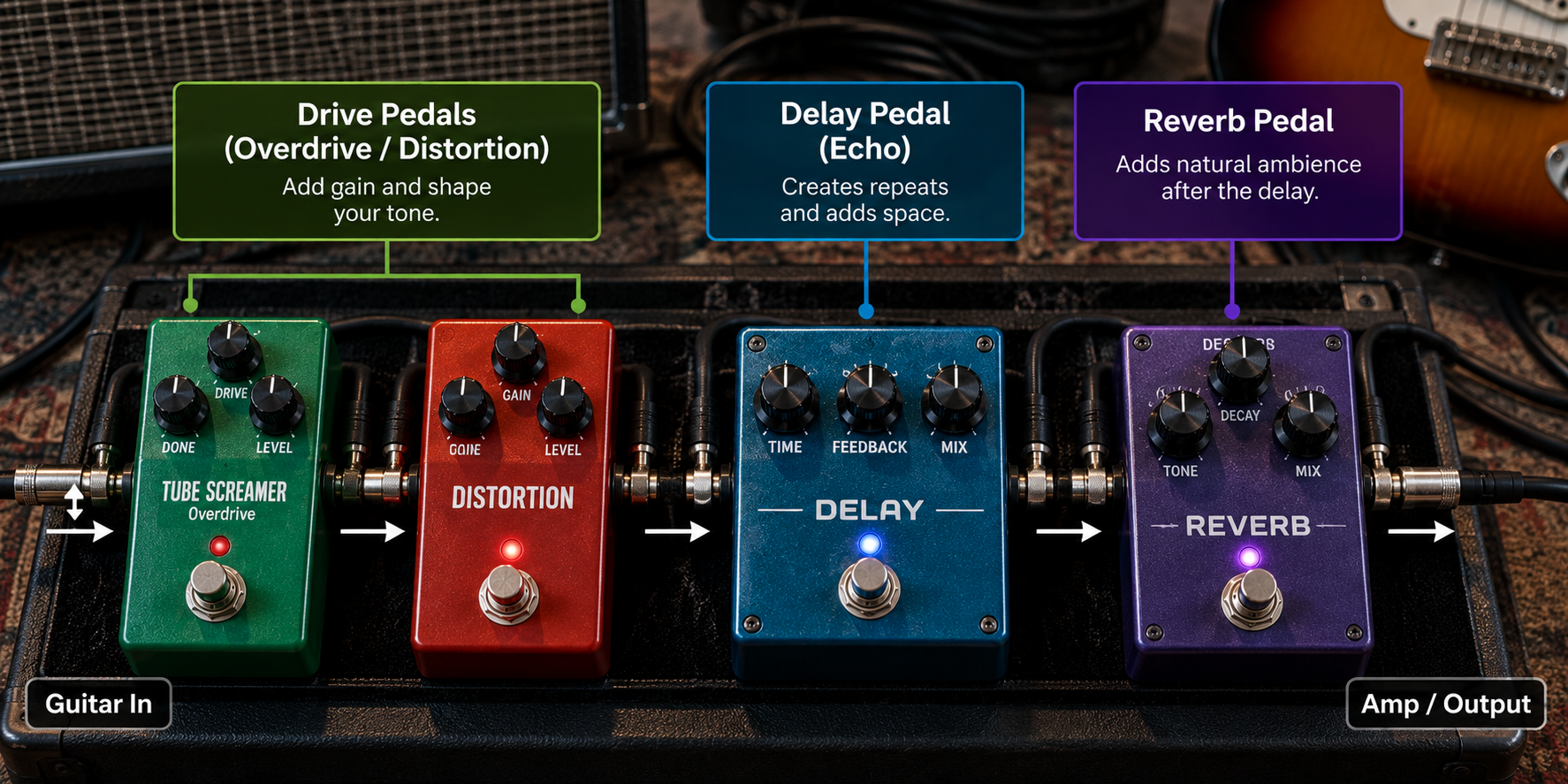
Two things that trip people up. Put the pedal after your drive and before reverb, because an echo feeding a distortion circuit smears every repeat into the next.
And set the mix lower than feels right in a quiet room. If you can clearly hear the echo while the band plays, it is almost certainly too loud.
Frequently asked questions
What is the difference between delay and reverb?
It gives you distinct repeats you can count. Reverb gives you hundreds of reflections too dense and close together to separate, which the ear reads as a room rather than an echo. Set a delay very short with high feedback and it starts to approach reverb, which is a good way to hear where the line sits.
Does a delay pedal need tap tempo?
Not for slapback or ambient settings, where the exact time does not need to agree with anything. It matters the moment the repeats are meant to be rhythmic, because a pattern that drifts against the drummer is worse than no pattern. If you play to a click or change tempo between songs, tap is the feature to pay for.
Where should a delay pedal go in the signal chain?
After distortion and overdrive, before reverb. Feeding the repeats into a drive circuit compresses and smears each one, so the echo loses definition as it decays. Some players run it in the amp's effects loop instead, which keeps the repeats clean behind a preamp-driven sound. Both work; the order above is the reliable starting point.
How many repeats should you use?
Two or three for most playing. One for slapback. More than four and the repeats start colliding with what you are playing next, which is the most common reason something that sounded great alone falls apart with a band. Feedback is the easiest control to overdo and the hardest to notice yourself overdoing.
Is analog delay better than digital?
Neither is better, and the labels describe storage rather than sound. Analog bucket brigade repeats get darker each pass, which some players love and others hear as mud. Digital repeats stay clean, which suits long times and precise rhythmic work. Several well-regarded pedals use digital chips specifically because of how they colour the signal.
Can you use a delay pedal with a tremolo or other modulation?
Yes, and the order matters. Modulation before the echo means the repeats inherit the wobble; modulation after means the wobble is applied to everything equally. I cover the modulation side separately in the guide to what a tremolo pedal is.
The bottom line on delay pedals
Three numbers decide almost everything: the gap, the number of repeats, and how loud they sit. Everything else is refinement.
If you remember one thing, make it the time map. Under 50 milliseconds thickens, 60 to 250 slaps back, 250 to 600 echoes, past 600 becomes atmosphere. That single scale explains more about this effect than any argument about analog versus digital.
Honest limitation: an echo cannot fix a part that does not leave room for it. The repeats need silence to land in, which is why players who struggle with this effect are usually playing too many notes rather than using the wrong pedal.
Two of mine sit at different ends of that range. The Delay TME is the compact one built on that tape-like chip.
The Rebound is the multi-program one, eight voices and a buffered bypass borrowed from the More Louder circuit.
That last choice is the buffered versus true bypass question answered in hardware, and the rest of the range sits on the delay and reverb page.