
What Is a Tremolo Pedal? How It Works and How to Use One
Posted by Jon Cusack on 7th Oct 2026
|
The 30-second version
|
If you have ever heard a chord seem to breathe, or a clean part flutter like a fan is passing in front of the speaker, you have heard a tremolo pedal. It is one of the simplest effects ever built and one of the easiest to set badly.
I build these for a living, so here is my opinion before the explanation. Most players buy one, set the knobs by eye and never touch them again. Ten minutes understanding what the two main controls actually do is worth more than any upgrade.
What is a tremolo pedal, and what does it do?
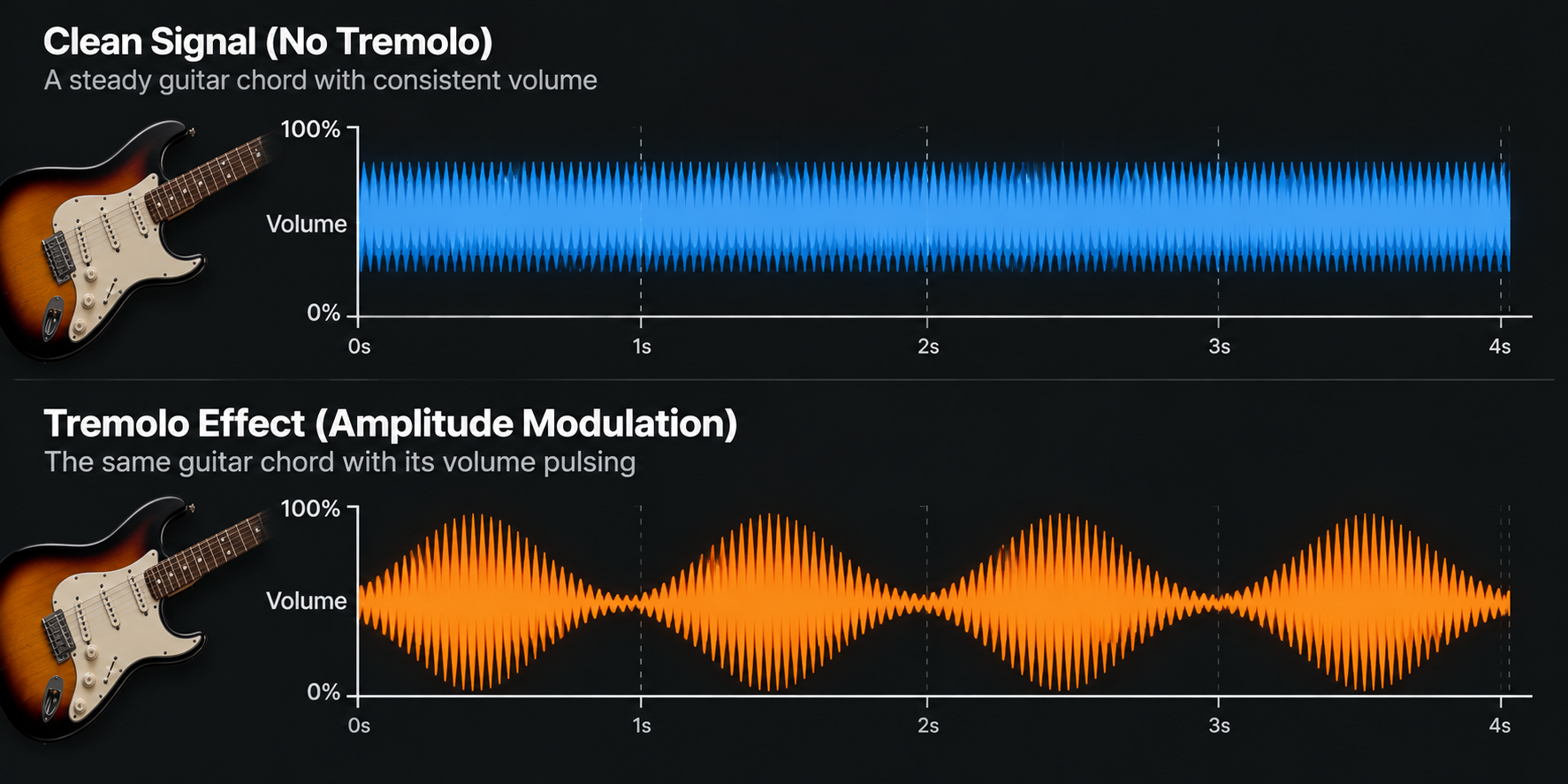
A tremolo pedal is a modulation effect that varies the amplitude of your guitar signal over time, producing a pulse. The academic name for that is amplitude modulation.
The Claire Trevor School of the Arts puts it in one line: "low-frequency amplitude modulation is called tremolo".
Picture someone standing at your amp turning the volume knob down and back up, in time, forever, without ever getting tired. That is the entire effect.
What it does not do matters just as much. Pitch stays exactly where you put it.
That is the line between this and vibrato, which moves pitch instead, and the two names got swapped on amp panels decades ago. I sorted the whole family out in my guide to tremolo vs vibrato.
How does a tremolo pedal work?
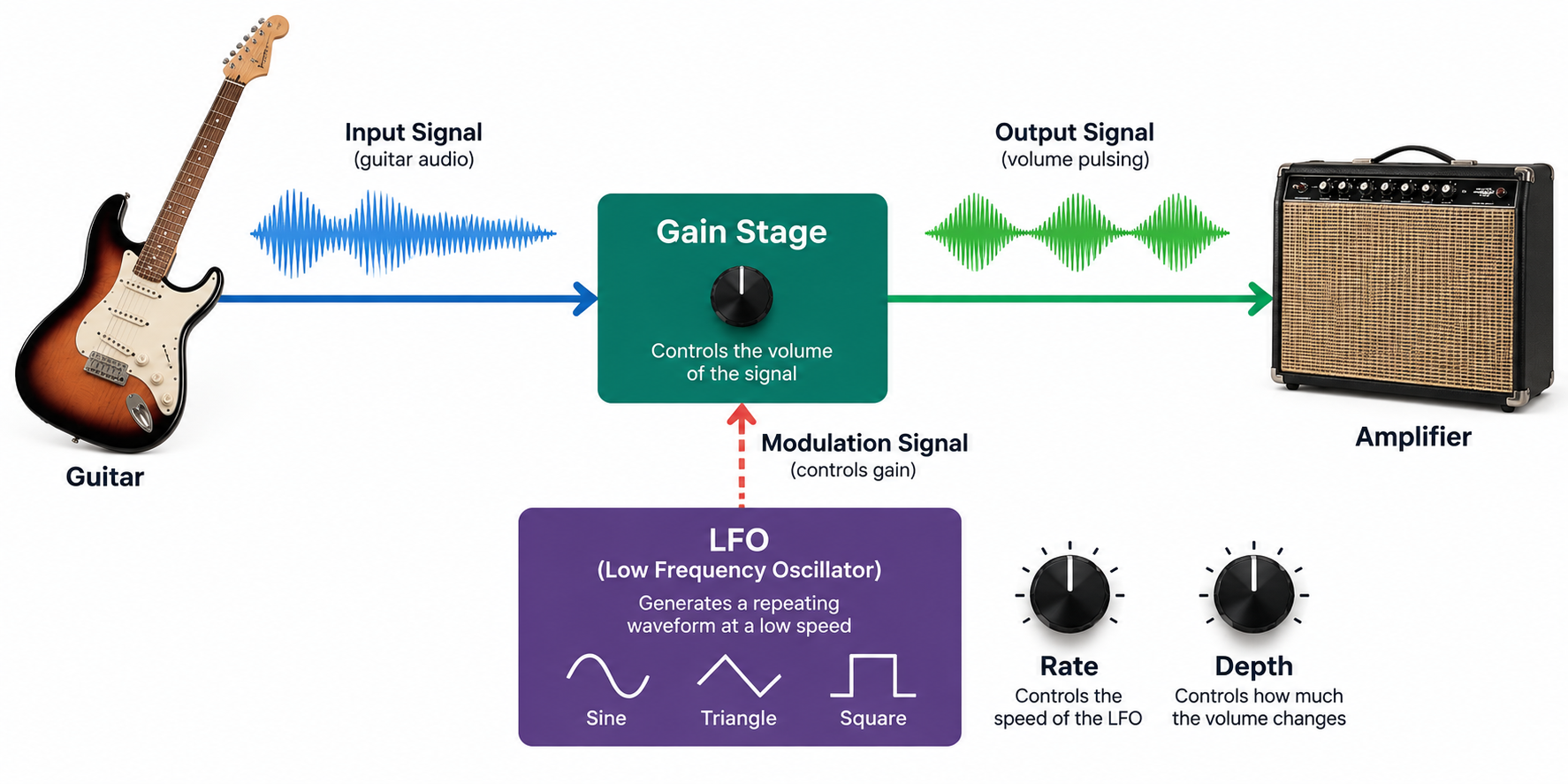
Inside every one of them sits a low frequency oscillator, usually shortened to LFO, which is a circuit that generates a slow repeating wave. That wave is not something you hear. It is a control signal that tells the audio path how loud to be from moment to moment.
Think of the LFO as sheet music for the volume knob. The guitar makes the sound; the oscillator reads out the instructions.
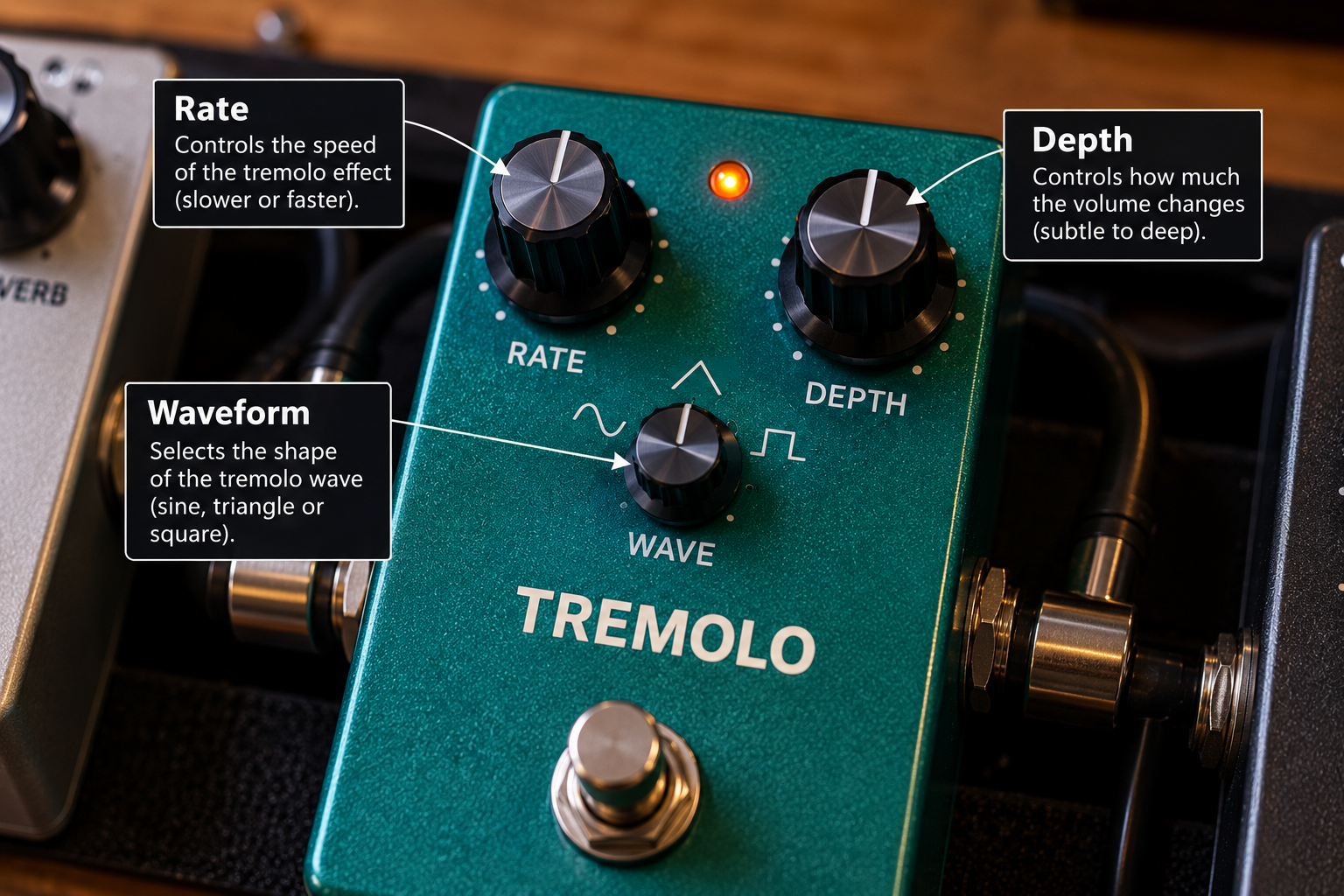
The shape of that wave is what gives each pedal its personality:
- Sine: smooth rise and fall, the gentlest option, right under vocals and ballads.
- Triangle: a straighter climb and descent, slightly more defined than a sine.
- Square: full on, full off, nothing in between. This is the hard chop.
- Ramp or sawtooth: fades one direction and snaps back, so each pulse swells or falls away.
Audacity's manual, which documents the same effect in software, lists those waveform options and a frequency range in hertz with a default of 4.
How the volume actually gets changed varies by circuit. Some designs shine a lamp on a light-sensitive resistor, some wobble the bias on a power tube, some use code, and each sounds meaningfully different.
That distinction is a whole subject on its own, which is why I wrote a separate breakdown of the types of tremolo rather than compressing it here.
What do the controls on a tremolo guitar pedal do?
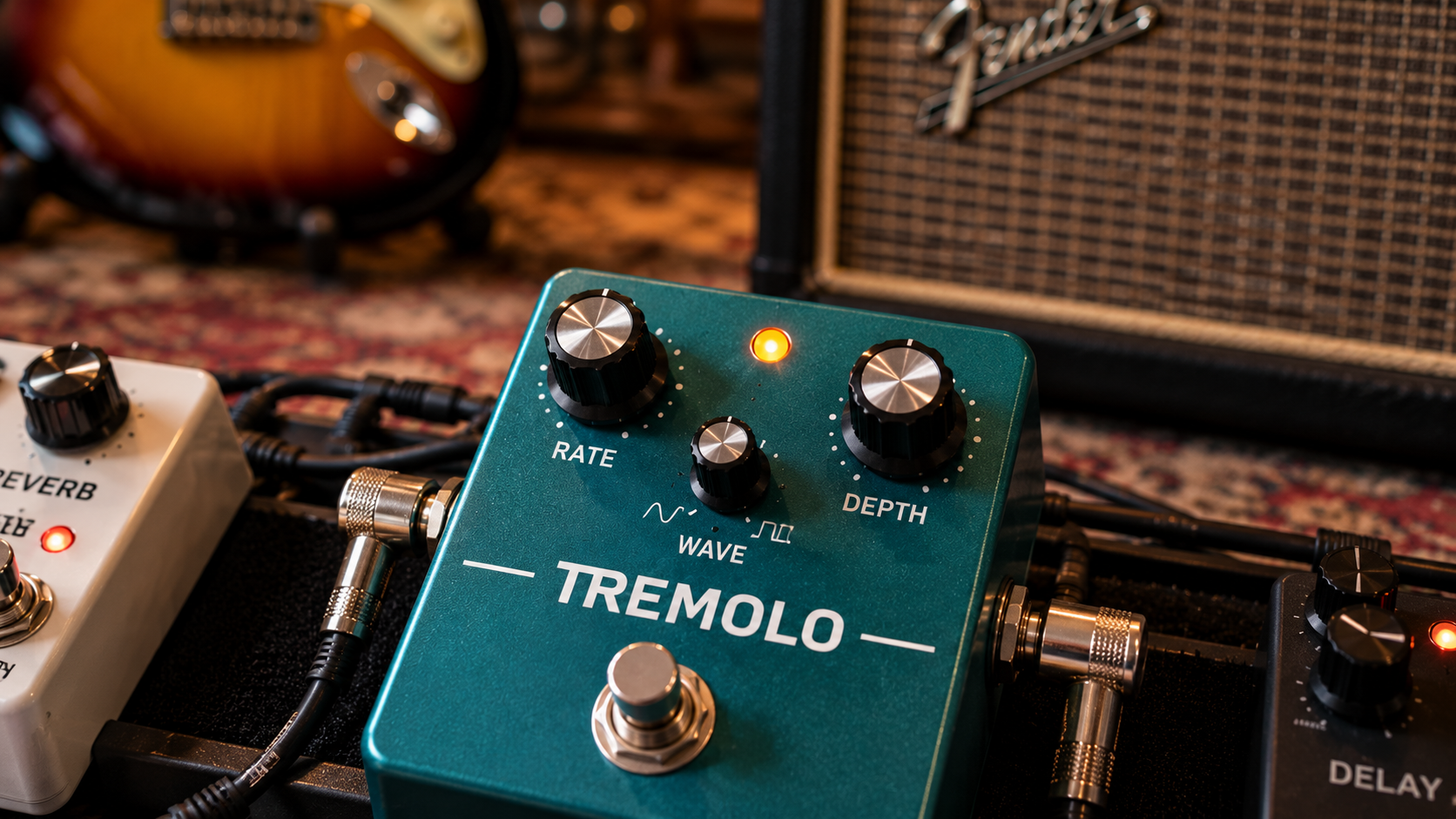
Three knobs cover almost every unit ever made, and a fourth shows up on better ones. Those are your tremolo pedal settings in full.
|
Control |
What it changes |
What happens at maximum |
|---|---|---|
|
Rate or Speed |
How many pulses per second |
Fast flutter, close to a helicopter |
|
Depth or Intensity |
How far the volume drops each cycle |
Signal falls to near silence between pulses |
|
Waveform or Shape |
The edge of each pulse |
Hard square chop instead of a gentle swell |
|
Level or Volume |
Output level, to offset perceived loss |
Compensates for the quieter average volume |
Rate and depth are independent, and mixing them up is the single most common mistake. Turning depth up does not make the pulse faster, it makes each dip deeper.
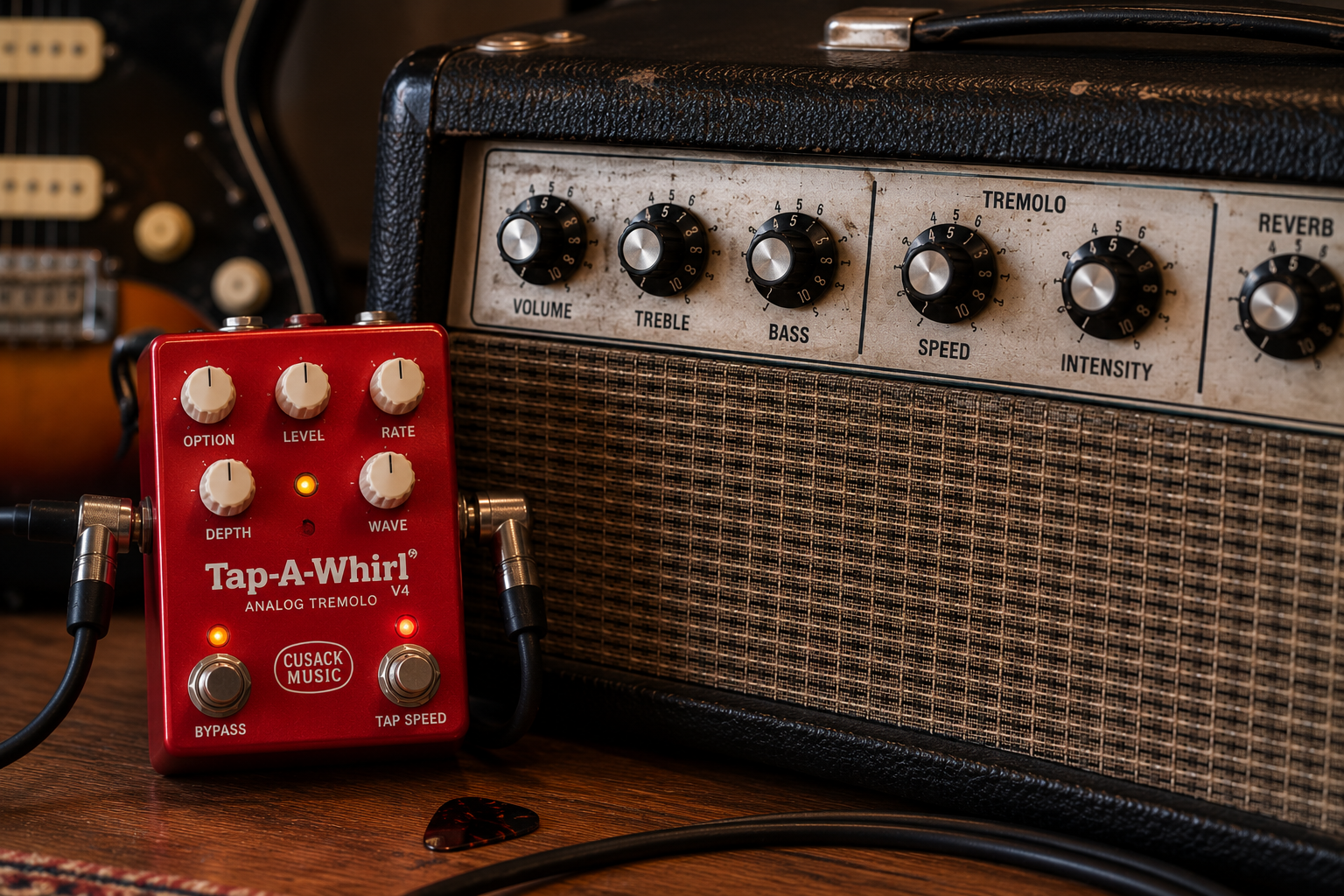
The fourth control worth paying for is tap tempo, which sets rate from footswitch taps so the pulse matches the song instead of a guessed knob position. I explained how divide settings work in my guide to the tap-tempo tremolo.
How to use a tremolo pedal: four settings to start from
Set the speed first, then the depth, then listen with the band rather than alone. These four starting points cover most of what players reach for:
- Gentle breathing under a clean chord. Sine wave, slow rate near 2 Hz, depth around 30 percent. The part should sound alive, not effected.
- Classic mid-tempo pulse. Sine or triangle, rate near 4 Hz, depth near 50 percent. This is the setting most pedals ship with, and it suits a lot of mid-tempo rock.
- Hard rhythmic chop. Square wave, faster rate, depth 80 percent or more. Aggressive on purpose, and best on single notes or simple chords.
- Slow swell for atmosphere. Ramp wave, very slow rate, high depth. Each note rises out of nothing, which works under arpeggios and against reverb.
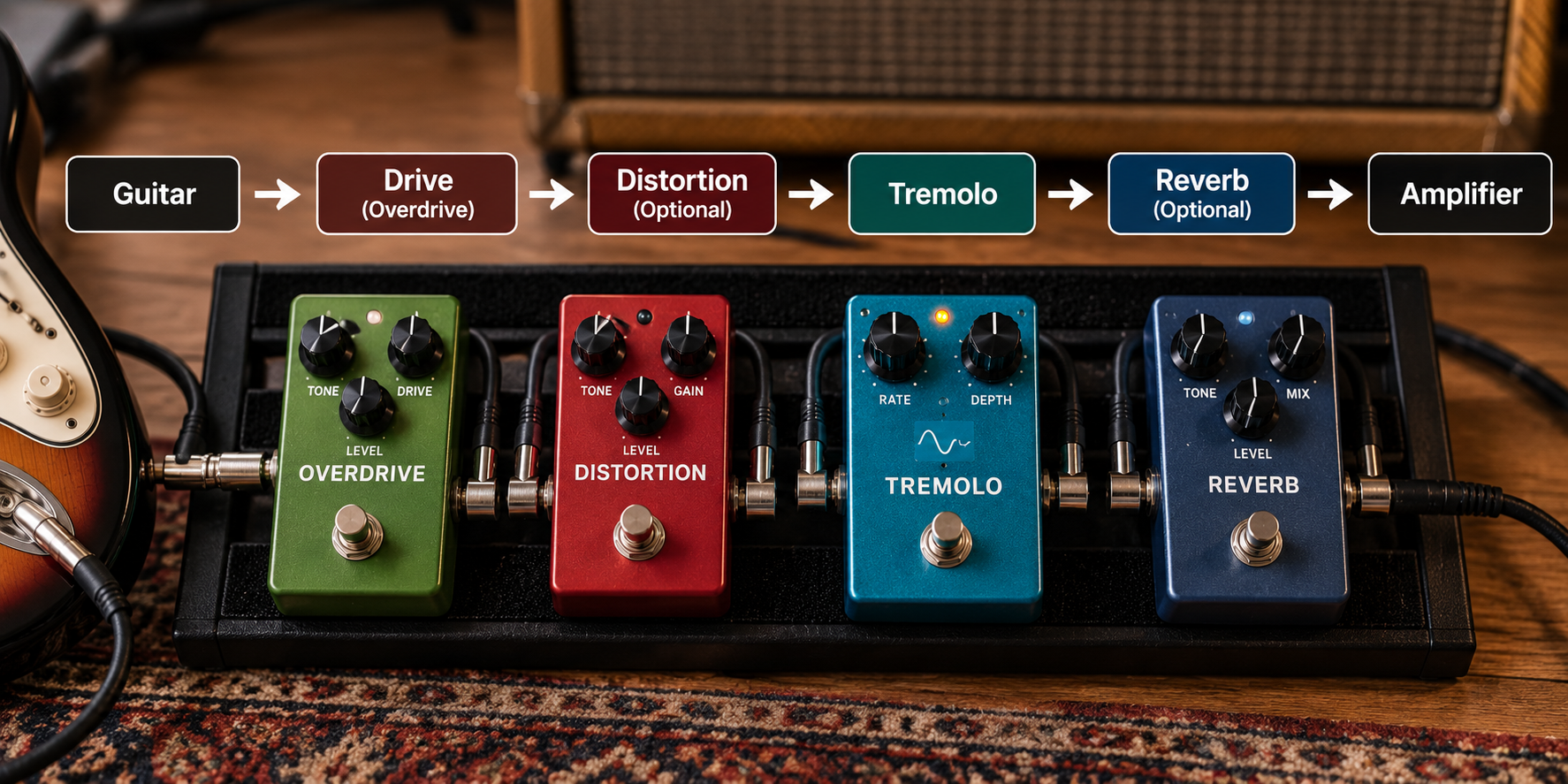
Two practical notes. Put it after your drive pedals, because a distortion circuit placed afterwards squashes the quiet half of each pulse back up and flattens the effect.
And expect the perceived volume to drop as depth rises, since the average level falls. That is what the level control is for.
Which amps have the tremolo effect built in, and how old is it?
Older than you probably think, and older than every other guitar effect. Premier Guitar's history of it places the sound on four songs Roosevelt Sykes recorded in Chicago on 16 April 1942.
Amp builders picked it up through the fifties, and two of the most copied examples are still made as reissues.
The Vox AC30, introduced in 1959 and designed by Dick Denney, shipped with a tremulant switch and a three-position speed control. Later Vox AC30 models gave it a dedicated Vib-Trem channel.
Fender's answer ran longer. The Fender Deluxe Reverb, built from 1963 to 1982, put 22 watts behind a circuit whose preamp and oscillator share a bank of 12AX7 tubes.
A used Fender Deluxe Reverb is still the shortcut most players take to this sound.
If you own one: a pedal gives you waveform choice, tap tempo and stereo that no vintage amp offers, but it cannot modulate that amp's own output stage. Different tools.
Frequently asked questions
What does a tremolo pedal do to your tone?
It changes loudness in a cycle and leaves everything else alone. A well-built one adds no colour of its own when switched off, and very little when on, beyond the pulse itself. What players sometimes hear as tone loss is the drop in average volume that comes with high depth settings, which the level control exists to correct.
Is tremolo the same as vibrato?
No. One varies volume, the other varies pitch, and Wikipedia's entry on tremolo sets that out plainly.
Fender labelled amp circuits "vibrato" and called the pitch-bending bridge on a Stratocaster a "tremolo arm", reversing both terms for a generation of players. It still causes arguments.
Where should it go in the signal chain?
After drive and before delay and reverb, in most rigs. Placed before a distortion pedal the pulse gets flattened, because the drive compresses the quiet part of each cycle back toward the loud part. Some players put it last for a dramatic chop on the wet signal, which also works. Both positions are defensible; test rather than assume.
Do you need one if your amp already has it?
Not necessarily, and I will be straight about that even though I sell them. If your amp's circuit sounds good and you play at one tempo, you are fine. A pedal earns its place when you need waveform choice, tap tempo, stereo, or the same sound through a borrowed backline.
What is a good first setting?
Rate around 4 Hz, depth near 50 percent, sine wave. That is roughly twelve o'clock on most pedals and lands close to eighth notes at 120 BPM. Halve the rate for a slower throb and double it for chop. Judge the result against the song, not in a quiet room, where every setting sounds more dramatic than it is.
Does it work on bass or keyboards?
Yes, with one caveat. Deep settings on bass can make the low end disappear and reappear in a way that sounds unstable in a mix, so keep depth lower than you would on guitar. On keys and synths it behaves exactly as it does on guitar, since the circuit does not care what produced the signal.
The bottom line on tremolo pedals
Strip away the history and the circuit arguments and you are left with three things: how fast the volume moves, how far it moves, and what shape it moves in.
Get those three right against a real song and the cheapest unit on the shelf sounds musical. Get them wrong and the most expensive one sounds like a broken cable.
Honest limitation: no pedal in front of an amp can modulate that amp's own power section, so a true vintage amp sound still lives in the amp. Everything else, a good box does better.
If you want to hear the differences for yourself, the modulation range is where mine live, and the Tap-a-Whirl V4 is the one built around tap tempo and waveform choice.