
Tremolo vs Vibrato vs Chorus: The Definitive Explainer
Posted by Jon Cusack on 29th Sep 2026
|
The 30-second version
|
The tremolo vs vibrato question has a one-line answer: tremolo moves volume, vibrato moves pitch. Chorus is the one people leave out, and it belongs in the comparison, because a chorus pedal is built on the same pitch wobble that a vibrato uses.
We build tremolo pedals in Holland, Michigan, and we do not make a chorus or a vibrato, so weigh our enthusiasm accordingly. What follows is the plain version of how all three work.
What is the difference between tremolo, vibrato, and chorus?
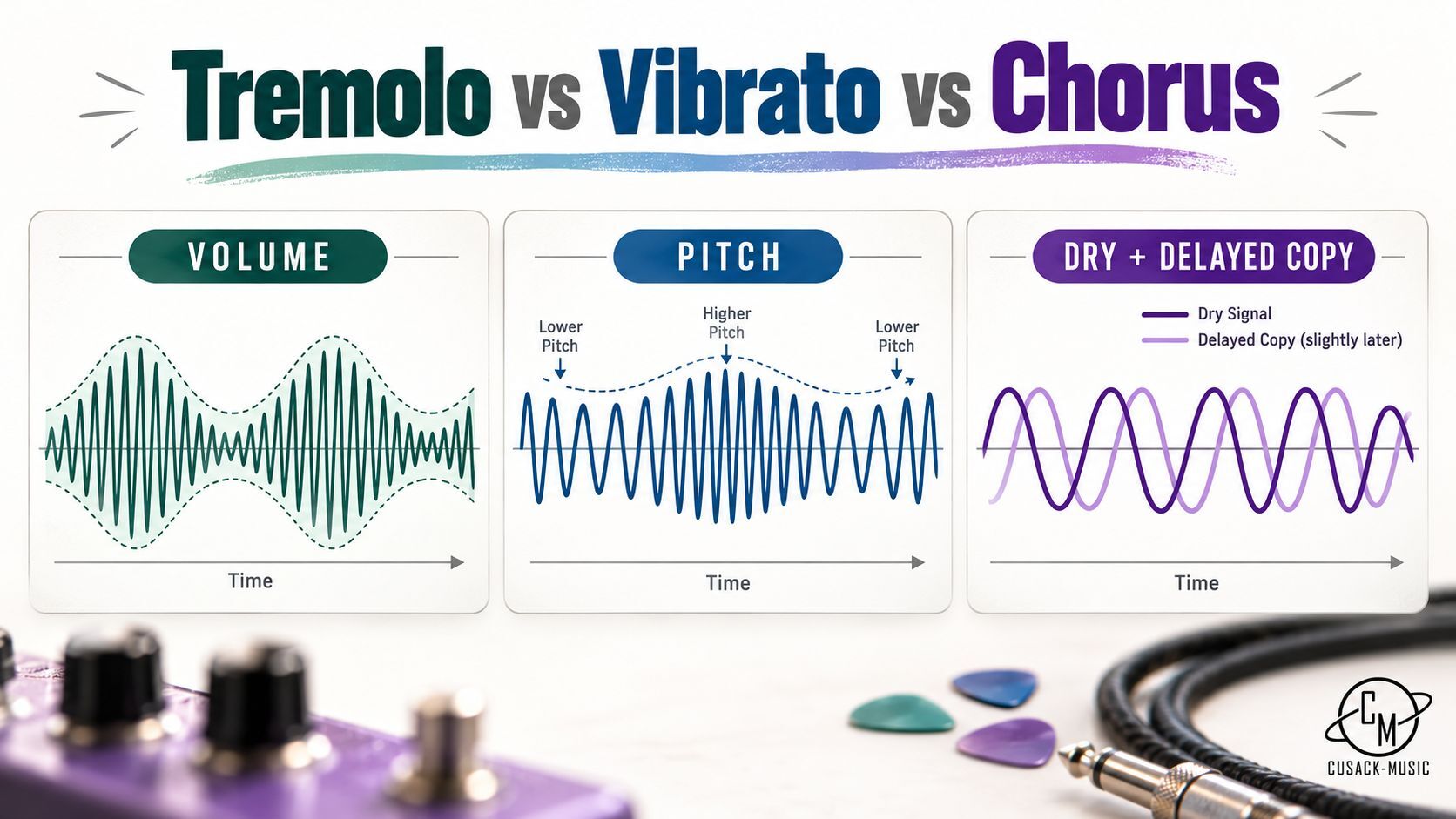
Tremolo modulates volume, vibrato modulates pitch, and chorus mixes a delayed, pitch-modulated copy of your signal with the original. All three are modulation effects, which means a low-frequency oscillator (LFO), a slow wave you feel rather than hear, is moving something up and down on a cycle.
Picture a singer holding one long note. Swelling louder and softer is tremolo. Bending the note slightly sharp and flat is vibrato. Adding a second singer who is never quite in tune or in time is chorus.
|
Effect |
What moves |
How it's made |
Sounds like |
Heard on |
|---|---|---|---|---|
|
Tremolo |
Volume |
An LFO turns the signal up and down |
Pulsing, from a gentle throb to a hard chop |
"How Soon Is Now?" by The Smiths |
|
Vibrato |
Pitch |
An LFO shifts the pitch sharp and flat |
Wavering, singing, or seasick |
Jimi Hendrix's "Machine Gun" |
|
Chorus |
Pitch, plus a delayed copy blended with the dry signal |
A short modulated delay detunes a duplicate |
Wide, shimmering, doubled |
Clean 1980s guitar tones |
Both song examples come from MasterClass and Gearank, which cite the same two tracks.
What does tremolo actually do to your signal?
Tremolo works by rhythmically lowering and raising your volume, nothing more. Think of a hand rolling your amp's volume knob down and back up on a fixed schedule, several times a second.
Three controls shape it. Rate sets how fast the cycle runs, Depth sets how far the volume drops, and Waveform sets the shape of each dip, from a rounded sine to a hard square chop.
Because the pitch never moves, it sits comfortably under a chord without smearing it. That's also why the effect can carry a rhythm part on its own, which is what Johnny Marr's pulsing intro does.
Our analog tap-tempo tremolo takes that idea further by locking the pulse to the song's tempo, which is covered in our guide to tap-tempo tremolo (INTERNAL LINK PLACEHOLDER: tap-tempo tremolo guide).
What does vibrato do, and why is it labeled wrong on your guitar?
Vibrato works by moving pitch up and down around the note you played, the way a violinist rocks a finger on the string. Your volume stays put; the note itself wavers.
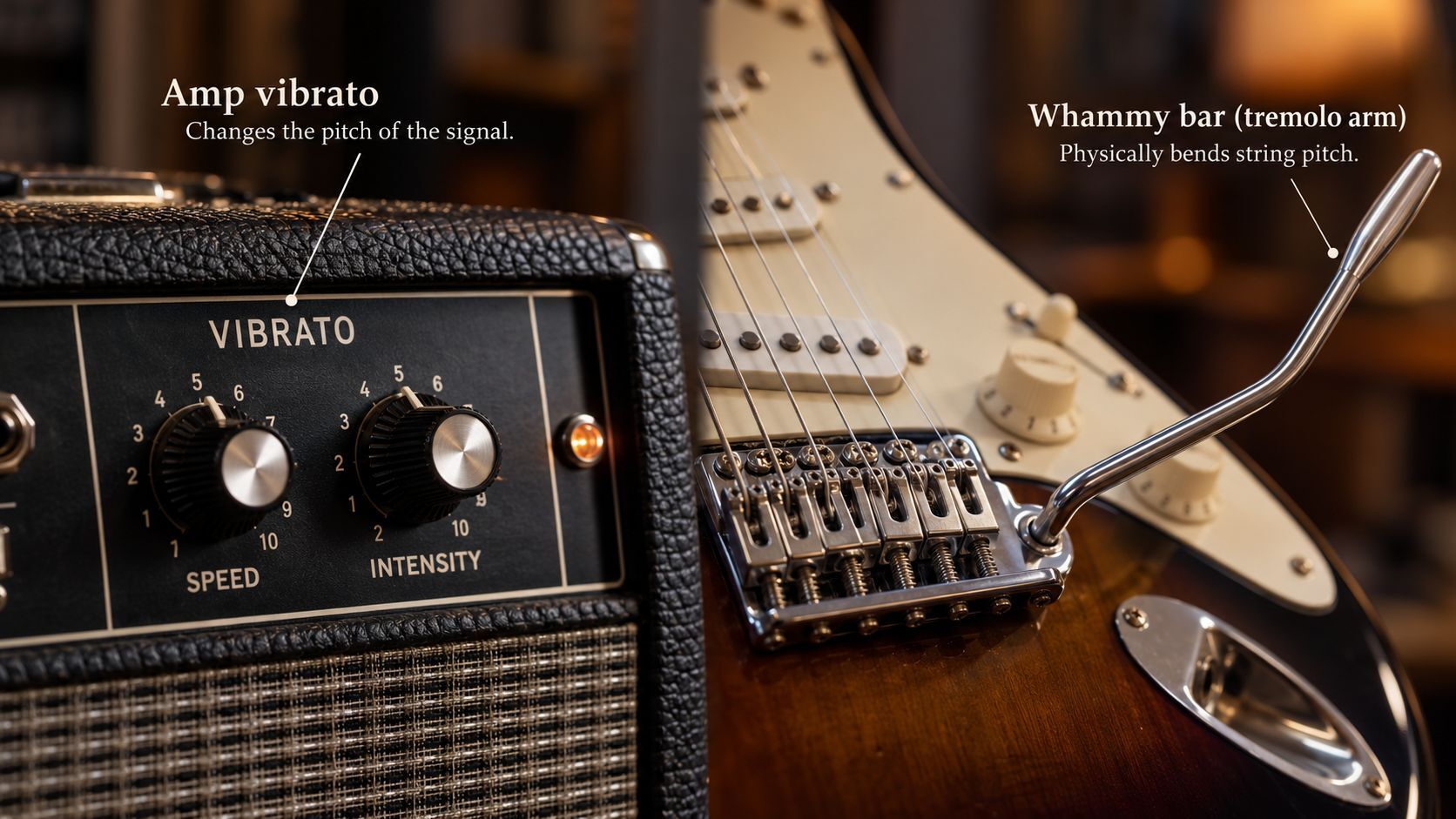
Then there's the naming mess. Fender's own account says that "for decades, guitar and amp makers, Fender included, have labeled the mechanisms of vibrato-equipped guitars as tremolo systems," and did the reverse with its amps.
One of the first Stratocaster ads in 1954 led with the headline "Tremolo Action," for a bridge that bends pitch. As Wikipedia's vibrato unit entry puts it, electric guitarists ended up using both terms in the opposite sense to every other musician.
True pitch vibrato in an amp was rare. Magnatone built it in the late 1950s and 1960s and marketed it as F.M. Vibrato, while most channels carrying that label were tremolo circuits wearing the wrong badge.
How does a chorus pedal make one guitar sound like several?
A chorus copies your signal, delays that copy by a few milliseconds, wobbles the delay time so the copy drifts slightly out of tune, then mixes it back with your dry sound. Two nearly identical guitars, slightly apart in pitch and time, read to your ear as a section rather than a soloist.
That last step is the whole trick. As Perfect Circuit explains, the modulated signal in a vibrato stands alone, while a chorus blends that copy with the dry sound to create width.
Stanford's Julius Smith describes the modern version as "several time-varying delay lines," each tap panned to its own stereo position.
More taps, more voices, wider sound.
The effect went mainstream through Roland's Jazz Chorus amplifier in 1975, which used a bucket brigade delay chip to produce it, and the first standalone chorus pedals followed a year later.
This is also where the family starts to blur. Shorten the delay, add feedback, and you have a flanger.
Sweetwater dates that sound to a tape trick producing delays of 0.5 to 15 milliseconds.
Which effect should you reach for?
Start with what you want the part to do, not with which pedal looks best. Rhythm, expression, and size are three different jobs.
- Choose tremolo if you want the part to pulse in time: surf, swampy blues, dreamy indie, or anything where the guitar should breathe with the drums.
- Choose vibrato if you want a single note to sing or sway: slow leads, warbly clean chords, or a subtle detune that sounds like a worn tape.
- Choose chorus if you want your clean tone to sound wider and thicker without sounding effected: arpeggios, clean rhythm, bass, or anything that feels thin in a mix.
Here's our honest take, bias flagged: chorus is the easiest instant win on a clean tone, and the one we get asked for most. Tremolo is the one you cannot fake with technique, because your hands can do vibrato but they cannot chop your volume 8 times a second.
One caveat. All three lose their charm at extreme settings faster than most effects, so if a setting sounds great alone and vanishes in the band mix, cut the depth rather than raising it.
How do tremolo, vibrato, and chorus fit in your signal chain?
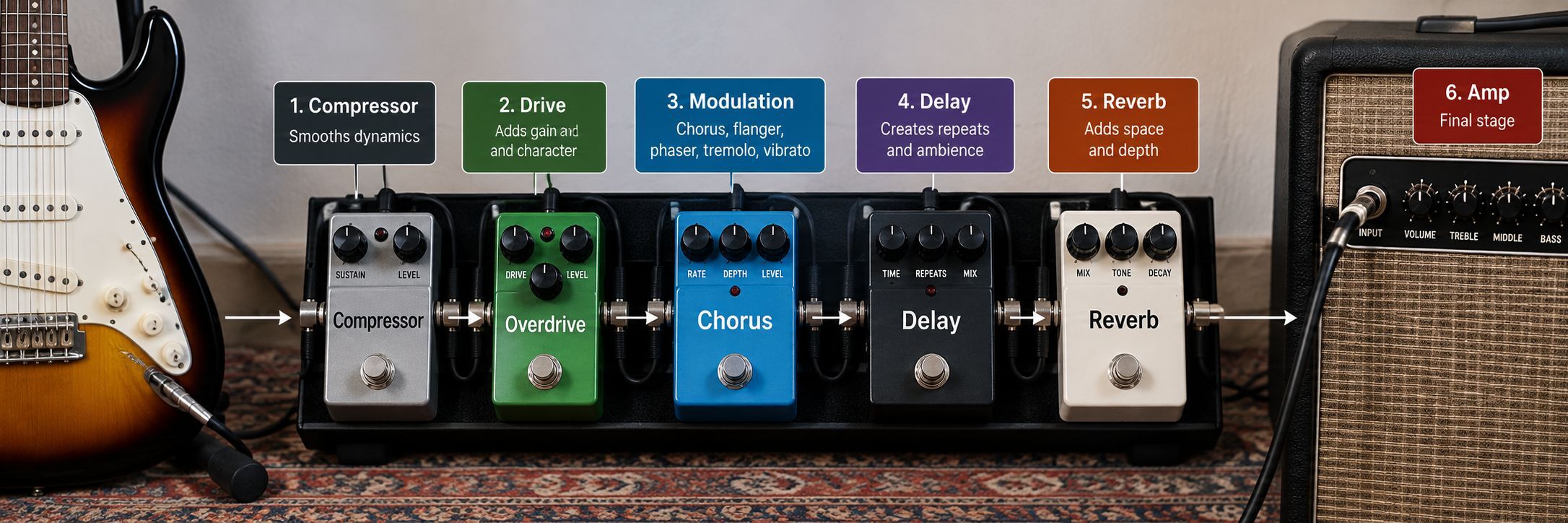
Put modulation after your dirt and before your time-based effects. That way the pulse or wobble shapes a finished tone, and delay and reverb smooth the edges rather than being chopped up by them.
- Run drive first. Overdrive, distortion, and fuzz belong ahead of all three, so the modulation acts on the tone you have already shaped.
- Keep compression ahead of the pulse. A compressor placed after a tremolo fights the volume dips and flattens the effect.
- Place pitch effects before delay and reverb. Ambience after modulation sounds natural; ambience before it gets stuttered.
- Stack carefully. Chorus plus a pitch wobble usually turns to mush, but pairing a pulse with a detuned copy works, since one moves volume and the other moves pitch.
- Go stereo if you can. Chorus and a stereo pulse both open up across two amps, because the pulse or the detuned voice can sit on one side.
Want movement without adding another modulation box? Our delay with modulation covers some of that ground, and the rest of our modulation pedals sit at the tremolo end of the family.
Frequently asked questions
Is a tremolo arm actually a vibrato arm?
Yes. A whammy bar changes string tension, which changes pitch, and pitch modulation is vibrato by definition.
The name stuck because Fender used it on the Stratocaster in 1954 and the industry followed. Nobody is renaming the part now, so most players say trem arm and mean vibrato.
Is chorus just vibrato with the dry signal mixed back in?
Close enough to be a useful shortcut, and it is how many pedals are built: turn the dry signal down and you get pure pitch wobble. The full version adds a short delay to the wet copy, which creates the doubling. The wet copy alone is vibrato, and wet plus dry is chorus.
What is the difference between chorus, flanger, and phaser?
All three split your signal and modulate a copy, so the chorus vs flanger question comes down to delay time. Chorus uses the longest delay and no feedback, which gives the doubled sound.
Flanger uses a much shorter delay with feedback, giving the jet-engine sweep. Phaser uses filters rather than delay, producing a softer swirl.
Can you get a chorus sound out of a tremolo pedal?
Not really. Tremolo only moves volume, and chorus needs a pitch-shifted copy, which a volume circuit cannot produce.
Very fast, shallow settings can add a shimmer that reads as movement, but they will not thicken or widen your tone. A modulated delay gets you closer.
Why does an amp's vibrato channel sound like tremolo?
Because it almost certainly is. Most amps with that label use a circuit that modulates volume, not pitch.
True pitch modulation needs more complex circuitry, which is why Magnatone's F.M. Vibrato was the exception rather than the standard. Trust your ears over the faceplate.
Do you need all three pedals?
Most players do not. Pick the one that matches the job you keep running into: rhythm, expression, or width. Many modulation pedals also cover two of the three, and a stereo rig will get more out of one good pedal than a mono board gets out of three. Buy the effect you can hear yourself using weekly.
The bottom line on tremolo, vibrato, and chorus
|
If you want |
Reach for |
Because |
|---|---|---|
|
A pulse in time with the song |
Tremolo |
It moves volume, so the pitch stays put |
|
A note that sings or wavers |
Vibrato |
It moves pitch around the note you played |
|
A wider, thicker clean tone |
Chorus |
It adds a detuned copy next to your dry signal |
|
A jet sweep |
Flanger |
Short delay plus feedback |
|
A soft swirl |
Phaser |
Filters instead of delay |
Tremolo vs vibrato is settled by one question: is the volume moving or is the pitch moving? Chorus answers a different question, which is whether you want one guitar or the illusion of several.
If it's the pulse you're after, our tremolo pedals start with the Tremolo AME and go up to the Tap-A-Whirl V4.