
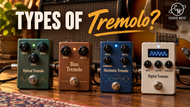
Types of Tremolo: Optical, Bias, Harmonic and Digital Explained
Posted by Jon Cusack on 6th Oct 2026
|
The 30-second version
|
Ask ten players to name the types of tremolo and you will get three answers, two of them wrong. The confusion is understandable, because the amps that made these sounds famous printed the wrong word on the panel.
I build tremolo pedals in Holland, Michigan, and I lost one of them to this subject, so here is my opinion up front. Circuit type matters far less than waveform control. A good square wave from any circuit beats a mediocre sine from a famous one.
What are the main types of tremolo?
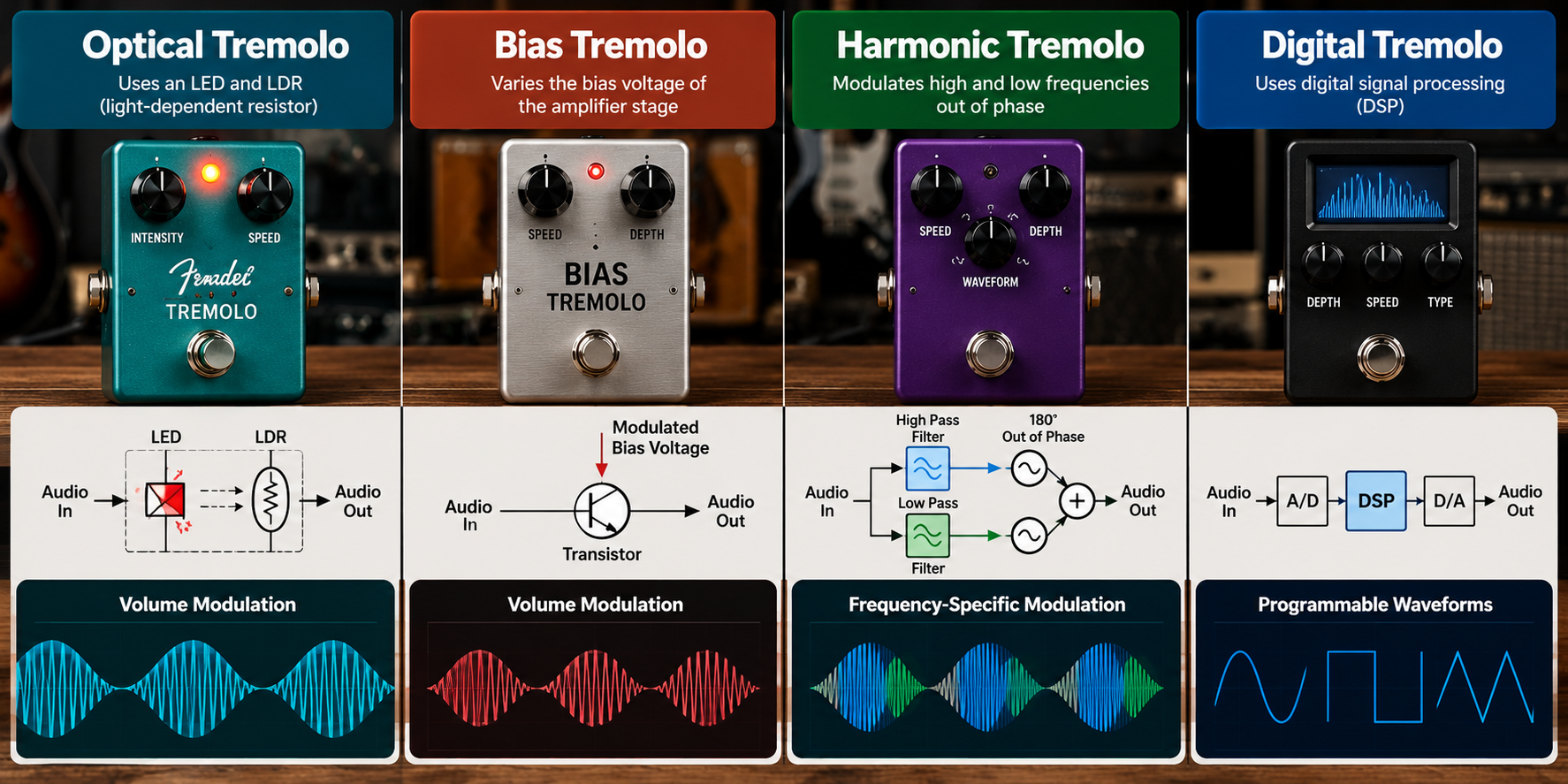
Tremolo is a modulation effect that varies a signal's amplitude over time, and the types are named for the component doing the varying. Everything else, the rate knob, the depth knob, the waveform, sits on top of that one choice.
A useful way to picture it: the low frequency oscillator is the hand on a volume knob, and the circuit type is whose hand it is. A lamp and a photocell turn the knob one way. A power tube's bias turns it another.
|
Type |
How it modulates |
Character |
Where it came from |
|---|---|---|---|
|
Optical (photocell) |
Lamp brightness changes an LDR's resistance |
Choppy, hard-edged, strong throb |
Blackface Fender amps, late 1963 onward |
|
Bias |
Power tube bias voltage is wobbled |
Soft, lilting, slightly compressed |
Fender Tremolux 1955, early Princeton |
|
Harmonic |
Two filtered bands fade against each other |
Sweeping, phase-like, watery |
Fender brownface era, 1960 to 1963 |
|
Analog solid state |
A JFET or OTA varies gain |
Clean, predictable, wide rate range |
1970s pedal designs onward |
|
Digital |
Code multiplies the signal by a waveform |
Any shape, tap tempo, presets, stereo |
Modern pedals and modelers |
|
Pitch vibrato |
Pitch is modulated, not volume |
Seasick, not a throb at all |
Magnatone, often miscalled tremolo |
The last row is in the table on purpose. It is the type that is not a tremolo, and it causes most of the arguments.
How does optical tremolo work?
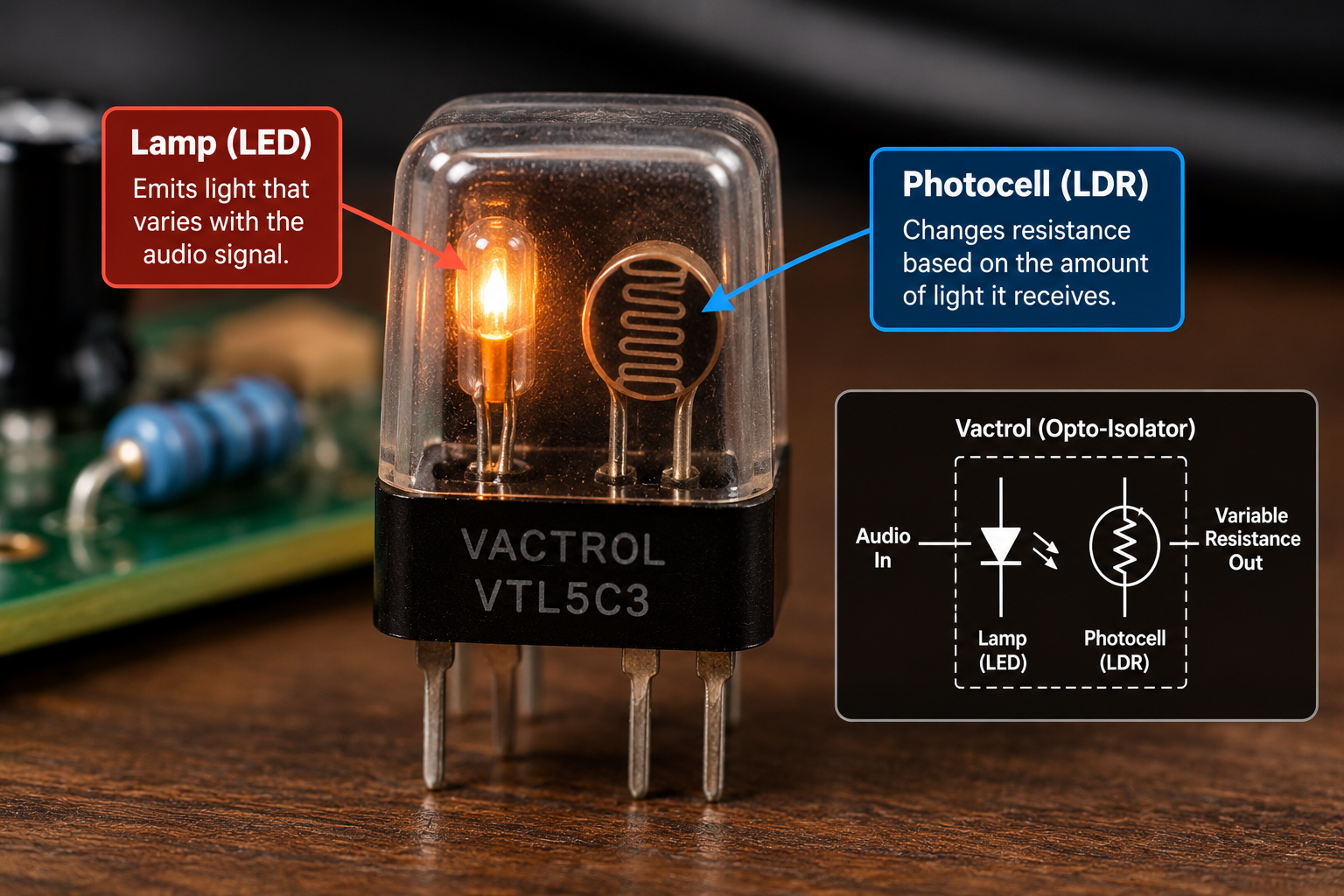
Optical tremolo puts a small lamp next to a light dependent resistor and lets the lamp's brightness swing the resistance up and down. The audio passes through that resistor, so the volume follows the light.
The sealed pairing of lamp and photocell has a name. A resistive opto-isolator, usually called a vactrol, houses a light source with a photoresistor made of cadmium selenide or cadmium sulfide.
Two things about that photocell shape the sound. It is slow, and it is not linear.
Wikipedia's figures put cadmium sulfide response at roughly 140 milliseconds at 25 degrees Celsius, against under 20 milliseconds for cadmium selenide. A lazy cell rounds the edges of a square wave whether you want that or not.
Then there is the lamp. Classic Fender optical circuits used a neon bulb, and a neon bulb does nothing at all until the voltage reaches its strike point near 90 volts.
That is why vintage photocell tremolo sounds chopped rather than smooth. The light does not fade in from zero; it snaps on, then varies. One tube-pedal builder's published teardown describes exactly this jump at the moment the neon gas ionises.
Why are vactrols disappearing from new pedals?
Cadmium. The same Wikipedia entry notes that production and distribution of cadmium-based photoresistors has been banned in the European Union since 1 January 2010, with a narrow exemption added from 2 January 2013 for analogue optocouplers in professional audio equipment.
I learned this the hard way. The original Tap-A-Whirl was discontinued over exactly this, and its product page still describes that obsolete vactrol as "the heart of the pedal."
I searched far and wide for a replacement and found none, so I worked with vendors on a custom part instead. The Tap-a-Whirl V4 analog tap tempo tremolo exists because that search failed.
How does bias tremolo work?
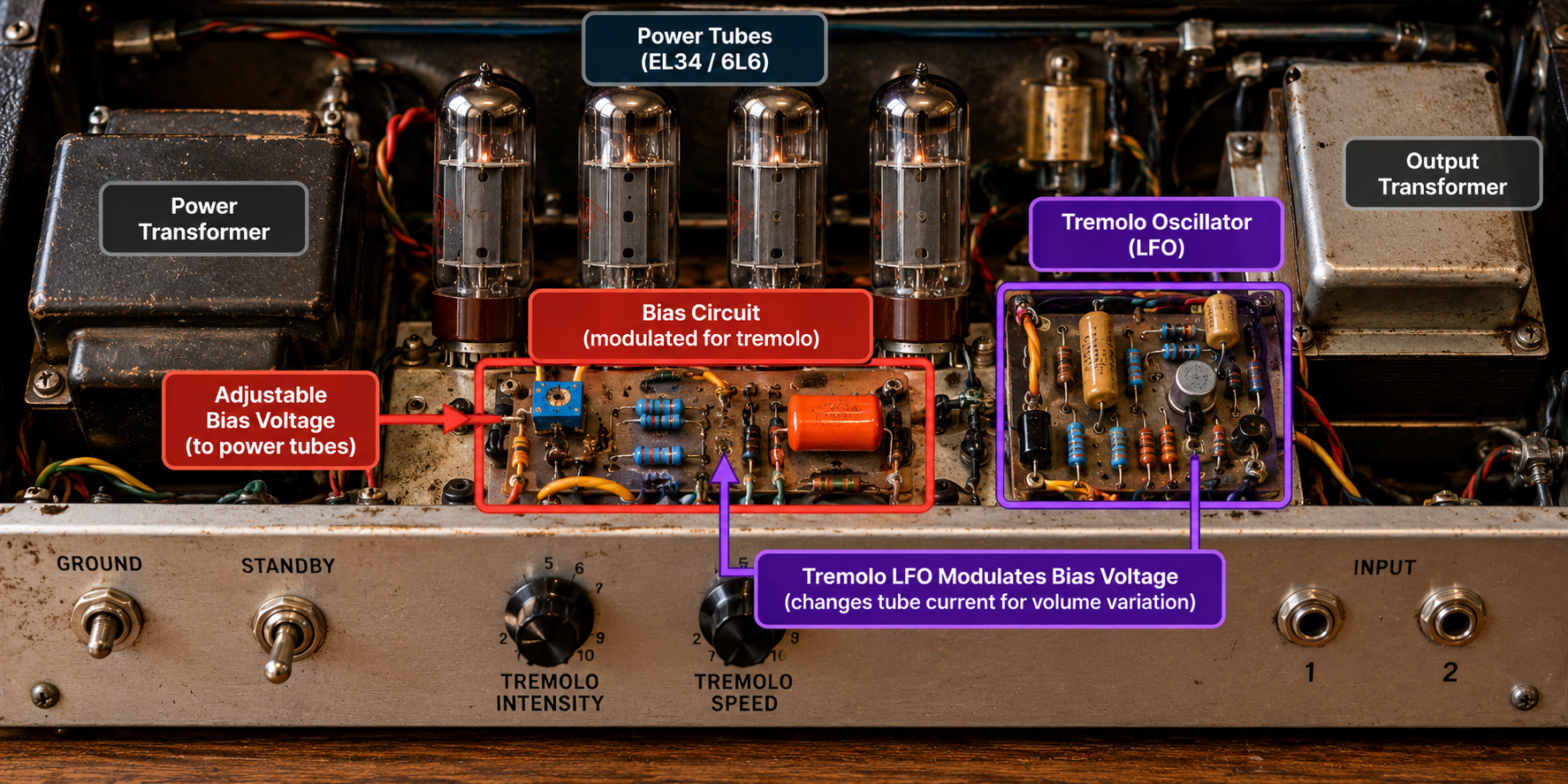
Bias tremolo modulates the bias voltage sitting on the power tubes, so the output stage itself gets louder and quieter. Nothing stands between your guitar and the speaker; the amplifier breathes.
Picture a dimmer switch wired into the engine rather than the lamp. That is the difference between bias trem and every circuit that modulates the signal downstream.
This is the oldest tube amp tremolo approach. Early Fender combos used it, the Tremolux from 1955 onward and the Princeton before 1963, wobbling the idle current through 6V6 or 6L6 output tubes.
The sound is the reason people still chase it. Because the vacuum tube is being pushed in and out of its linear range, the quiet half of each cycle carries a little crossover distortion, which reads to the ear as warmth rather than fault.
No pedal can do this, and that is not marketing. A pedal sits in front of the amp, so it can only modulate the signal arriving at the input, never the vacuum tube stage driving the speaker.
Three traits mark a bias circuit:
- Soft edges: the waveform is smoothed by the tube's own transfer curve, so hard chop is not really available.
- Volume dependent: the effect changes character as you turn the amp up, because tube behaviour changes with it.
- Narrow rate range: vintage phase-shift oscillators typically ran only about 4 to 8Hz before losing strength.
One honest warning, since this is a tube amp circuit and not a pedal. If the intensity pot in a bias circuit fails open, the negative bias voltage can disappear and the output tubes can run away. That is a technician's job, not a weekend one.
The Fender Vibrolux sits in the middle of this story, and like its siblings it wore the word "vibrato" on a panel controlling a tremolo circuit.
What is harmonic tremolo and why does it sound different?
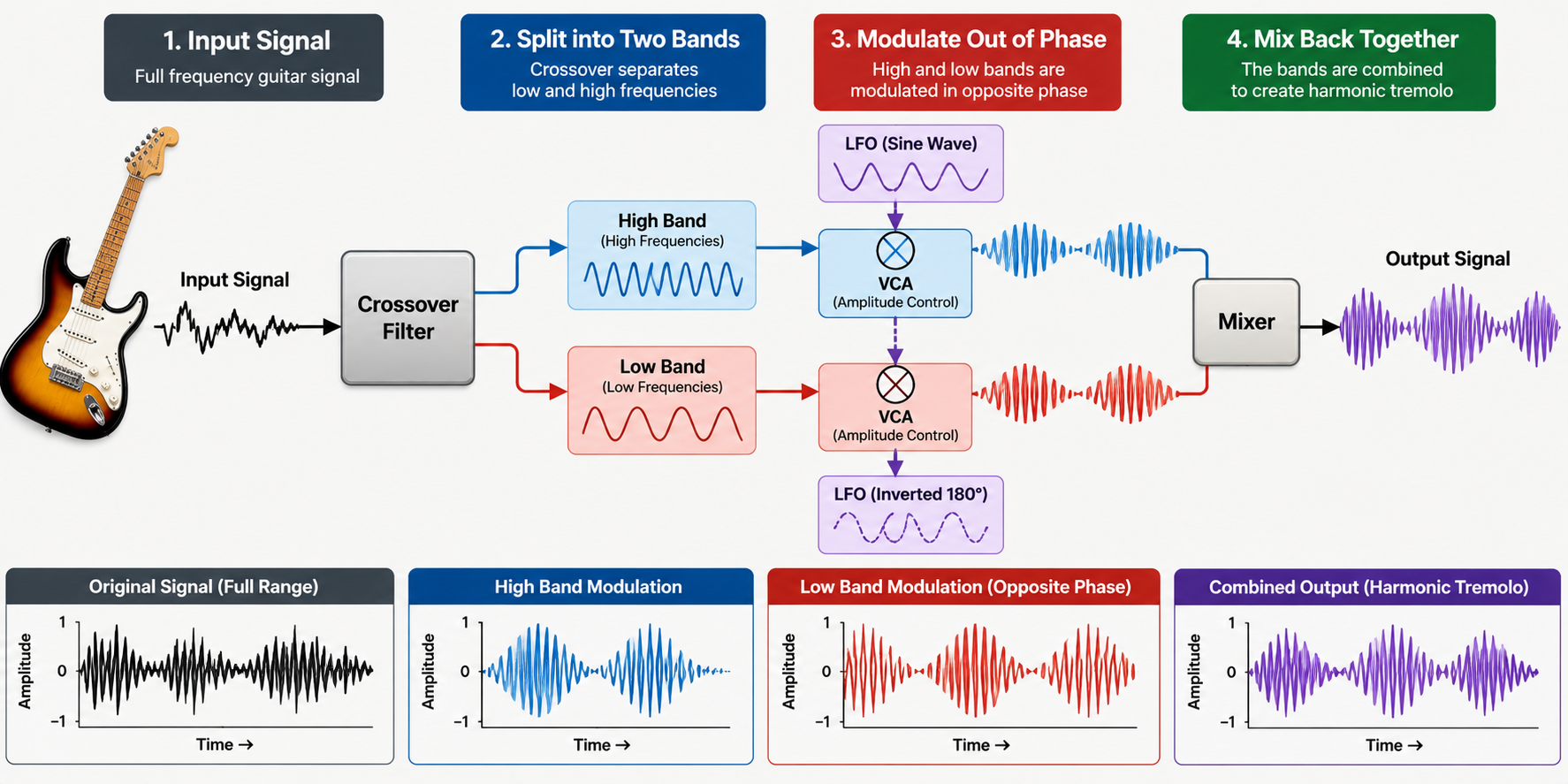
Harmonic tremolo splits your signal into a high band and a low band, then fades one up while fading the other down. You never lose volume completely, which is why it sweeps instead of pulsing.
Think of a crossfader between a bright copy of your guitar and a dark one. Nothing drops out, the colour just moves back and forth, and that motion is what people hear as watery or phase-like.
Fender built the famous version, and brownface amps from 1960 to 1963 carried it.
Guitar.com, in its look at a 1961 Pro Amp, notes that by late 1963 "its harmonic 'vibrato' was switched out for an optical circuit."
Three years. That short window is why original harmonic amps cost what they do.
The circuit modulated high-pass and low-pass filters and mixed the outputs, which nudges phase as well as level. Purists point out that this makes the Fender design closer to vibrato than to pure amplitude modulation, and they have a point.
Britain got there first in a different way. The Vox AC15, introduced in 1958 and designed by Dick Denney, carried a vibrato "identical in design to the JMI Vibravox phase shift/modulation effects unit".
By 1960 the Vox AC15 let players choose between tremolo and vibrato outright, with a speed knob on the panel and depth hidden on an internal trim pot.
Worth noting for anyone shopping vintage: that choice was unusual, and most amps of the period gave you one circuit and one label, correct or not.
Where does Magnatone fit?
It does not, and this is the correction worth making. Magnatone amplifiers produced true pitch shifting vibrato, built on a 1961 patent describing a "vibrato circuit comprising a bridge having non-linear impedance elements".
Volume never moves in a Magnatone. Pitch does, which is a different effect wearing a similar coat, and I untangle the whole family in my guide to tremolo vs vibrato.
Optical vs bias tremolo: which one should you pick?
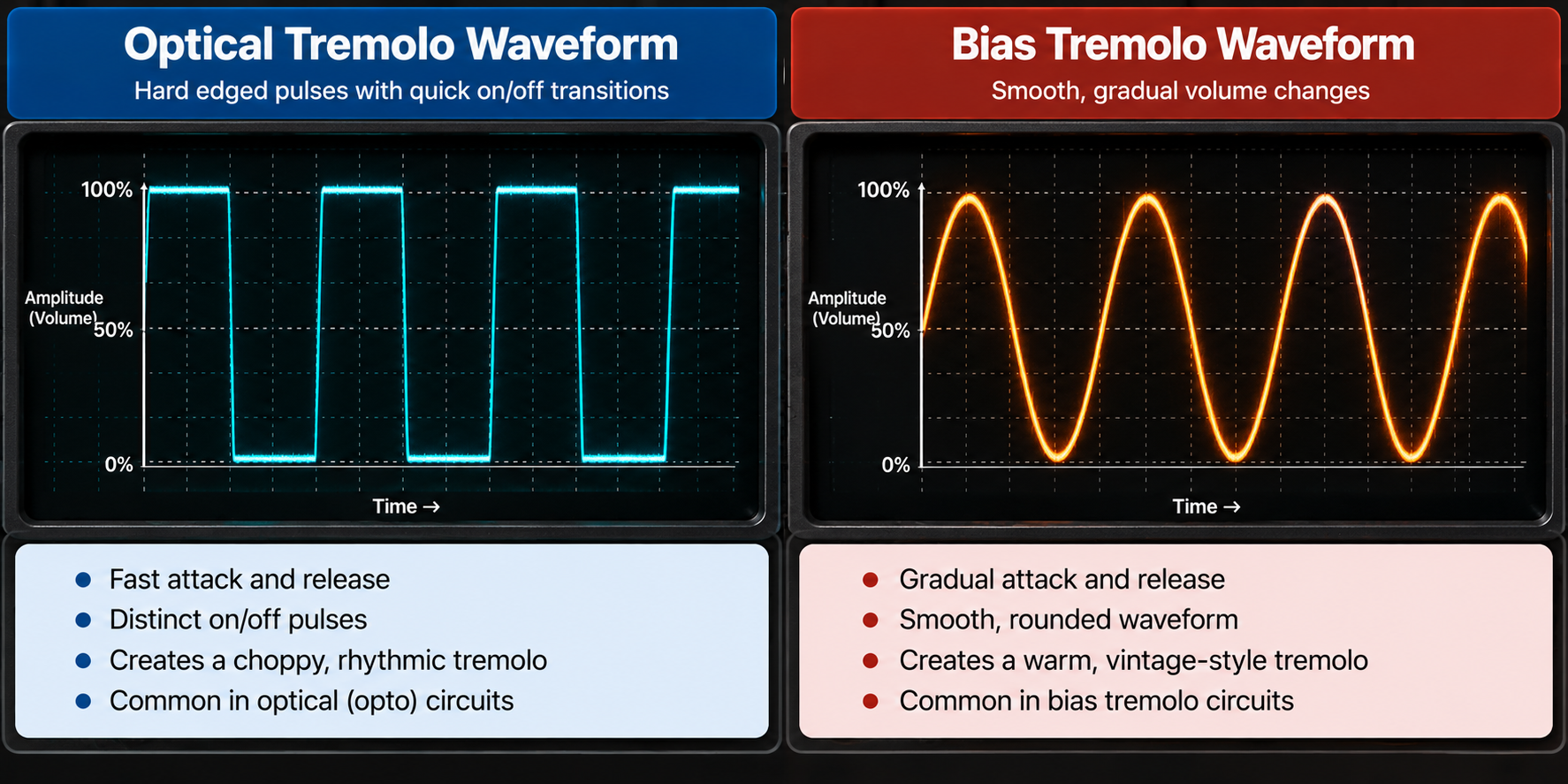
Pick by how hard you want the throb to hit. Optical chops, bias breathes, and no amount of knob twisting fully converts one into the other.
|
Optical tremolo |
Bias tremolo |
|
|---|---|---|
|
What moves |
Resistance in a photocell |
Power tube bias voltage |
|
Edge of the pulse |
Hard, closer to a square |
Soft, closer to a sine |
|
Depth at maximum |
Can approach full silence |
Rarely fully silent |
|
Interaction with volume |
Consistent at any level |
Changes as the amp drives harder |
|
Best for |
Surf, stabs, rhythmic chop |
Slow shimmer, blues, ballads |
Two honest caveats. The character differences above are smaller than demo videos suggest once a band is playing, and both circuits lose their identity when the depth control sits below halfway.
Era matters more than model name when you shop. A Fender Vibrolux from the early sixties and one from 1965 carry different circuits behind the same badge, so check the year before you judge the sound.
If you want one pedal that can do both jobs, waveform control matters more than which vintage circuit it is modelled on.
Analog vs digital tremolo: which one do you actually need?
The analog vs digital tremolo question comes down to control, not warmth. Analog varies gain with a physical part, a photocell, a JFET or an OTA, while digital multiplies the audio by a waveform calculated in code.
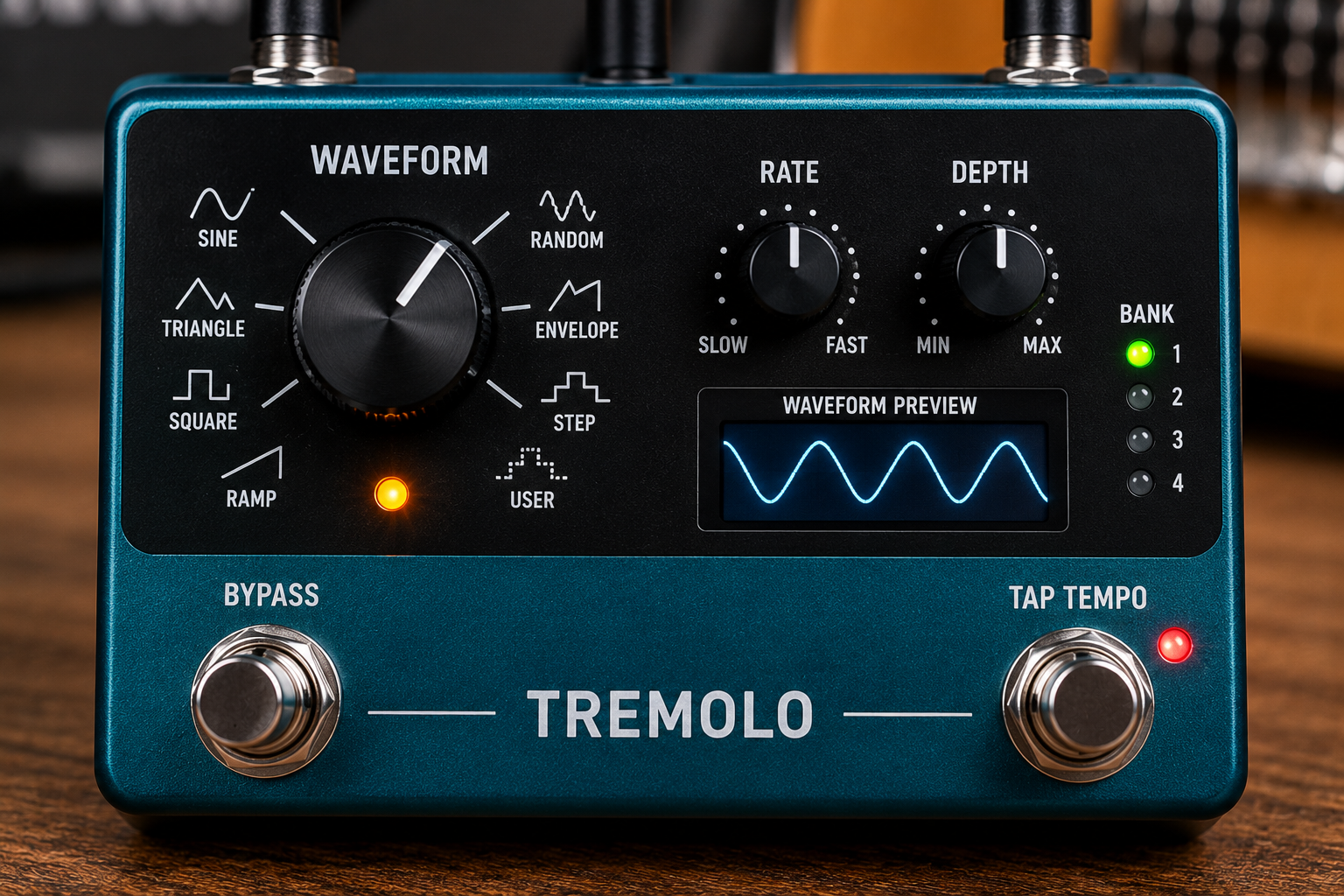
A digital engine can draw any shape you ask for, remember it, and restart it in time with the song. An analog circuit is stuck with the shape its parts produce, which is a limitation and also the reason certain vintage units sound the way they do.
Where each one wins:
- Analog: smooth interaction with your pickups and volume knob, no conversion stage, and the slightly imperfect waveform that defines vintage tremolo.
- Digital: odd waveforms, tap tempo and note divisions, presets, stereo panning, and perfect repeatability from gig to gig.
- Hybrid: an analog audio path with digital control over the LFO, which is where most modern tap tremolo sits.
That hybrid line is where my own pedals live. Tap-a-Whirl V4 keeps the audio analog and runs 24 waveforms across three banks, with a buffered bypass borrowed from the More Louder boost circuit.
The Tremolo AME takes the simpler route with nine waveforms in three banks, though it is out of stock as of October 2026.
Which type of tremolo is right for your rig?
Match the circuit to the part you play, not to the decade you admire. Four cases cover most players:
- You play surf, or anything with rhythmic stabs: optical, or any pedal with a true square wave and a fast rate.
- You want the amp to breathe under a slow blues: bias tremolo in a tube amp, or a pedal with a soft sine and shallow depth.
- You want that watery brownface sweep: harmonic tremolo, which no amount of depth on a standard trem will imitate.
- You play to a click, or need the same sound twice: a tap tempo pedal, where tap-tempo tremolo locks the pulse to the song.
Budget matters here too. A brownface amp costs several thousand dollars, and a pedal that covers the same ground sits in the low hundreds.
Browse the modulation pedals if you want to compare what I build against the vintage circuits described above.
Frequently asked questions
Is tremolo the same as vibrato?
No. Tremolo varies volume and vibrato varies pitch, which is the whole distinction.
Wikipedia's entry on tremolo records that Fender labelled tremolo circuits "Vibrato, adding to the confusion between the two terms." The whammy bar on a Stratocaster makes it worse, since that device bends pitch while carrying the tremolo name.
What is a photocell tremolo?
Photocell tremolo is another name for optical tremolo. A lamp shines on a light dependent resistor, the resistance rises and falls with the light, and your signal level follows. The pairing is sealed into one part so outside light cannot interfere. Response speed of the photocell material sets how sharp the pulse can be.
Which Fender amps have harmonic tremolo?
Brownface models built between 1960 and 1963, including Pro, Super and Concert amps of that era. By late 1963 the harmonic circuit was replaced with a simpler optical design, so blackface amps from 1964 onward carry photocell tremolo instead. That three year window is why original harmonic amps command the prices they do.
Does tube amp tremolo sound better than a pedal?
It sounds different, not automatically better. A bias circuit modulates the output stage, which no pedal in front of the amp can replicate exactly. A pedal gives you waveform shapes, tap tempo and stereo that no vintage amp offers. Players chasing one specific amp tone should buy the amp; everyone else gets more music from a pedal.
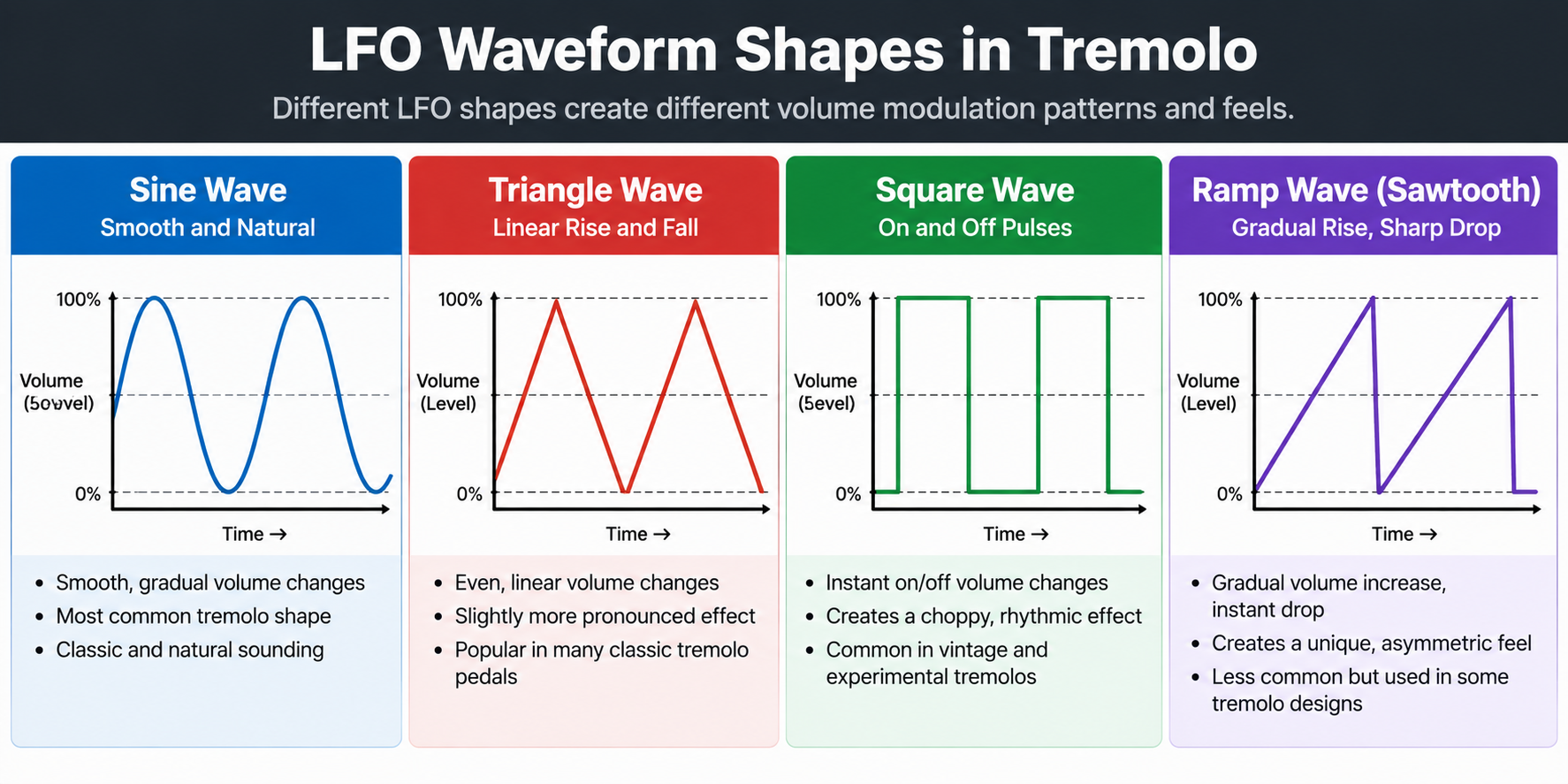
What waveform should you use for tremolo?
Start with a sine for smooth pulsing, a square for hard chop, and a ramp when you want each note to swell or fall away. Sine suits ballads and slow blues. Square suits surf, stabs and anything rhythmic. Ramp and sawtooth shapes read as reverse swells, which work well under clean arpeggios.
What is a vactrol, and why do pedals mention it?
A vactrol is a sealed lamp and photoresistor pair used to vary resistance with light. Pedal builders mention it because the part defines how an optical circuit behaves and because cadmium based photoresistors have been restricted in the EU since 2010. Several builders, myself included, have redesigned products around replacements.
Where should a tremolo pedal go in your signal chain?
After drive and before delay and reverb is the standard position, so the pulse chops a finished tone rather than feeding a distortion circuit that squashes it back flat. Some players put trem last for a dramatic chop on the wet signal. Both work, and a loop switcher lets you compare the two in seconds.
The bottom line on types of tremolo
|
If you want |
Reach for |
Why |
|---|---|---|
|
Hard rhythmic chop |
Optical or square wave |
The pulse edge stays sharp |
|
Soft breathing swell |
Bias tremolo or a sine |
The tube rounds every edge |
|
Watery sweeping motion |
Harmonic tremolo |
Two bands fade against each other |
|
Pitch wobble, not volume |
Vibrato, not tremolo |
Magnatone built this, Fender mislabelled it |
|
Tempo locked pulses |
Digital or hybrid with tap |
Taps set the rate, divisions do the rest |
The types of tremolo are easier to hold onto once you stop sorting them by brand and start sorting them by what moves. A lamp, a tube's bias, two filter bands, or a line of code.
Honest limitation: no pedal placed in front of an amp can modulate that amp's own output stage, so a true bias sound still lives in the amp.
Wondering whether a buffered or true bypass trem suits your board? That question is covered in my guide to buffered vs true bypass.