
Analog vs Digital Delay: What Actually Changes, and When It Matters
Posted by Jon Cusack on 14th Oct 2026
|
The 30-second version
|
The analog vs digital delay argument usually gets framed as warmth versus precision. That framing is not wrong, but it skips the part that matters.
My honest position: the label on the box tells you how the echo is stored, and almost nothing about what you will hear. Filtering, distortion and pitch instability do that work, and all three can be built either way.
What is the difference between analog and digital delay?
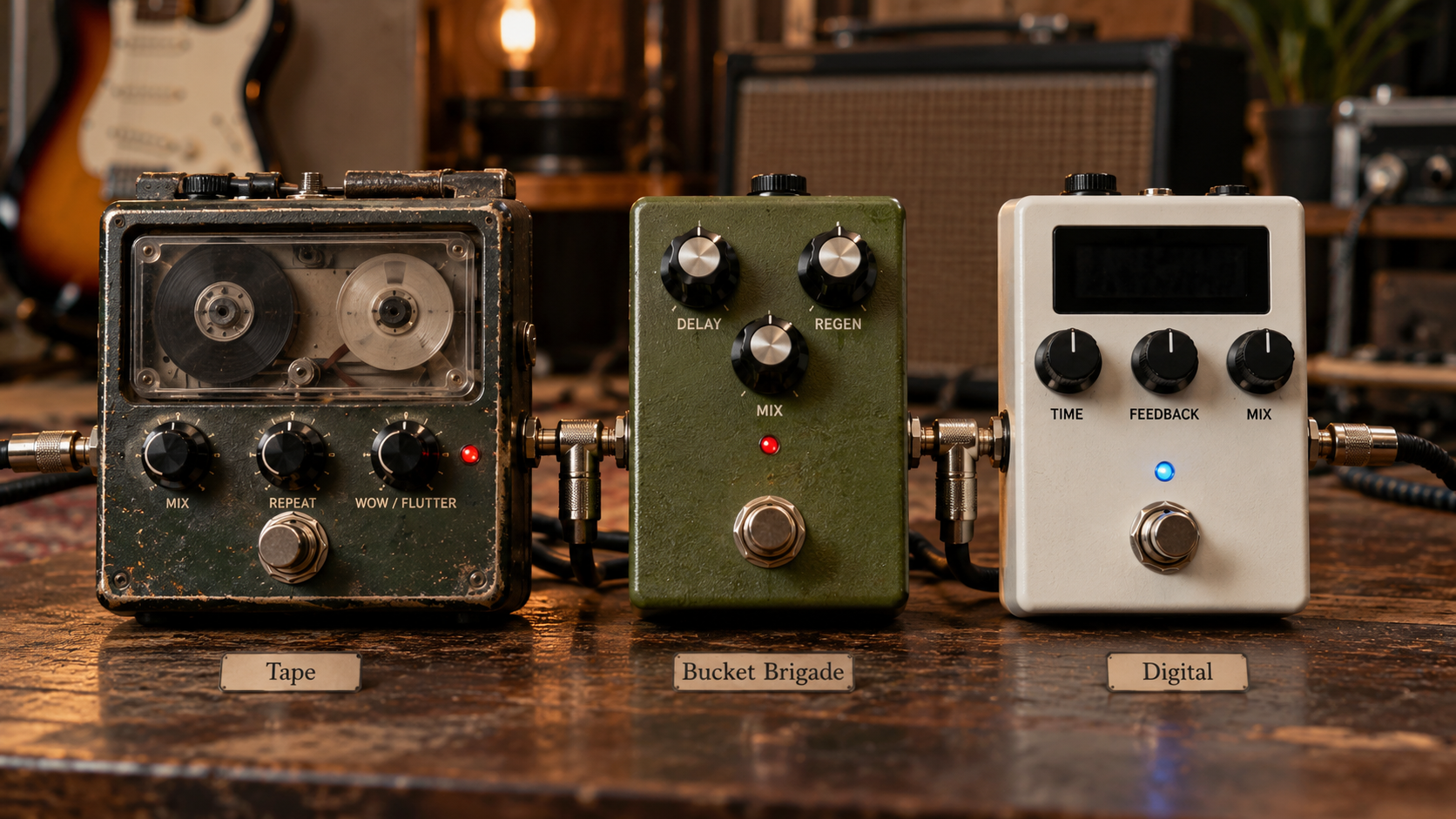
Storage. One holds your signal in capacitors, one on magnetic tape, one as numbers in memory. Everything players argue about follows from that choice.
|
Tape echo |
Analog (BBD) |
Digital |
|
|---|---|---|---|
|
Stores the signal as |
Magnetism on moving tape |
Charge in a capacitor chain |
Numbers in memory |
|
Repeats over time |
Degrade and wander in pitch |
Get darker each pass |
Stay identical |
|
Typical maximum time |
Short, set by head spacing |
Commonly under a second |
Seconds, sometimes minutes |
|
Noise floor |
Highest, tape hiss included |
Audible on long settings |
Effectively silent |
|
Upkeep |
Tape and heads wear out |
None |
None |
|
Best for |
Instability as a feature |
Repeats that sit behind you |
Clarity, long times, precision |
Read that as behaviour, not quality. Each column is a set of trade-offs somebody chose on purpose.
What is analog delay, and how does a BBD chip work?
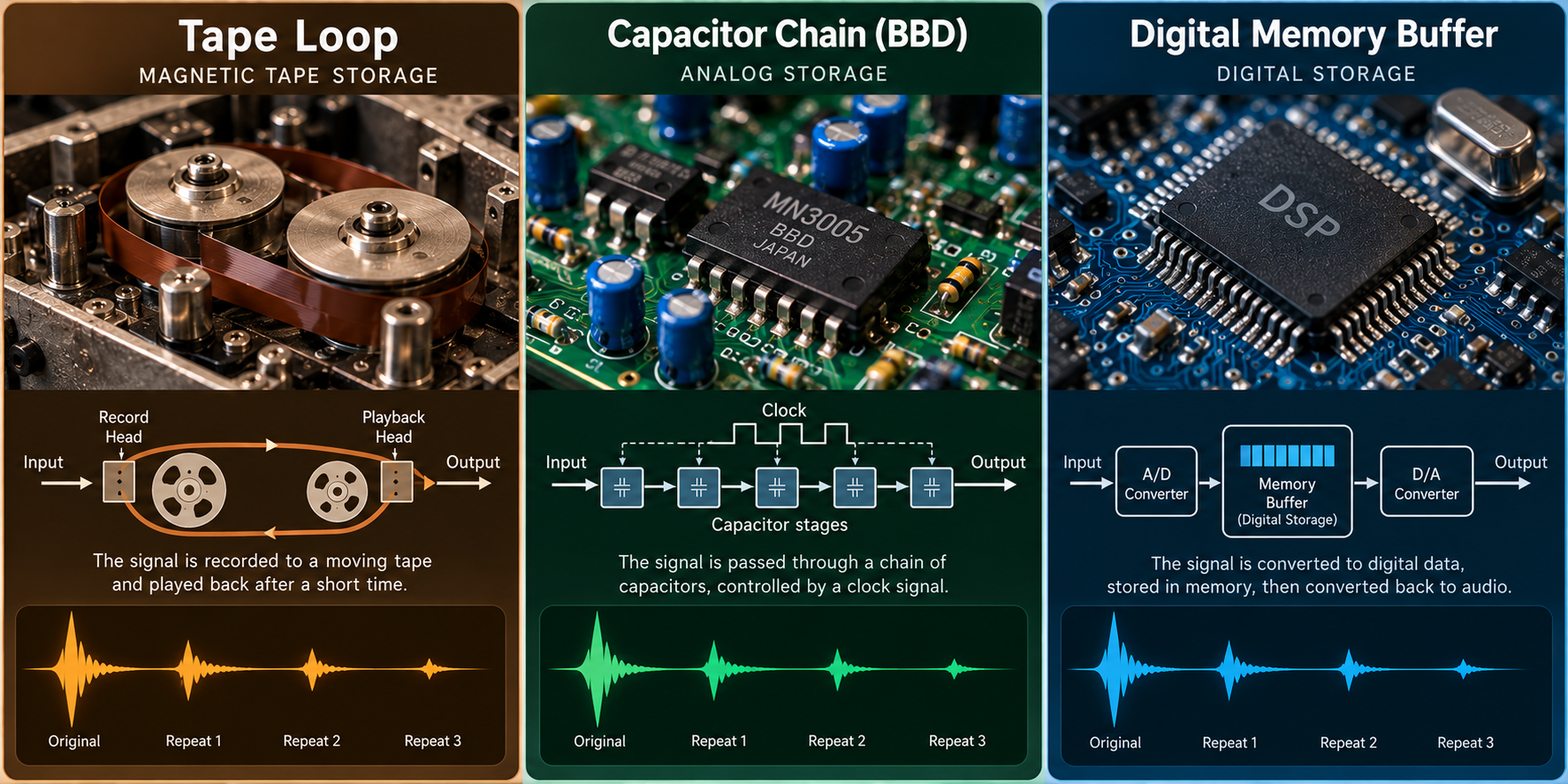
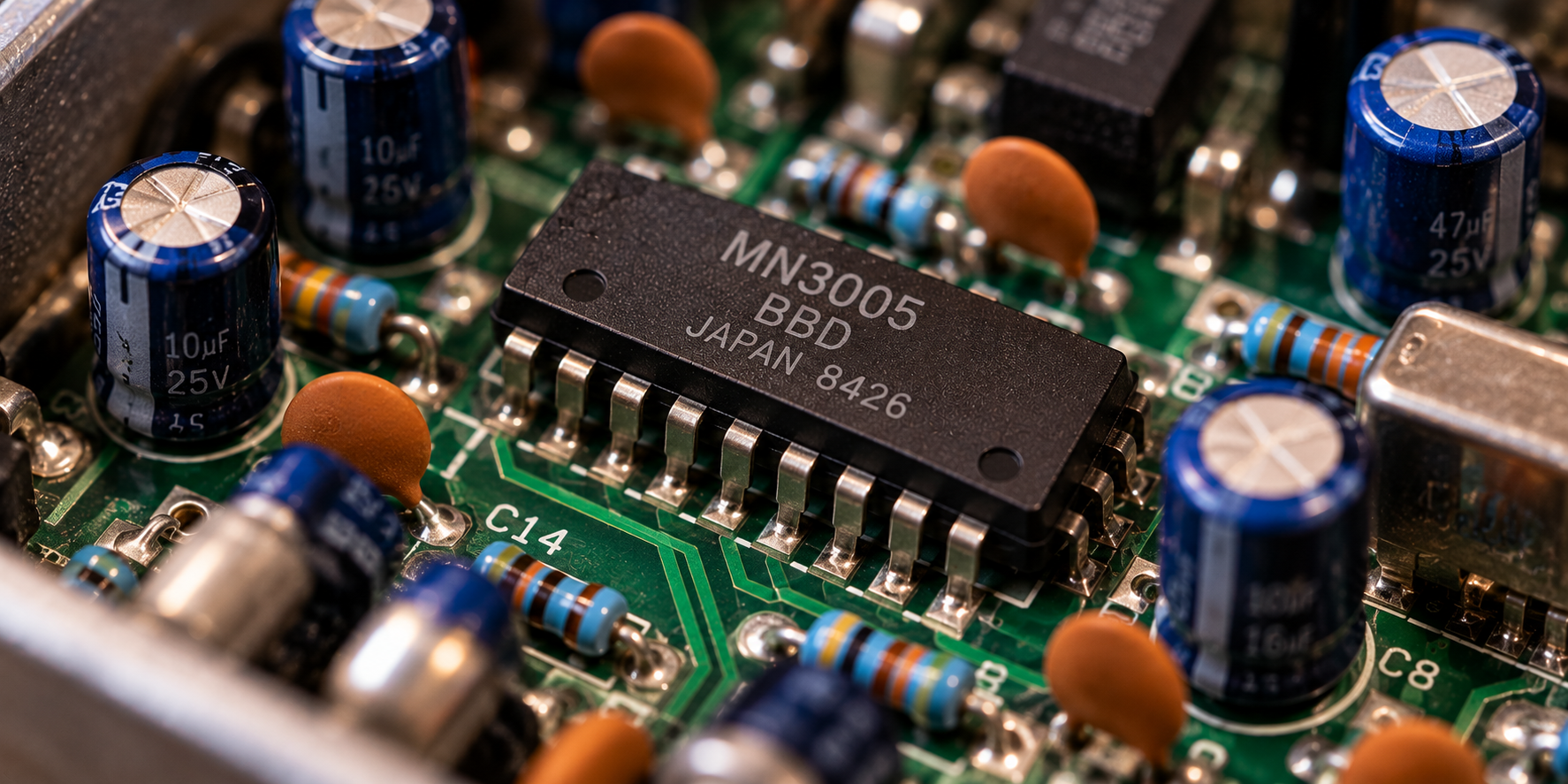
Analog delay holds your signal as an electrical charge and shuffles it along one step at a time. The part doing that is a bucket brigade device, usually shortened to BBD chip.
A bucket-brigade device was developed in 1969 by Sangster and Teer at Philips Research Labs.
It is a discrete-time analogue delay line, and a delay line is simply any circuit that holds a signal and releases it later. Bucket brigade delay is the guitar world's name for the result.
The name is the explanation. Charge is handed down a line of capacitors, one step per clock tick, the way a fire brigade passes buckets.
Every handoff spills a little. That is why the repeats get darker as they go, and why players call analog warm repeats rather than accurate ones.
There is a second reason the top end disappears. The chip is discrete in time, so it is bound by the sampling theorem and needs filtering on the way in and again on the way out.
Those filters are not optional and they cost treble. Dark repeats are physics, not a voicing decision.
What is tape delay, and why does it sound unstable?
Tape delay records onto a moving loop and reads it back a moment later. The gap between the record and playback heads sets the time.
The Echoplex, introduced in 1959 and designed by Mike Battle, did exactly that with a sliding record head, so players could change the time without changing tape speed.
The instability people love is measurable. Wow and flutter are speed fluctuations, split by convention at 4 Hz: slower wobbles are wow, faster ones flutter.
The figures are smaller than you would guess, and Wikipedia's entry on wow and flutter measurement has them.
A professional machine sits near 0.02 percent, which is inaudible, against roughly 0.08 percent for a high-end cassette deck, which is not.
A tape echo pedal chases that imperfection deliberately. Pitch that drifts a fraction of a percent reads to the ear as life rather than error, which is the heart of the tape delay vs analog delay question.
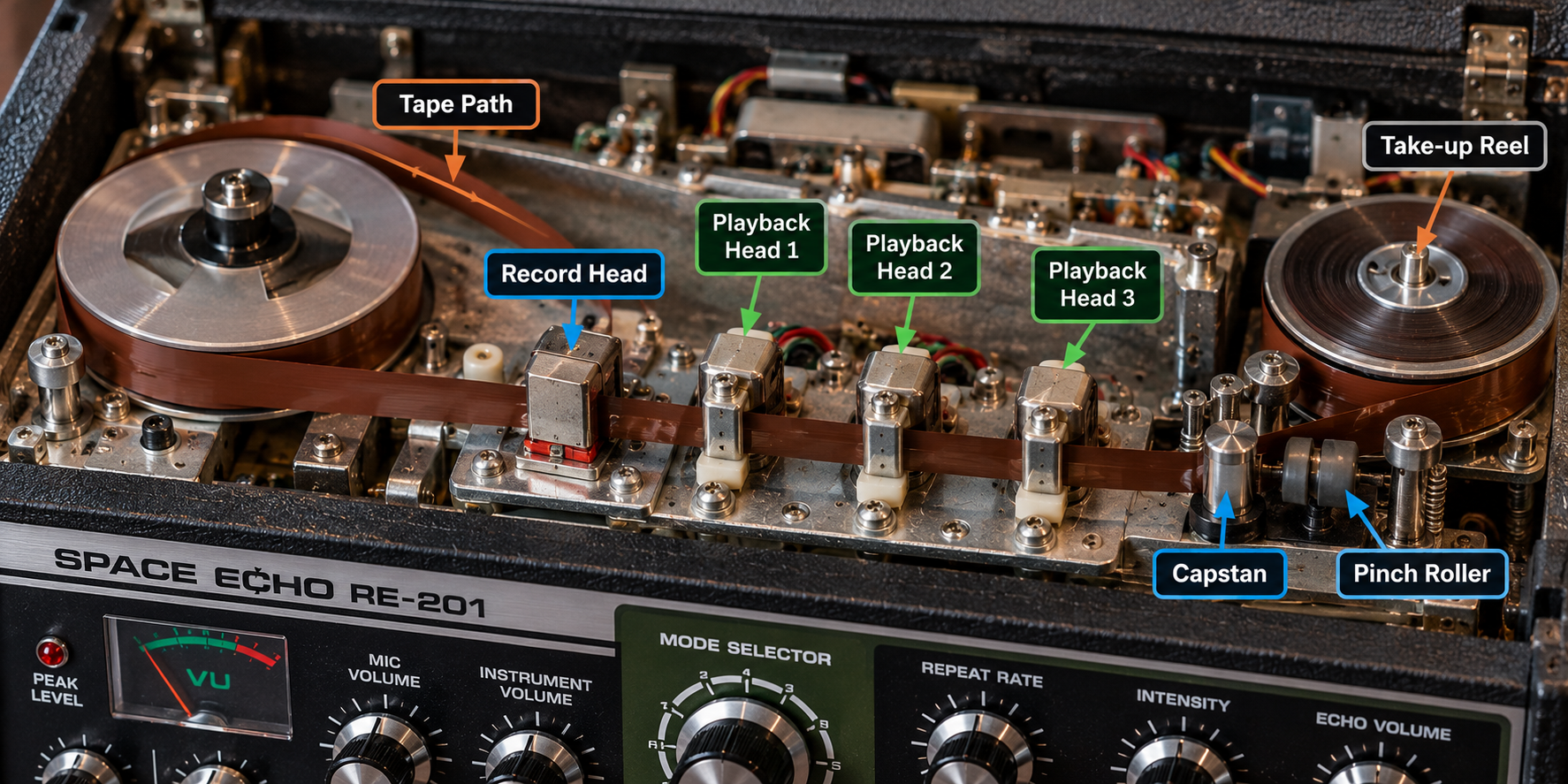
Roland solved the reliability problem in 1974. The Roland Space Echo replaced the tape reel with a free-running transport, which cut wear, noise and wow and flutter.
The Roland Space Echo also carried one recording head and three playback heads, which is why those units produce rhythmic multi-tap patterns rather than a single repeat. Raise the feedback and those taps stack into a pattern.
What is digital delay, and what does DSP actually do?
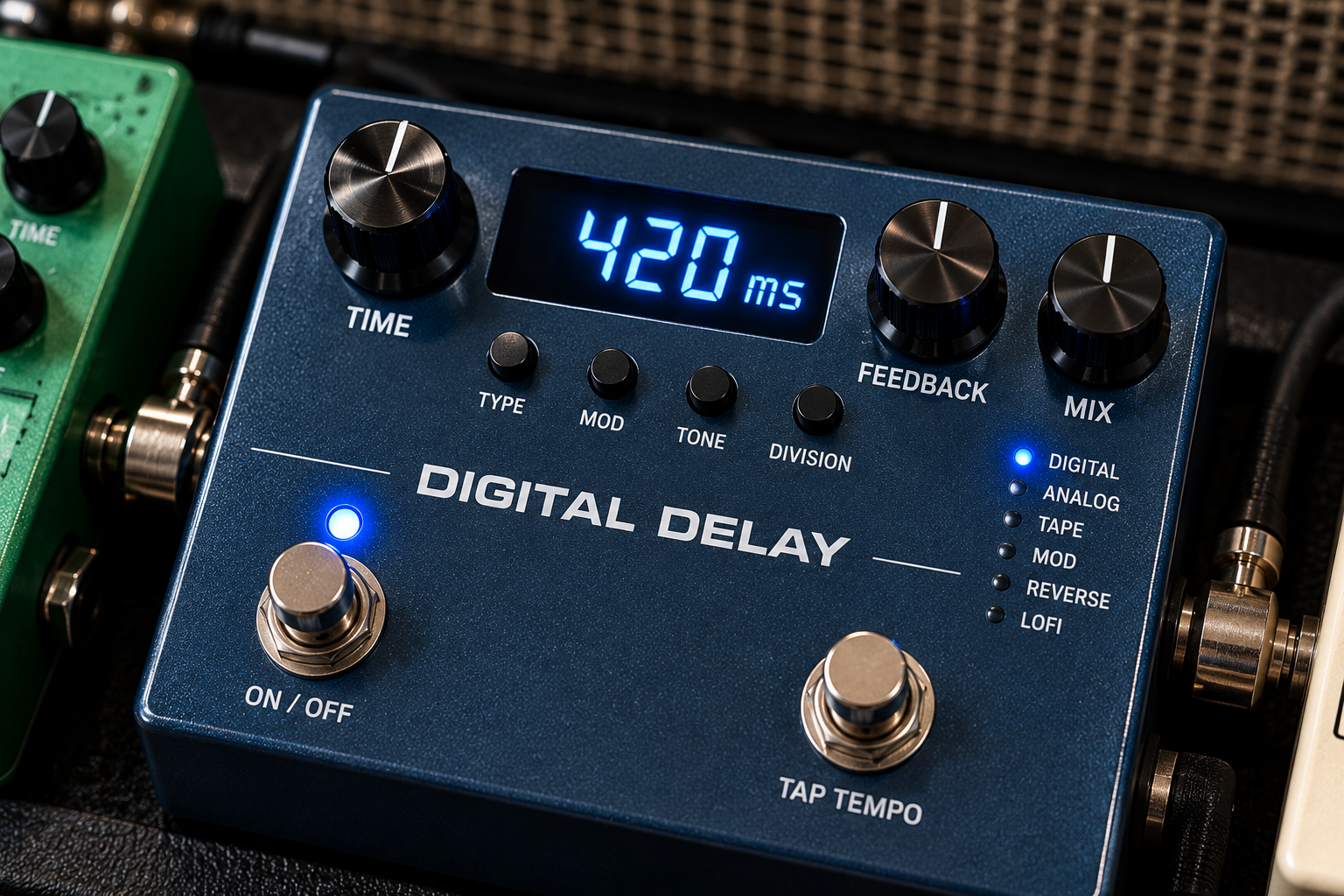
Digital delay turns your signal into numbers, keeps them in memory, and turns them back. Wikipedia's entry on delay as an audio effect describes the chain as a converter, a memory buffer, then playback.
Digital signal processing, or DSP, is the arithmetic performed on those numbers while they sit in memory. Nothing physical degrades, so nothing has to.
That is the whole analog delay vs digital delay difference in one line: one format loses something at every step, the other only loses what the code is told to remove.
That buys two things the others cannot match. Times run to seconds rather than fractions of one, and the hundredth repeat is identical to the first.
The first digital delay pedal reached players in the mid-1980s. Early converters were coarse, which is where the reputation for cold, brittle repeats came from, and it has outlived the hardware that earned it.
A modern digital pedal can also emulate the other two. Repeat decay, filtering and pitch wobble are all just arithmetic once the audio is numbers, which is why digital signal processing now sells more tape emulations than tape ever sold machines.
Is the analog versus digital split actually real?
Less than the marketing claims, and I can show it with something I sell. The labels describe storage; your ears respond to filtering, distortion and pitch movement.
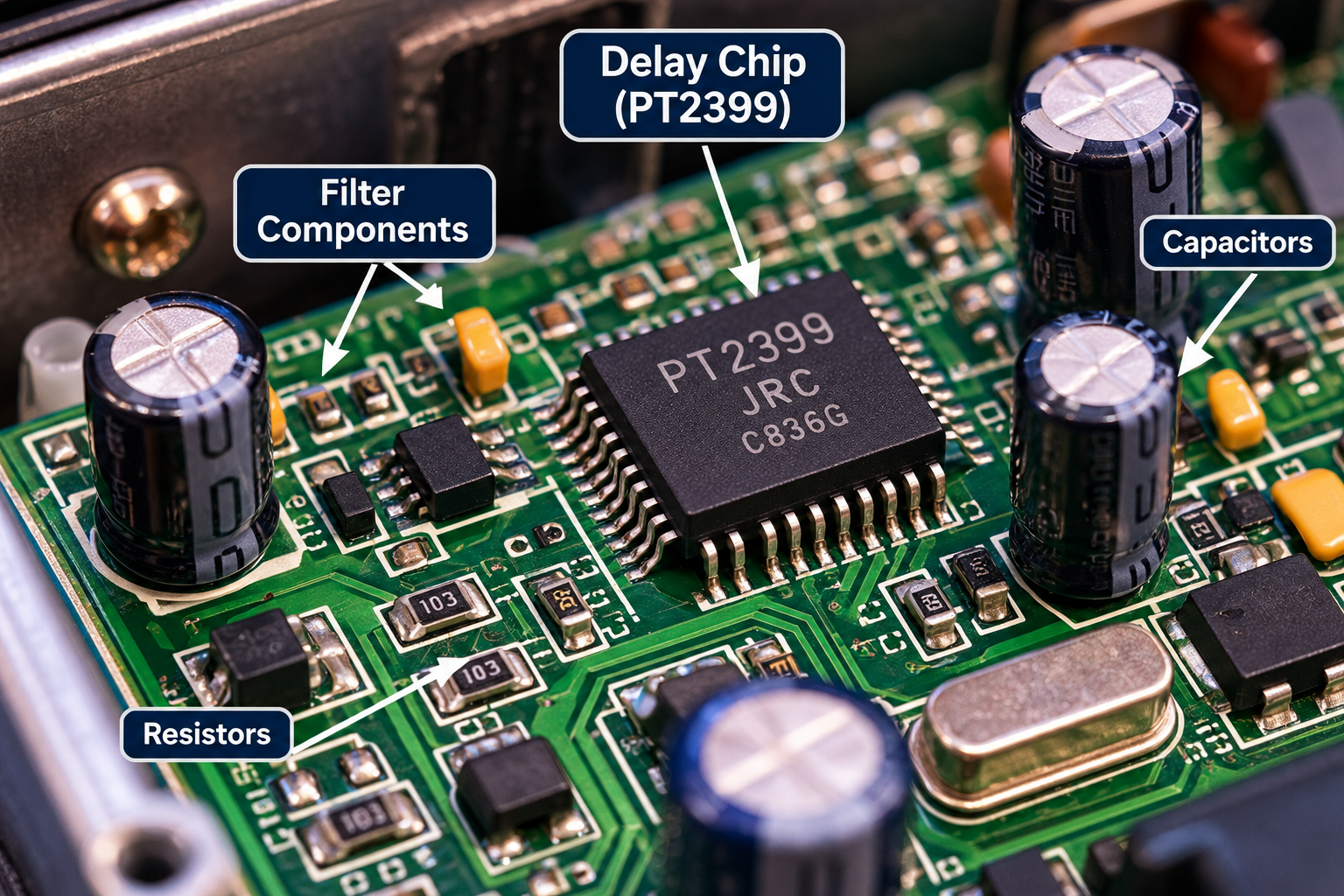
My Delay TME is built on the PT2399, which is digital silicon: a converter, internal memory, and a converter back.
Players and builders describe that chip as tape-like, and the product name stands for Time Modulation Emulator. Time modulation is the wobble a tape machine produces by accident and a pedal produces on purpose.
A widely cited teardown of that chip puts its clean working range at roughly 30 to 340 milliseconds, with treble rolling off sharply and distortion climbing past about 350.
So a digital part pushed past its comfortable range produces exactly the darkening the word analog is supposed to signal. The logic runs both ways: a well-filtered BBD design can sound cleaner than a cheap digital one.
I made the same point about modulation in the breakdown of types of tremolo, sorted by what physically moves rather than by era.
Which one should you choose?
Choose by the job the repeats are doing, not by the word on the enclosure.
- Pick a bucket brigade design if you want the echo to sit behind the dry note and disappear politely.
- Pick tape or a tape emulation if instability is the point. Pitch drift and degrading repeats are the sound, not a compromise.
- Pick digital if you need long times, rhythmic precision, presets, or repeats that survive twenty passes intact.
- Pick a multi-program pedal if you do all three on one board. My Rebound carries eight voices including analog and tape programs, which is the pragmatic answer.
Honest caveat: in a loud room with a band playing, these differences shrink to almost nothing. They matter most when recording and least on a stage.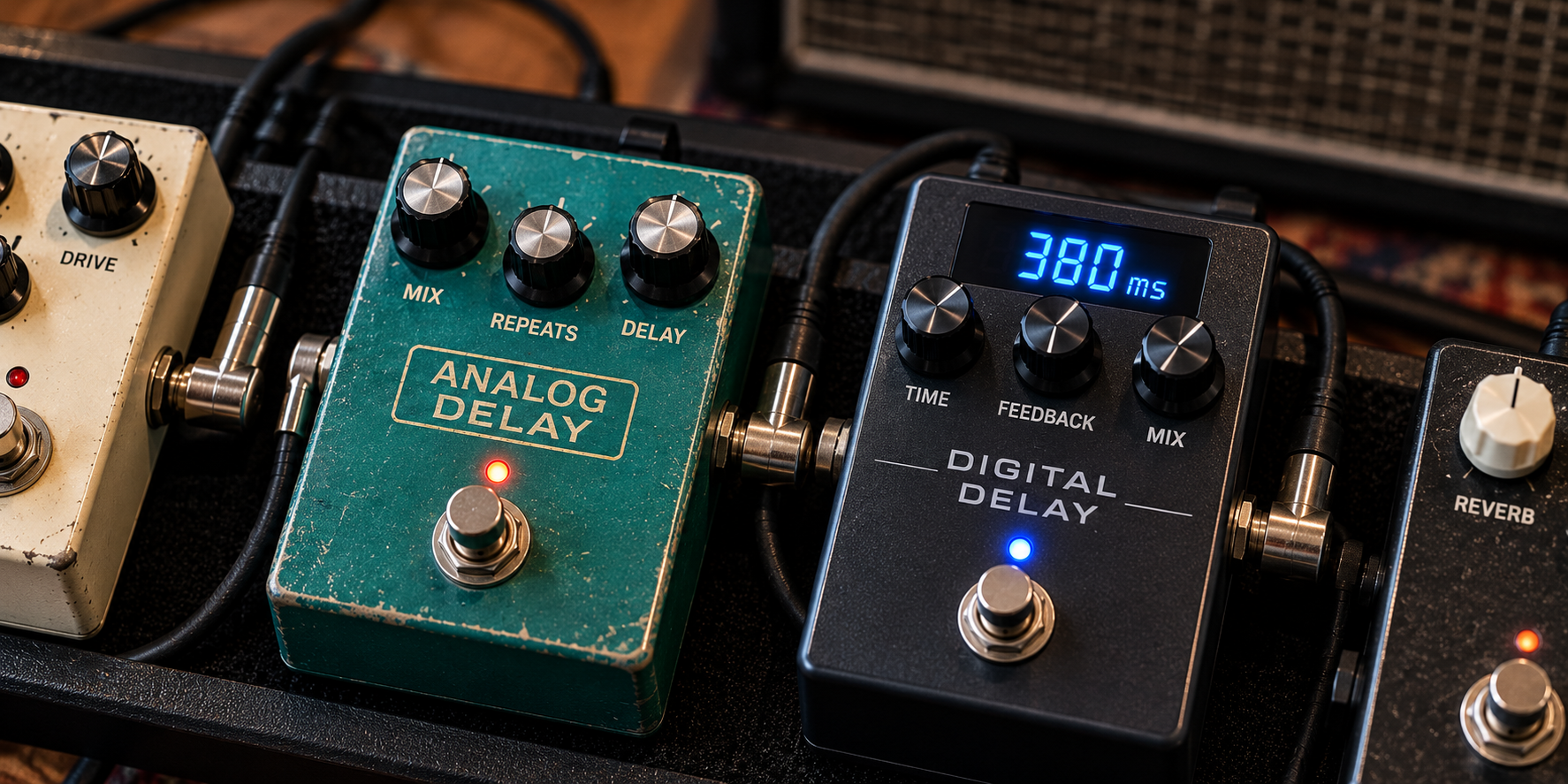
Frequently asked questions
Is analog delay warmer than digital?
Usually, but warmth here means treble loss. A BBD chip filters the signal on the way in and out, so each repeat arrives darker than the last. Digital repeats keep their top end unless the designer removes it, and many modern pedals do exactly that. The word warm no longer maps cleanly onto the word analog.
How long can an analog delay go?
Most bucket brigade designs run under a second, and pushing further costs noise and clarity fast. Stretching the clock to buy time lowers the sampling rate, which eats treble that was already under pressure. Digital pedals face no such limit.
What is tape delay better at?
Instability. Pitch drift, saturation and repeats that degrade unpredictably are things the other two have to simulate. A real machine also demands upkeep, since tape and heads wear out, which is a trade most players make once and then reconsider.
Does a BBD chip add noise?
Yes, and it becomes obvious at longer settings. The chip's noise floor sits well above a digital converter's, and every repeat passes down the delay line again, so hiss accumulates alongside the signal. On short slapback settings it is inaudible. On a long wash with the feedback high, it is part of the sound whether you wanted it or not.
Is digital delay better for recording?
Often, because recall and precision matter more in a session than character does. You can darken a clean repeat afterwards; you cannot recover treble a BBD chip already discarded. Plenty of records were made the other way round, though, and committing to a sound is legitimate.
The bottom line on analog vs digital delay
Three storage methods, one effect, and a label that explains less than it promises. Tape wanders, bucket brigade darkens, digital holds steady, and each can now emulate the others.
Remember one thing: what you hear is filtering, distortion and pitch movement. Storage format is just how a builder arrived at them.
Honest limitation: none of this settles which sounds better on your record. That depends on the part, the room and the mix, and anyone claiming one format wins universally is selling something.