
Delay or Reverb First? The Best Guitar Pedal Order
Posted by Jon Cusack on 27th Oct 2026
Delay or Reverb First? The Best Guitar Pedal Order
Wondering whether delay or reverb should go first in your guitar pedal chain? Learn the best pedal order, how each setup affects your tone, and when to switch things up. Discover practical tips for clearer echoes, rich ambient sounds, and the perfect signal chain for your playing style.
Delay Before Reverb
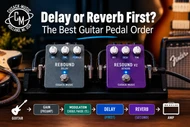
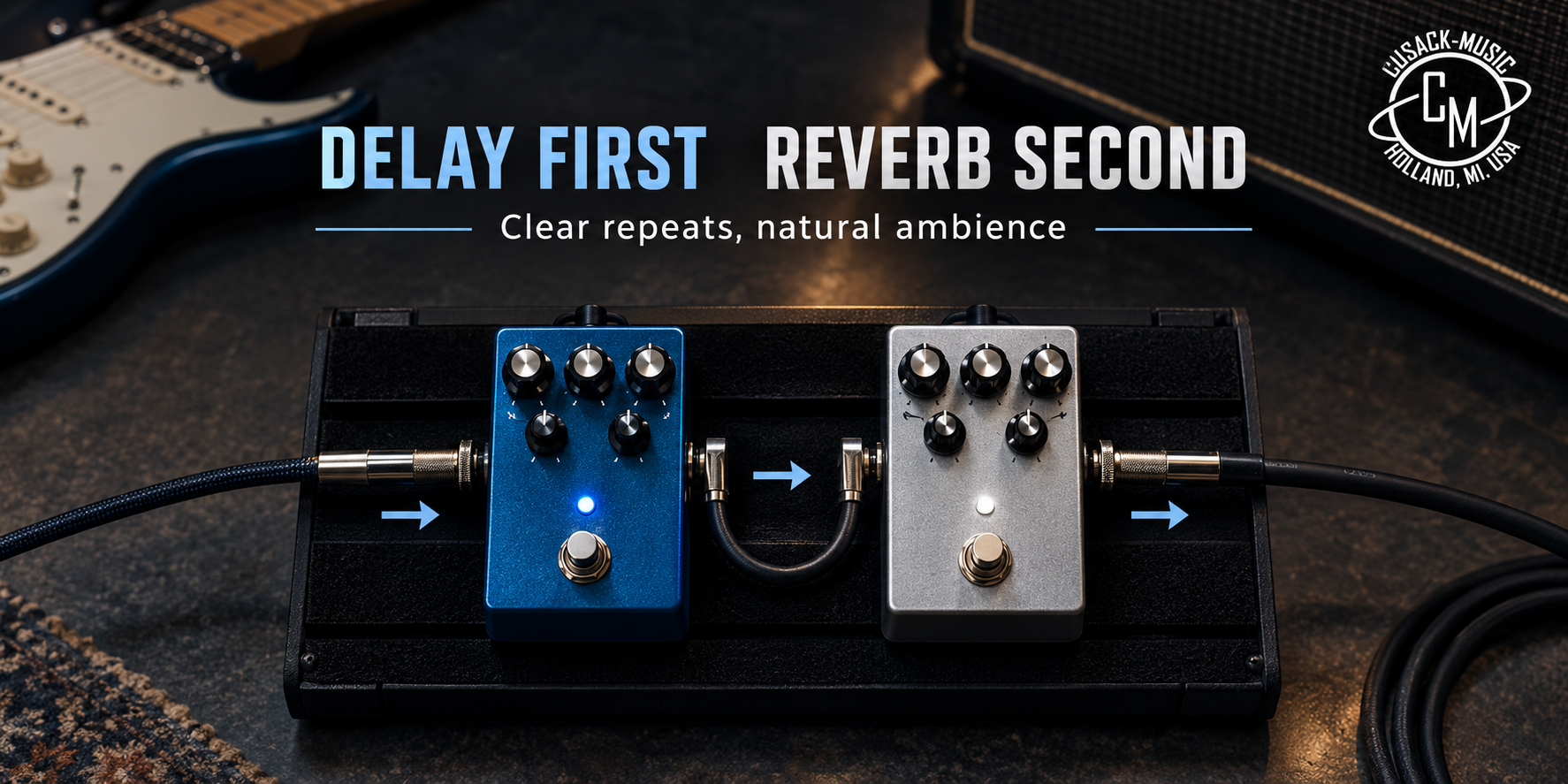
In a typical signal chain, delay sits before reverb. Here is why that default has lasted so long.
Think about a single note played in a large hall. You hear the note and the room’s reflections together. Now picture an echo of that note. In real life, the echo is also a sound traveling through the same hall, so it gets the same ambience as the original.
Putting delay before reverb recreates that. The reverb pedal receives your dry note and every delay repeat, then blends them into one space. The repeats sound like they belong with the note instead of floating on top of it.
The reverse order, reverb before delay, repeats the reverb tail itself. Each repeat is a copy of an already washy sound, and the copies pile up quickly. The result is denser and more ambient, which is great in some situations and cluttered in others.
Reverb Before or After Delay: What Each Order Sounds Like
Searches for “reverb or delay first” or “reverb before or after delay” usually come from the same question: what will I actually hear? Here are the two options side by side.
Delay Before Reverb (The Standard Order)
- Repeats stay fairly distinct, then dissolve into the reverb as they fade.
- Notes stay clearer, because the reverb adds space to the echoes instead of smearing them.
- Works well for lead lines, clean tones, country and worship playing, and anything where note definition matters.
- Easy to dial in, since time and feedback control the echoes and decay controls the room.
Reverb Before Delay (The Wash Order)
- The delay repeats the reverb tail, so each echo gets bigger and softer.
- Repeats blur into each other and the sound becomes a thick, drifting texture.
- Suits ambient guitar, post-rock, swells, and pad-style playing.
- Can turn muddy fast, especially with long decay times and high feedback.
Neither order is wrong. Delay first is the safer starting point, and reverb first is a deliberate creative choice. Many players keep both options in mind, which is part of why presets and flexible routing are so useful.
Delay vs Reverb: Why the Difference Matters for Your Signal Chain
When people compare delay and reverb, they are really comparing two different jobs.
A delay pedal records your signal and plays it back after a set time, so you hear distinct repeats. If you want a refresher on how it works, our guide on what a delay pedal is and how to set one covers time, feedback, and mix.
Reverb simulates the reflections of a space. Instead of a few clear repeats, you get thousands of tiny ones blended into a sense of room, plate, hall, or spring.
Because reverb is a dense, continuous wash, stacking it before a delay gives the delay a messy source to repeat. Delay is cleaner and more rhythmic, so it works best feeding the reverb. That is the practical logic behind the standard order.
Where Delay and Reverb Fit in the Rest of Your Signal Chain
A common pedal order, from guitar to amp, looks like this:
- Tuner, wah, compressor
- Overdrive, distortion, fuzz
- Modulation (chorus, phaser, flanger, tremolo)
- Delay
- Reverb
Gain pedals go early so the delay and reverb process your overdriven tone instead of being distorted themselves. Time-based effects go last so they sit on top of everything else. Within that group, delay comes before reverb for the reasons above.
Chorus Before or After Delay?
This is a frequent question, especially if you use a chorus alongside your delay and reverb. The usual answer is chorus before delay. The chorus shapes your tone first, then the delay repeats that chorused sound, which keeps the echoes smooth and consistent.
Putting chorus after delay modulates the repeats along with your dry signal. The echoes shimmer and move, which can sound lush, but it can also feel more unstable. If you like that swirl, try it. Otherwise, chorus first is the safer default. Cusack’s modulation pedals are one place to look if your board needs that slot filled.

Using an Effects Loop: Does the Order Change?
If your guitar amplifier has an effects loop, the usual advice is to run gain pedals into the front of the amp and time-based effects through the loop. Here is the reasoning.
When you push an amp’s preamp into distortion, any delay or reverb placed in front of it gets distorted too. Repeats turn gritty and reverb tails can sound compressed and noisy. In the loop, delay and reverb come after the preamp, so they stay clean and keep their definition.
The order inside the loop is the same: delay first, then reverb. If your amp has its own built-in reverb (spring reverb is common) and you run your delay pedal in front of the amp, you get delay before reverb by default, which matches the standard order.
If you use stereo effects, check that your pedals and amp loop can handle two channels. Pedals with dedicated left and right outputs, like the Cusack Rebound and Resound V2, can feed two amps or a stereo return.
Understanding Pre-Delay in Reverb
Searches for “reverb pre delay” are about something different from the pedal order, but it is related and worth understanding.
Pre-delay is the short gap between your dry note and the start of the reverb. A longer pre-delay lets the note speak clearly before the room kicks in, which helps keep leads and fast passages from getting buried. A short or zero pre-delay blends the note and reverb tightly together.
On Cusack’s Resound V2, the Room program description notes that pre-delay is very effective with shorter decay times for slapback, small-room, or chamber effects. If you are using reverb after a delay, a touch of pre-delay can also help keep the first echo from smearing into the reverb onset.
When to Break the Rule and Put Reverb First
The standard order is a starting point. Here are the situations where reversing it makes sense:
- Ambient and soundscape playing. If you want sounds to bloom and drift, reverb into delay builds that density naturally.
- Swells and pads. Combined with a volume swell, a reverb tail repeated by the delay creates evolving layers.
- Creative effects. Some players love the chaos of a reverb tail being echoed, especially with reverse or pitch-shifted delay.
If you try it, keep delay feedback and mix lower than you would normally, and shorten the reverb decay. Otherwise the wash can swallow your playing.
Practical Setup Tips and Troubleshooting
If Your Sound Gets Muddy
Cut back on one of three things: delay feedback, delay mix, or reverb decay. Muddiness usually comes from too much of each stacking together. Lowering the reverb mix is often the quickest fix.
If Repeats Disappear Into the Reverb
Raise the delay mix slightly, or shorten the reverb decay. You can also lower the reverb level so the room sits behind the repeats instead of in front of them.
If You Want Clear Attack With Long Trails
A ducking delay can help. The Cusack Rebound has a Ducking program that lowers the delayed signal while you play, keeping your attack clear and letting the trails bloom when you pause. According to Cusack, it is a good way to get ambient decay without muddying the initial note.
Match Analog and Digital Character to the Reverb
Analog delay repeats tend to get darker as they fade, which blends naturally into a reverb. Cleaner digital repeats stay brighter and more defined. Neither is better, but it helps to know which one you are putting in front of the reverb. Our article on analog vs digital delay goes into the differences in more detail.
Use Trails Settings Correctly
If you want delay and reverb to ring out after you turn the pedal off, make sure trails are enabled where available. The Resound V2 and Rebound both let you save sounds as presets, so you can switch between a short, tight setting and a long, ambient one without turning knobs.
Choosing a Reverb and Delay Pedal Setup
If you are looking for the best reverb delay pedal for your board, the right answer depends on how you play. A few questions help narrow it down:
- Do you want separate pedals for more control, or one pedal with both effects?
- Do you need presets for switching sounds between songs?
- Do you play in stereo, or mono through a single amp?
- How much board space do you have?
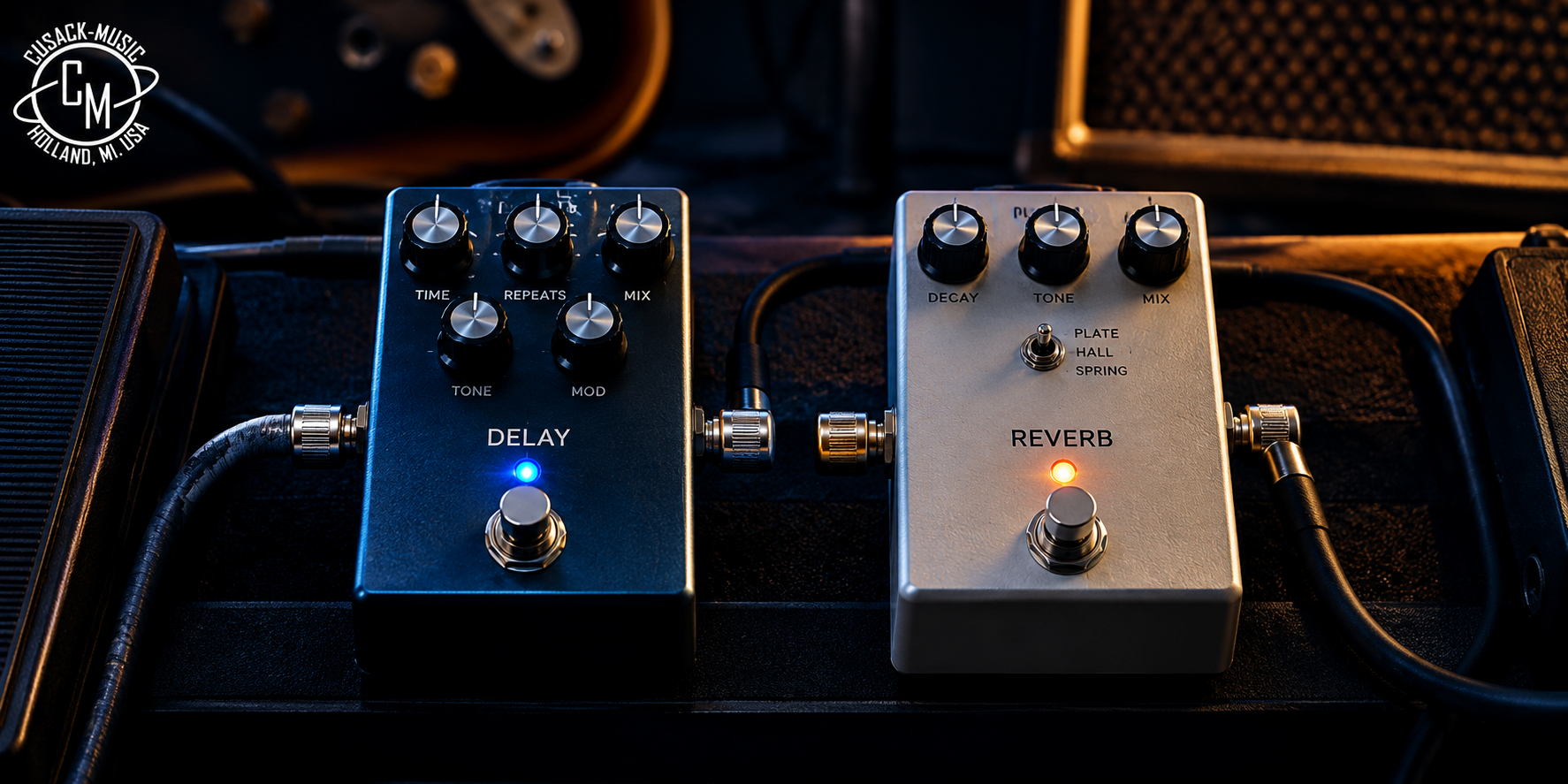
If you prefer dedicated pedals, a delay and a reverb in sequence is the most flexible approach. Cusack’s Delay & Reverb category lists the current options. Some highlights:
- Rebound is a multi-program delay with eight stand-alone programs (including Mod Analog, Tape, Digi-Pong, Dual, Reverse, Ducking, Pitch, and Space), tap tempo, an expression pedal input, dedicated left and right outputs, and a preset system.
- Delay TME is a compact delay built around the PT2399 chip, with a delay range of 120 to 750ms, modulation, Brake modes, tap divide, and an expression and tap jack.
- Resound V2 is a programmable reverb with presets and an Extend feature. Its programs include Room, Plate, Cathedral, Modulated, Swell, Hall/Freeze, Spring, and Shimurmur, plus dedicated expression pedal input and left and right outputs.
Run the delay into the reverb, and you have a signal chain that follows the standard order and gives you plenty of room to experiment.
Frequently Asked Questions
Should delay or reverb go first in a guitar pedal chain?
Delay usually goes first, followed by reverb. This keeps your echoes clear and places them in a natural-sounding space. Reverse the order only if you want a denser, more ambient wash.
Does the order of delay and reverb matter that much?
Yes, but it depends on your settings. With short delay times and low reverb mix, the difference is subtle. With long repeats and big decay, the order changes the character of your tone noticeably.
Where should delay and reverb go if I use an effects loop?
Put both in the loop, after your amp’s preamp, with delay first and reverb second. This keeps them clean even when you run the amp with heavy gain.
Can I use one pedal for both delay and reverb?
You can, and some players like the simplicity. Separate pedals give you independent control over each effect and make it easier to change the order. A single pedal saves space but may limit how much you can adjust each part.
Final Thoughts
The best guitar pedal order for most players is delay first, reverb second. It keeps your repeats defined, places them in a believable space, and is easy to dial in. If you want something wilder, reverb before delay is there for ambient and experimental playing.
Start with the standard order, adjust feedback, mix, and decay until it sounds right in your rig, then try flipping the order to hear the difference yourself. When you are ready to build or upgrade your board, browse Cusack Music’s Delay & Reverb pedals to find a setup that fits how you play.